· 9 min read
Four DVSA Tests a Year: Brake Testing Frequency for UK Operators
Turn DVSA's four tests a year rule into a workable schedule. Use the 14 day window, log risk assessments, and keep audit ready records.

Four DVSA Tests a Year: Brake Testing Frequency for UK Operators
DVSA guidance sets a clear baseline: commercial vehicle operators should carry out a minimum of four laden brake performance assessments per year, spread evenly across the year, and this can include the annual MOT test. Every safety inspection must also include a documented brake performance assessment, or a signed risk assessment where a laden test isn’t possible. Accepted methods are the roller brake test, EBPMS and the decelerometer, and a test done up to 14 days before a safety inspection still counts.
TL;DR:
- Operators must schedule at least four laden brake performance assessments annually, with the annual MOT counting as one if it includes a laden test.
- Different vehicle types and usage patterns require tailored inspection cycles, from 6 to 13 weeks, to ensure brake assessments are evenly spread.
- The three accepted methods for brake testing are roller brake tests, electronic monitoring systems for trailers, and decelerometers, each with specific loading and validity conditions.
- When a laden test can’t be performed, a signed risk assessment documenting reasons and alternative checks is mandatory, and it triggers future testing requirements.
- Maintaining comprehensive, properly stored paperwork with signed reports and evaluations is essential for audit readiness and compliance verification.
Table of Contents
- Regulatory minimums and inspection interval guidance
- What counts as a brake performance assessment
- Practical scheduling across different fleet types
- If you can’t do a laden test: risk assessments and sign-off
- Record keeping and audit readiness
- Preparing for tests to keep laden brake testing efficient
- Why this matters beyond the paperwork
- How OperatorCompliance keeps brake testing evidence audit-ready
- Sources
- FAQ
Regulatory minimums and inspection interval guidance
The four-tests-a-year figure isn’t a target to hit occasionally. It’s a floor. DVSA’s Guide to maintaining roadworthiness expects operators to spread these laden brake performance assessments evenly through the year rather than clustering them, and the annual MOT counts as one of the four provided it’s a laden test. That leaves at least three more laden assessments to schedule around your safety inspection calendar.

Inspection frequency itself isn’t fixed. DVSA guidance sets typical intervals of 4 to 13 weeks depending on how a vehicle is used, its age and its mileage. Vehicles and trailers aged 12 years or older should normally be inspected at least every 6 weeks, reflecting the higher risk of wear-related defects on older assets.
Because every safety inspection needs its own brake performance assessment (or a signed risk assessment), your inspection interval effectively sets your minimum testing rhythm too. A few examples show how this plays out:
- 13-week cycle: four safety inspections a year lines up neatly with the four-laden-test minimum provided each inspection includes a genuine laden assessment rather than a risk assessment by default.
- 6-week cycle: roughly 8 to 9 inspections a year, so operators have more opportunities to spread laden tests but also more inspections that need a brake assessment or documented risk assessment attached.
- Mixed fleet: a haulier running both newer tractor units on 10-week PMIs and older trailers on 6-week PMIs needs separate schedules for each, tracked individually rather than as one fleet-wide rule.
Getting the interval right matters as much as hitting the annual minimum. A safety inspection interval that’s too long for a vehicle’s duty cycle increases the risk of a defect being missed between checks, regardless of how many laden brake tests you log.
What counts as a brake performance assessment
DVSA accepts three methods for assessing laden brake performance, each with its own rules on loading and validity.
The laden roller brake test (RBT) is the most common method. It measures brake efficiency across each axle while the vehicle sits on rollers, and its accuracy depends heavily on how the vehicle is loaded. The Heavy vehicle brake test best practice guide recommends loading to at least 65% of design axle weight (DAW) for a reliable result, with 50% as the absolute minimum acceptable load. Below that, the test doesn’t put enough demand on the braking system to reveal genuine weaknesses.
EBPMS (electronic braking performance monitoring systems) is accepted currently only for trailers. Rather than a one-off test, it continuously logs brake performance data from the vehicle’s own systems. That convenience comes with a catch: every EBPMS report still needs to be evaluated and signed off by a competent person before each safety inspection. It’s a monitoring tool, not an automatic pass.
Decelerometers measure deceleration during a road test and offer a practical option when roller testing isn’t available. They can’t be used for trailers, and when a vehicle is tested unladen, valid results depend on recording brake temperatures alongside the deceleration figures.
A laden RBT carried out up to 14 days before the safety inspection still counts, as long as the report is supplied to whoever carries out the PMI and retained on the vehicle’s maintenance file.
- RBT: measures brake efficiency per axle, needs at least 50% DAW loading (65% recommended).
- EBPMS: continuous trailer monitoring, requires signed evaluation before each safety inspection.
- Decelerometer: road-based measurement, not valid for trailers, needs temperature readings when unladen.
Practical scheduling across different fleet types
How you schedule laden tests should follow how the vehicle actually works, not a generic calendar. Four broad patterns cover most fleets:
- Light, low-mileage vans and light goods vehicles often sit toward the longer end of the guidance, with inspections every 10 to 13 weeks and laden tests timed to fall on at least four of those visits or on separate loaded runs.
- General haulage tractors and trailers typically run on 8 to 10-week PMI cycles, giving five or six inspection opportunities a year, comfortably covering the four-test minimum with room to spare.
- Arduous use vehicles, such as tippers, muck-away trucks or anything running consistently overloaded routes, usually need 6-week inspections regardless of age, given the accelerated wear these duty cycles cause.
- Vehicles and trailers 12 years or older move to a 6-week inspection floor as standard, which naturally produces more than enough inspection points to distribute four laden tests evenly.
When a fleet runs a genuinely mixed pattern, time-based and mileage-based frequency, the maximum time-based frequency recorded in the Vehicle Operator Licence (VOL) system should be no more than 13 weeks, with the mixed frequency box ticked. Monitor defect rates monthly against that schedule and shorten the interval if defects start rising.
The 14-day rule is the practical lever here: instead of pulling a vehicle off the road purely to load it for a test, operators can time a laden RBT to coincide with a scheduled loaded run in the fortnight before a PMI is due.
If you can’t do a laden test: risk assessments and sign-off
A laden test isn’t always possible: a vehicle might be off-site, a customer load might not meet the loading threshold, or an RBT facility might be unavailable. In that case, DVSA guidance requires a documented risk assessment in place of the laden brake performance assessment, not a skipped one.
The risk assessment needs to:
- explain specifically why a laden test wasn’t carried out on that occasion.
- record what alternative checks were done (an unladen roller test, a road test, a visual and functional check).
- be signed by a competent person, someone with the technical knowledge to judge braking performance and identify a likely defect.
- be stored with the safety inspection record it relates to, on the vehicle’s maintenance file.
A risk assessment is not a workaround for avoiding testing altogether. If it flags anything unusual, reduced efficiency, uneven wear, an unexplained pull to one side, that vehicle needs a proper laden test or further investigation before its next journey, not at the next scheduled PMI.
Pro Tip: Treat a risk assessment as a trigger for the next available laden test slot, not as a substitute you can repeat inspection after inspection.
Record keeping and audit readiness
DVSA and traffic commissioners judge compliance largely on paperwork. A vehicle with excellent brakes and no evidence to show it is, on paper, indistinguishable from one that was never checked.
The Guide to maintaining roadworthiness expects operators to retain:
- signed RBT printouts, or manually recorded results where the equipment can’t print.
- decelerometer readings, including temperature logs for unladen tests.
- signed EBPMS evaluations completed before each relevant safety inspection.
- the safety inspection (PMI) report itself, with the brake assessment or risk assessment clearly referenced.
Each of these should be attached to the specific safety inspection it relates to, on that vehicle’s maintenance file, not filed separately by date or by test type. At a roadside check or a traffic commissioner audit, an examiner wants to see a straight line from vehicle to inspection to brake result, not a folder they have to cross-reference themselves.
A missing or unsigned document is one of the most common documentary causes of audit findings, often on vehicles that were mechanically sound throughout. Keeping evidence centralised, dated and attached to the right vehicle record at the point of inspection, rather than reconstructed later, removes most of that risk.
Preparing for tests to keep laden brake testing efficient
A few habits make laden testing faster and more reliable, and reduce the chance of a false failure.
- Load to at least 65% of design axle weight where practical, since underloaded tests risk masking a genuine weakness and can trigger a retest.
- Check tyre pressures before the test, as incorrect pressures skew roller brake test readings independently of actual brake condition.
- Warm the brakes with a short drive beforehand, since cold brakes can produce misleadingly low efficiency figures on some systems.
- Have the previous test report and vehicle file ready, so the RBT result can be attached immediately rather than chased down later.
Pro Tip: Book laden RBTs to coincide with a loaded delivery run within the 14-day window before a PMI, so you’re not paying for a dedicated loading trip just to test.
Why this matters beyond the paperwork
Operators who treat four laden tests a year as a genuine minimum, folded into routine maintenance rather than bolted on separately, tend to catch brake wear earlier and face fewer awkward conversations at audit. The documentation discipline matters as much as the testing itself: a signed risk assessment or a properly attached RBT report is often what separates a clean audit from a drawn-out one.
— Vytautas
How OperatorCompliance keeps brake testing evidence audit-ready
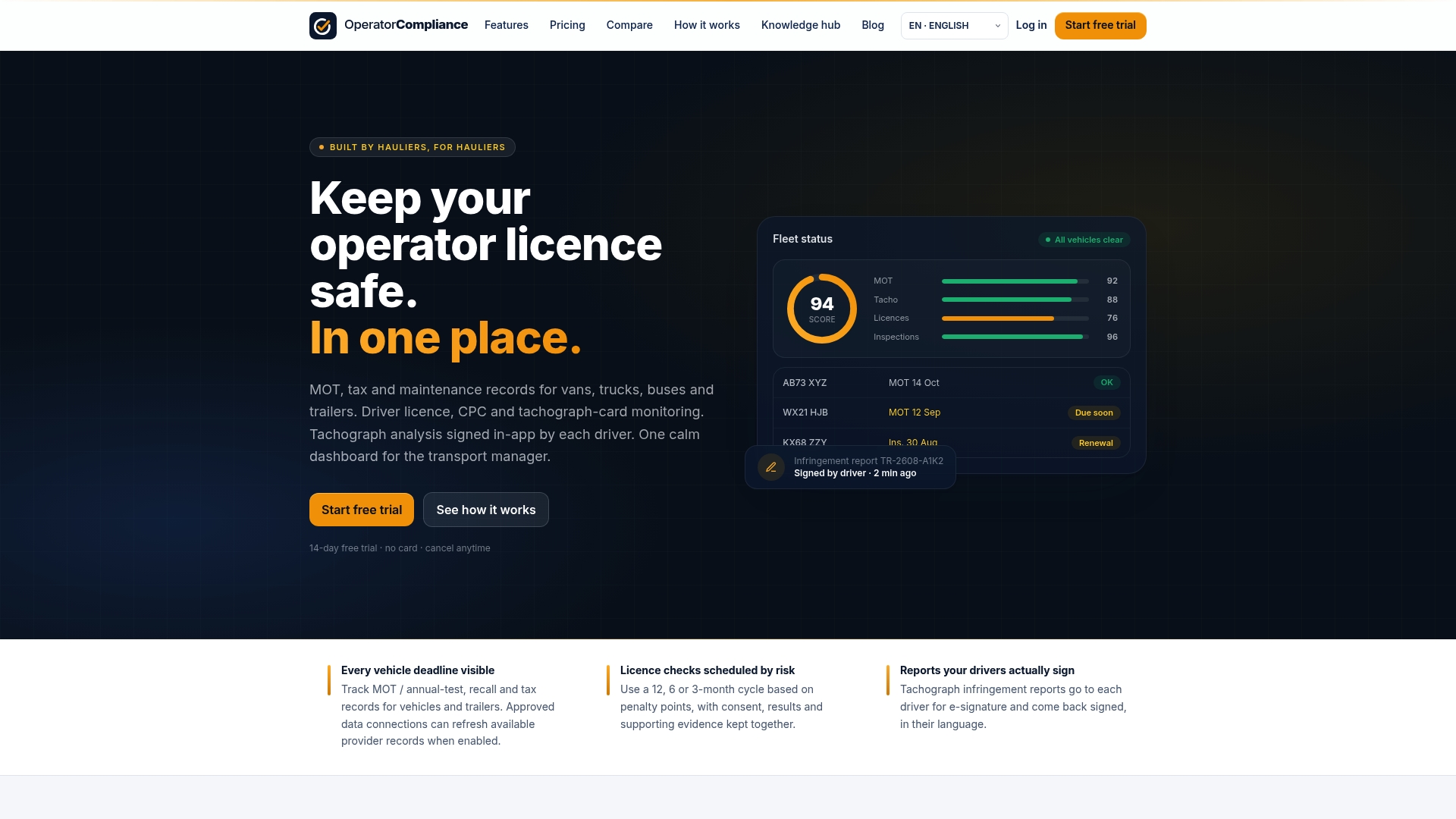
Running laden tests on time is only half the job. The other half is proving it, on demand, months later, to a DVSA examiner or a traffic commissioner’s office. OperatorCompliance is built by hauliers for hauliers around the DVSA Guide to Maintaining Roadworthiness, and it turns that scattered paperwork into one dashboard your team actually uses.
- an inspection calendar that flags each vehicle’s next safety inspection and laden test window automatically.
- a place to attach RBT printouts, decelerometer readings and signed EBPMS evaluations directly to the vehicle file.
- digital sign-off flows so a competent person’s risk assessment is captured and dated, not left in an inbox.
- an audit-ready compliance pack that pulls the right documents together the moment a traffic commissioner or DVSA examiner asks.
Plans start at Starter for £9 a month, with Standard and Professional tiers for larger fleets. See how it fits your transport management operation on the pricing page.
FAQ
What are the new brake testing rules in the UK?
DVSA’s current guidance
brake testing frequency