· 9 min read
Avoid Penalties in UK Clean Air Zones: What Fleet Managers Must Check
Which UK clean air zones charge vehicles, the seven charging cities, exemptions, retrofit options and the checks fleets need to avoid PCNs.
Avoid Penalties in UK Clean Air Zones: What Fleet Managers Must Check
Most diesel cars older than 2015 and vans below Euro 6 standard will pay a daily charge in one of England’s charging Clean Air Zones. Check any registration in seconds on the GOV.UK vehicle checker, or the TfL checker if you’re heading into London. Zones run around the clock and are enforced by camera, so pay by 23:59 on the sixth day after travel or expect a penalty notice, following official payment deadlines. Fleet managers should set up a business account and upload registrations in bulk rather than checking vehicles one by one.
TL;DR:
- Vehicles older than Euro 6 for diesel or Euro 4 for petrol, including vans and motorcycles, are liable for charges in most Clean Air Zones unless retrofitted or exempt.
- Fleet managers should verify vehicle standards and registration accuracy regularly, and set up business accounts for bulk checks and easier payment management.
- Tighter local rules may apply to taxis and private hire vehicles, and retrofit accreditation through CVRAS can exempt some older vehicles from charges.
- Checking and maintaining compliance records proactively can prevent unexpected costs and streamline fleet management across different city zones.
Table of Contents
- What are clean air zones and how do classes A to D work?
- Where are the UK’s clean air zones located right now.
- Which vehicles actually get charged?
- How do you check and pay a clean air zone charge?
- Who is exempt, and what support exists for retrofits?
- A compliance checklist for drivers and fleet managers
- How transport managers should think about clean air zone costs
- Stop chasing zone charges vehicle by vehicle
- Where to verify the current rules
- Sources
- FAQ
What are clean air zones and how do classes A to D work?
Clean Air Zones exist because transport is still the biggest domestic source of nitrogen oxides in the UK, responsible for a significant share of NOx emissions and primary PM2.5, according to 2024 data [GOV.UK], according to Defra’s transport and environment statistics. Charging zones target the vehicles doing the most damage to local air quality, using a four-tier framework set out in the Clean Air Zone framework for England.
Each class widens the net of vehicles that must comply:
- Class A covers buses, coaches, taxis and private hire vehicles.
- Class B adds heavy goods vehicles (HGVs).
- Class C adds vans, minibuses and other light goods vehicles.
- Class D adds cars and, where a local authority opts in, motorcycles.
England’s model charges non-compliant vehicles a daily fee. London runs a separate scheme, the Ultra Low Emission Zone (ULEZ), while Scotland’s Low Emission Zones work as outright bans rather than pay-to-enter charges, backed by policy targets in the Environmental Improvement Plan 2025. Three different frameworks, three different rulebooks. Operators moving between them need to check each one separately rather than assume one clean bill of health covers the lot.
Where are the UK’s clean air zones located right now.
Seven English cities currently run a charging Clean Air Zone, according to GOV.UK’s clean air zone guidance:
- Bath
- Birmingham
- Bradford
- Bristol
- Portsmouth
- Sheffield
- Tyneside (Newcastle and Gateshead)
Beyond these, London runs the ULEZ across the whole of Greater London, a scheme entirely distinct from the English CAZ framework and enforced by Transport for London rather than the local authority checker. North of the border, Glasgow, Edinburgh, Dundee and Aberdeen run Scottish LEZs, which restrict entry outright for non-compliant vehicles rather than charging a fee.
If you’re hunting for a clean air zones UK map to plan a route, GOV.UK’s guidance page is the only source worth trusting, because boundaries shift as councils extend zones or add streets. There are no windscreen stickers anywhere in this system. Every one of these zones relies on ANPR cameras reading your number plate as you pass, day or night, seven days a week. Drive through at 3am on a bank holiday and the camera still logs you.
Which vehicles actually get charged?
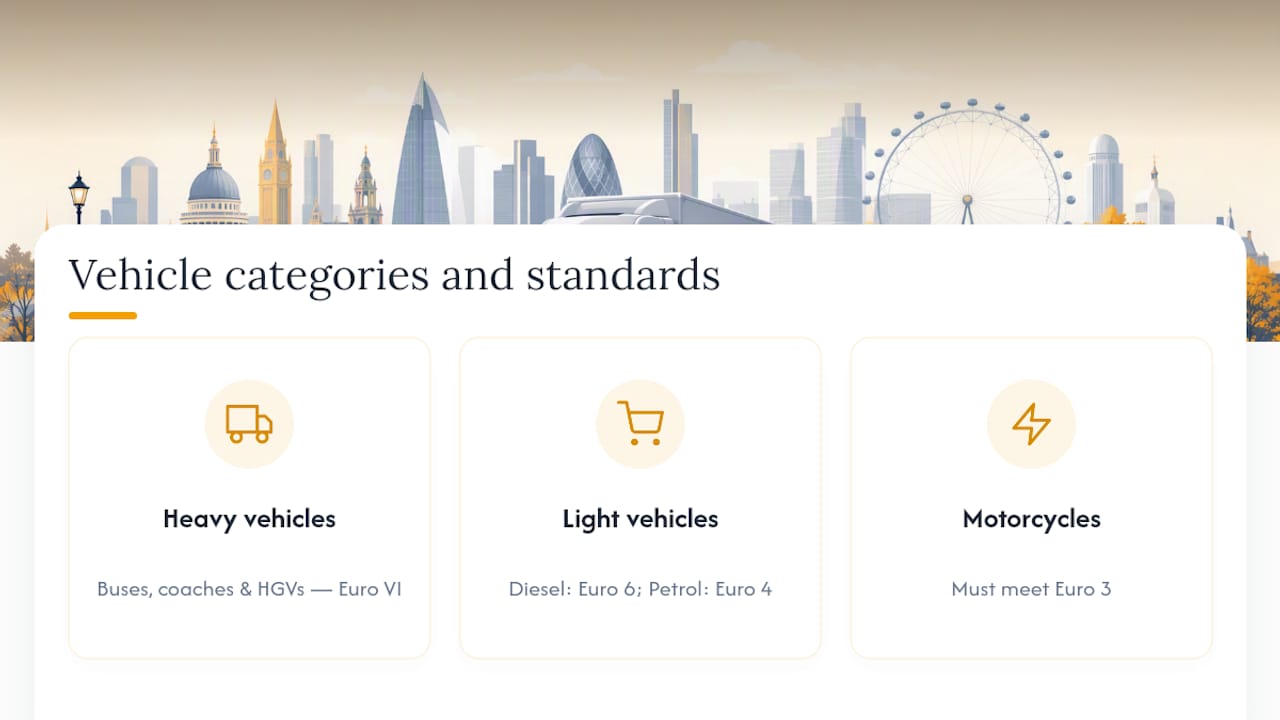
The minimum emission standards are fixed nationally, not decided city by city. Heavy vehicles, meaning buses, coaches and HGVs, need to meet Euro VI. Light vehicles need Euro 6 for diesel or Euro 4 for petrol. Motorcycles need Euro 3. Fall short of these and you’re liable for the daily charge in whichever class of zone applies, per the official minimum standards framework.
Local authorities can, and often do, set tighter or different rules for taxis and private hire vehicles, since these vehicles rack up disproportionate mileage in city centres. A taxi that’s fine on the open road might still fail a local PHV standard. Hybrids catch drivers out too: a plug-in hybrid still has to meet the petrol or diesel Euro standard for its combustion engine, so owning a hybrid is no automatic pass.
Charges vary by city and vehicle class rather than following one national price list, but the pattern is consistent: non-compliant cars and vans face a modest daily fee, while non-compliant HGVs, buses and coaches face a substantially higher one, reflecting their greater emissions per mile. If you run a mixed fleet of vans and heavier trucks, don’t assume the same charge band applies across the board. Check each vehicle type separately using the registration checker before you plan a route through any of these cities.
How do you check and pay a clean air zone charge?
Getting this wrong costs more than the charge itself. Here’s the sequence that avoids a penalty:
- Enter the vehicle’s registration on the GOV.UK vehicle checker, or use TfL’s tool if the journey is inside Greater London.
- If the vehicle is chargeable, pay before travelling or within the official payment deadline after driving into the zone.
- Miss that window and a Penalty Charge Notice follows, on top of the original charge.
- Running more than one vehicle? Set up a business account, upload a CSV of registrations, and add colleagues who need access rather than checking each plate manually.
The system leans entirely on DVLA-matched registration data. Sell a van, buy a new one, or run a personalised plate that hasn’t updated on the log book, and the checker can throw up the wrong answer. Business accounts support CSV upload for multiple plates at once and let you add up to ten team members, according to the official service guidance, which makes it far faster than checking vehicles one at a time when your fleet runs into double figures.
Pro Tip: Run every vehicle on your fleet list through the checker once a quarter, not just when you notice a new zone. Councils extend boundaries and change compliant vehicle types more often than most operators expect.
Who is exempt, and what support exists for retrofits?
Certain vehicles get a national exemption from charging CAZs without any local application needed. These include:
- Ultra low emission vehicles (ULEVs) that already beat the minimum standard.
- Vehicles registered in the disabled tax class.
- Military vehicles.
- Vehicles with historic tax status.
- Vehicles retrofitted under the Clean Vehicle Retrofit Accreditation Scheme (CVRAS).
CVRAS matters if you’re running an older HGV, bus or van that would otherwise fail. It provides independently verified accreditation for retrofit technologies, mostly exhaust treatment systems, that bring an older engine up to the required standard without buying a new vehicle, as confirmed in GOV.UK’s clean air zone guidance. A CVRAS-accredited retrofit means the vehicle is treated as compliant even though its original engine never met Euro VI or Euro 6 from the factory.
Grant support for retrofits or ULEV transition sits mainly with the Office for Zero Emission Vehicles and individual local authority schemes, which vary city by city. Worth a phone call to the local council before you assume a retrofit isn’t affordable.
A compliance checklist for drivers and fleet managers
CAZ compliance is a records problem as much as an emissions one. Get the paperwork straight and the charges look after themselves.
- Confirm the Euro standard of every vehicle on the fleet list, not just the ones you think are old.
- Check registration accuracy against DVLA records before relying on any zone checker’s output.
- Set up a GOV.UK business account and upload the fleet as a CSV rather than checking plates individually.
- Grant team access so more than one person can manage payments and checks without a single point of failure.
- Automate reminders for payment deadlines, since the six-day window closes faster than most schedules allow for.
- Keep an audit trail of every check and payment, useful evidence if a PCN dispute ever reaches a traffic commissioner hearing.
Missing a single payment window rarely causes a crisis on its own. The risk builds when it happens repeatedly across a fleet with no central record. A string of unresolved PCNs, combined with patchy drivers’ hours or maintenance records, starts to look like a pattern an operator can’t explain, and that’s exactly the kind of pattern a traffic commissioner takes an interest in.
Pro Tip: Treat CAZ payment deadlines the same way you treat MOT and safety inspection dates: on a calendar with an alert, not in someone’s memory.
How transport managers should think about clean air zone costs
CAZs change routing and procurement decisions more than most transport managers admit up front. A fleet built around older diesel HGVs suddenly costs more to run through Bristol or Birmingham, which pushes replacement and retrofit decisions earlier than planned. Centralising vehicle and compliance records isn’t just tidier. It’s the difference between forecasting these costs accurately and discovering them after the invoice arrives.
If you manage more than a handful of vehicles, the sensible next move is running your ten most-used registrations through the checker this week, not after the next PCN lands.
— Vytautas
Stop chasing zone charges vehicle by vehicle
Checking registrations one at a time works fine for a single van. It falls apart once you’re running fifteen vehicles across three cities with different Euro standards, retrofit records and renewal dates to track. Compliance software pulls MOT, tax, insurance and retrofit records into one dashboard, so a vehicle that’s about to fall out of compliance flags itself before it costs a daily charge or a penalty notice.

That matters most for CAZ exposure specifically: an expired MOT or a lapsed Euro VI retrofit record is exactly the kind of gap that turns a routine trip through Bradford or Tyneside into an unplanned charge. Automated deadline alerts catch it before the vehicle leaves the yard, and CSV upload means adding a new registration takes minutes, not a manual re-check across five different council portals. If you’re running HGVs, vans or PSVs through any charging zone regularly, see how compliance software for hauliers keeps registration, retrofit and renewal records audit-ready in one place, and start a trial to check your fleet’s current exposure today.
Where to verify the current rules
Confirm details directly with GOV.UK’s clean air zone guidance, the official vehicle checker, and Transport for London for ULEZ specifics. These are the only sources that reflect live boundary and charge changes.
Sources
FAQ
How do I know if I’m in a Clean Air Zone?
Check your route against the current list of charging cities on GOV.UK: Bath, Birmingham, Bradford, Bristol, Portsmouth, Sheffield and Tyneside, plus London’s separate ULEZ and Scotland’s LEZs.
clean air zones uk