· 10 min read
Plan a Compliant 30 Hour Double Manning Duty for UK Fleets
Practical UK guidance on double manning rules: a worked 30 hour schedule, pre departure checklist, tachograph tips and audit ready records.

Plan a Compliant 30 Hour Double Manning Duty for UK Fleets
Double manning lets each driver on a two-up duty take at least 9 hours’ daily rest inside a 30-hour window instead of the usual 24, provided a second qualified driver joins within the first hour of the duty. Every other limit still applies to each driver individually. Miss the first-hour window and the concession disappears; get the 30-hour maths wrong and you’ve got an infringement waiting to be found on a download.
TL;DR:
- Double manning allows drivers to take 9 hours of daily rest within a 30-hour window if a second driver joins within the first hour of duty; missing this window reverts the shift to single-manned rules.
- Both drivers must have valid licenses, driver cards, and driver CPCs if needed, and be genuinely able to drive; a driver exhausted of daily hours doesn’t count as available.
- The tachograph records driver activity and activity modes, requiring immediate corrections for activity mode mistakes, while accurately reflecting the first-hour contact for double manning eligibility.
- The limits of driving hours, breaks, and weekly rest rules still apply individually to each driver, with a strict no-flex policy on the 9-in-30-hour window starting from their last rest.
- Pre-departure planning, driver checks, and digital compliance software are essential to avoid infringements, ensure audit readiness, and keep the schedule within legal limits.
Table of Contents
- What counts as a double manned duty under UK rules?
- How do you record double manning on a digital tachograph?
- Which drivers’ hours limits still apply on a two-up duty?
- What mistakes cause double manning infringements and enforcement action?
- What does a compliant 30-hour double-manned schedule look like?
- What should be on the pre-departure checklist for double manning?
- How OperatorCompliance supports double manning compliance
- The one habit that stops most double manning infringements
- Get audit-ready for double manning duties
- Sources
- FAQ
What counts as a double manned duty under UK rules?
A duty only qualifies as double manned when two things are true at once: two qualified drivers are present to share the driving, and the second one is on board within the first hour of the shift starting. Get either wrong and the whole duty defaults back to single-manned rules, which means the standard 24-hour rest window applies rather than the more forgiving 30-hour version.
This is where a lot of operators trip up, because the requirement isn’t just “two drivers somewhere on the run”. It’s specific about timing and eligibility.
What has to be in place for double manning to apply:
- Two drivers must be available to drive the vehicle between two consecutive daily rest periods, or between a daily rest and a weekly rest.
- The second driver has to join within the first hour of the duty. According to the rules on double manning set out by CTT Limited, if that driver isn’t there inside the hour, the duty reverts to single-manned status for the entire shift, not just the late portion.
- Both drivers need a valid driving licence for the vehicle category, a valid driver card, and Driver CPC where the role requires it.
- Both drivers must genuinely be able to drive when needed. A driver who’s already exhausted their daily driving limit doesn’t count as “available” in any meaningful sense, even if they’re physically in the cab.
The first-hour rule catches out more crews than any other part of this. Picture a scenario that plays out weekly on trunk routes: Driver A sets off from the depot at 06:00 on a two-up job, and Driver B is meant to be picked up from a service station en route. If B doesn’t climb in until 07:15, the concession is gone for that entire duty. Not just for the missed 15 minutes. The whole shift falls back under single-manning rules, meaning A need a full 24 hours (minus the rest already taken) to recover their rest, not the more flexible 30-hour window.
Driver swaps mid-duty don’t automatically break the concession, but they do need care. If one driver finishes their stint and leaves the vehicle before the other has completed theirs, you need to check whether a genuine two-driver crew was still present for the relevant driving periods. A duty where the second driver drops out early and the first finishes the run alone isn’t double manned for that final stretch, and the rest calculation needs to reflect that split.
Minimum crew requirements aren’t just a box-ticking exercise either. Traffic commissioners and DVSA examiners look at whether both named drivers on the tachograph record were genuinely capable of driving, not simply present as passengers. A driver who’s already run out of daily driving hours before the shift even started doesn’t satisfy the requirement, regardless of what the card shows in the slot.
Get the eligibility criteria settled before the vehicle leaves the yard. It’s far cheaper to swap a driver in the traffic office than to discover during an audit that a duty you logged as double manned doesn’t meet the legal definition.
How do you record double manning on a digital tachograph?
The tachograph needs to reflect reality accurately, and that starts with card placement. Both drivers insert their driver cards into the two available slots, slot 1 and slot 2, as early in the duty as practically possible. Getting this right from the outset avoids a mess of manual entries later.
A practical sequence for the start of a double-manned duty:
- The driving driver inserts their card into slot 1 before setting off.
- The second driver inserts their card into slot 2 as soon as they board the vehicle, ideally within that critical first hour.
- Both drivers select the correct activity mode. The driving driver selects “driving”; the non-driving driver selects “other work”, “availability”, or “break” depending on what they’re actually doing.
- When drivers swap, the incoming driver switches their mode to “driving” and the outgoing driver switches to “other work” or “availability” as appropriate, without removing either card unnecessarily.
- At the end of the duty, both drivers remove their cards and, where the vehicle software allows it, confirm the record before finishing.
The tachograph automatically records Period of Availability (POA) when the second driver’s card sits in the vehicle while it’s moving and that driver isn’t actively driving. According to Tacho Agent’s explainer on multi-manning, the first 45 minutes of that POA can, in certain circumstances, count towards the driver’s break requirement. That’s a useful concession, but it only works if the activity is genuinely recorded as POA and not accidentally logged as rest or driving.
This is also where the most common recording error happens. POA is not daily rest, no matter how comfortable the bunk is or how long the non-driving passenger has been sitting there. Daily rest has to be taken while the vehicle is stationary, and the driver must be free from any duty, including the obligation to be ready to take over driving. A driver dozing in the bunk while the vehicle rolls down the motorway is on POA, not rest, and logging it as rest on the card will not survive a download check.
Pro Tip: If a driver realises mid-shift that they’ve selected the wrong activity mode, correct it immediately using the manual entry function rather than waiting until the end of the day. A same-shift correction with a clear explanation looks very different to an examiner than a retrospective edit made days later.
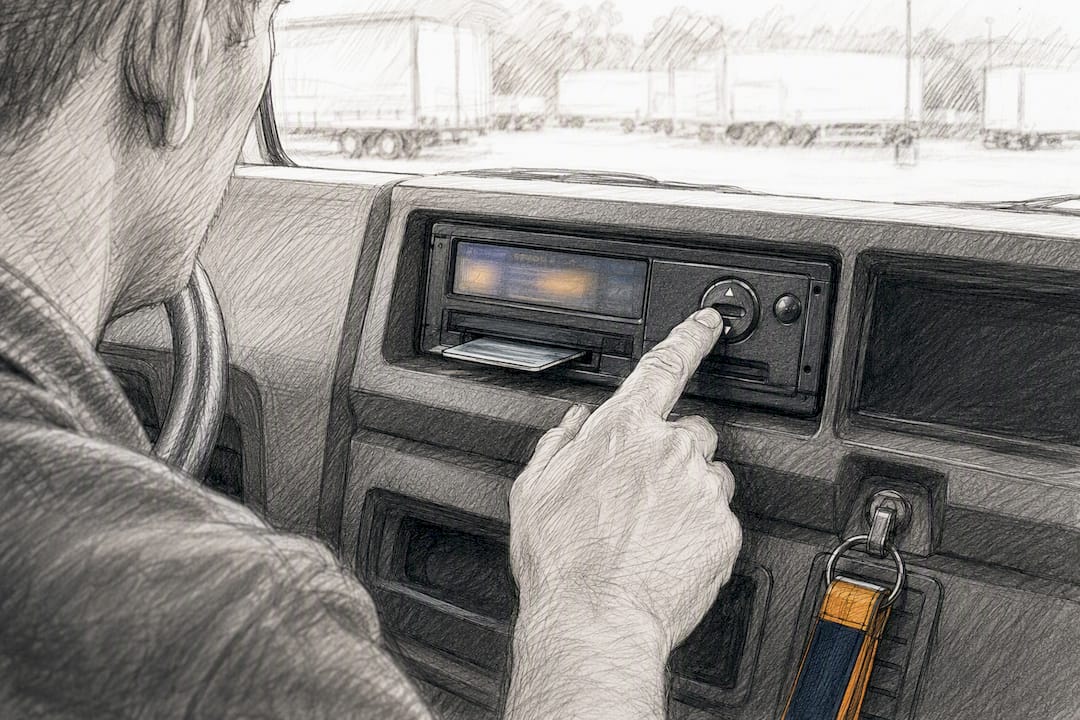
Mistakes happen, particularly with agency drivers who aren’t used to a specific vehicle’s tachograph interface. Most units allow manual entry corrections, and drivers should note the reason for any change at the time, not from memory a week later. Whatever gets corrected, the underlying .DDD download rules on the 28 and 90 day cycle still apply, and a corrected record is only useful if it’s actually downloaded, stored, and retrievable when a DVSA examiner asks for it.
Which drivers’ hours limits still apply on a two-up duty?
Double manning changes one thing: the daily rest window. Everything else, every driving limit, every break requirement, every weekly cap, stays exactly as it would for a driver working alone.
That’s the point operators most often get wrong, and it’s worth saying plainly: the concession is narrow. It relaxes rest timing, not driving allowance.
The limits that remain unchanged for each driver individually:
- A maximum daily driving limit of 9 hours, extendable to 10 hours no more than twice in a week.
- A required break of at least 45 minutes after no more than 4.5 hours of accumulated driving, which can be split into a 15-minute break followed by a 30-minute break, in that order.
- A weekly driving limit of 56 hours, and a fortnightly limit of 90 hours across any two consecutive weeks.
- Weekly rest requirements, including the rules on how many reduced weekly rests a driver can take before a compensating rest period is owed.
According to Croner’s analysis of multi-manning pitfalls, the single biggest source of enforcement trouble on double-manned duties isn’t the 30-hour concession itself. It’s operators assuming the relaxed rest window somehow loosens everything else too. It doesn’t. Both drivers still need their 45-minute break, still can’t exceed their individual driving caps, and still accrue reduced rests against the same limits as a solo driver.
The 9-in-30 rule, explained properly
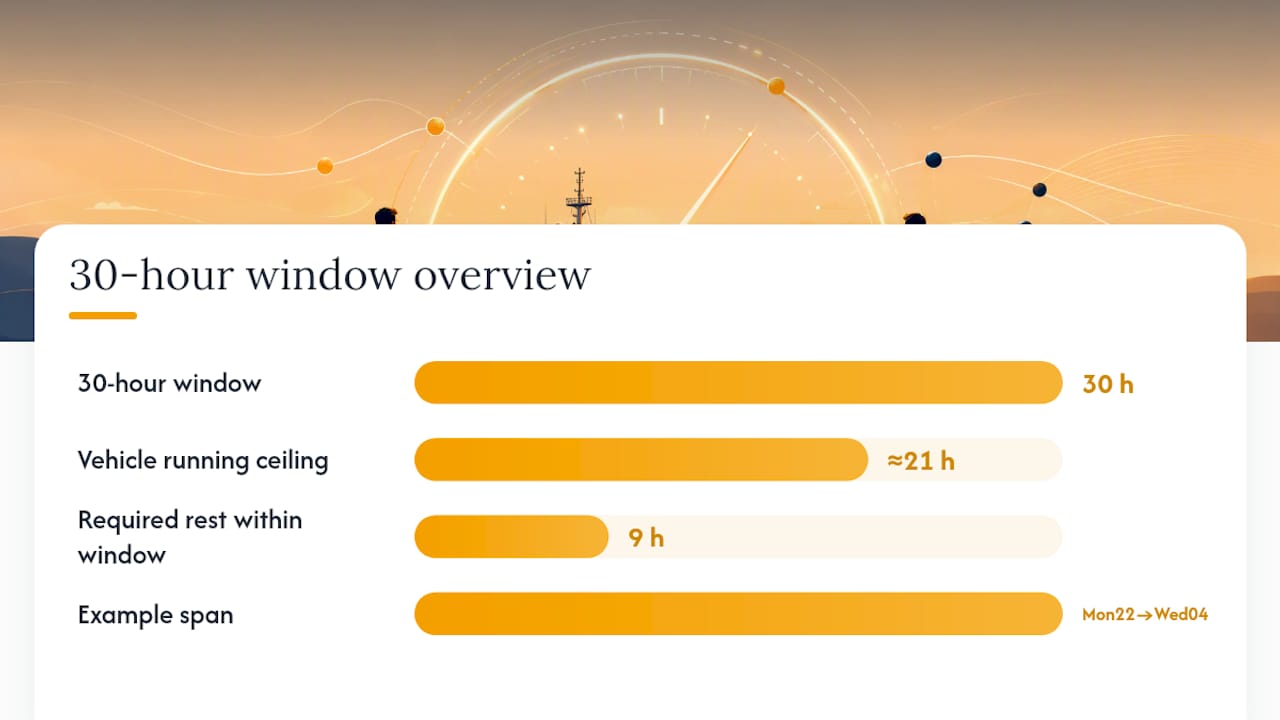
The window starts counting from the end of the previous daily or weekly rest period, not from the start of the current duty. So if a driver finished their last rest at 22:00 on Monday, the 30-hour clock is already running from that point, and their next 9-hour rest needs to start before 04:00 on Wednesday. Under Gov, that’s a hard boundary. There’s no flexibility to extend it further, and no equivalent of the reduced daily rest concession that single-manned drivers can use.
That 30-hour window is also why the commonly quoted figure of a vehicle running for around 20 to 21 hours gets thrown about in industry discussion. If you subtract a 9-hour rest from a 30-hour window, you’re left with roughly 21 hours in which the vehicle could theoretically be in motion, factoring in pickup timing and breaks. But that’s a ceiling built from the rest rule alone. It says nothing about whether either driver has enough individual driving hours left, whether they’ve already used their weekly extensions, or whether a reduced rest earlier in the week has left them owed compensation. Treating “20 hours of vehicle running” as an operational target rather than a mathematical upper bound is exactly how crews end up over their weekly limits without realising it until the download tells them otherwise.
What mistakes cause double manning infringements and enforcement action?
Most double manning infringements come from the same handful of misunderstandings, repeated across different fleets and different routes. None of them are exotic. All of them are avoidable with a bit of discipline in the traffic office.
The mistakes that show up most often on downloads and audits:
- Logging in-vehicle availability as daily rest, when the vehicle was moving and the driver wasn’t in a genuinely stationary, duty-free state.
- Missing the first-hour pickup window and continuing to log the duty as double manned when it legally reverted to single-manned.
- Stacking reduced weekly rests back to back without applying the required compensating rest, which builds up a deficit that examiners spot immediately on a multi-week download.
- Failing to download tachograph files within the required cycle, or losing driver-signed infringement acknowledgements that the Traffic Commissioner expects to see at audit.
- Assuming a passenger in the cab automatically counts as the second driver, without checking they hold a valid card and haven’t already exhausted their own hours.
Treating on-the-move availability as rest is the one that catches drivers out most often, largely because it feels like rest from the driver’s own perspective. They’re not driving, they might be lying down, and eight hours can pass without incident. But the legal definition of daily rest requires the vehicle to be stationary, and the driver to be free of any obligation connected to the vehicle, including being on standby to take over. A tachograph download will show the vehicle in motion during that period regardless of what the driver believed they were doing, and that mismatch is exactly what an examiner is trained to look for.
The insight from industry advisers at Croner on reduced rest stacking deserves repeating: a driver can take a reduced weekly rest of less than 45 hours, but only up to three times between two weekly rests, and any reduction has to be compensated with an equivalent rest attached to another rest period before the end of the third week following the reduced one. On busy double-manned trunk operations, where crews are chasing schedules and rest gets squeezed wherever it fits, this compensation requirement is easy to lose track of without a system flagging it.
Pro Tip: Don’t rely on driver memory to track reduced rest compensation across a rolling three-week cy
double manning rules