· 9 min read
6-10 Weeks: Audit Ready Fleet Maintenance Planning for Fleet Managers
Fleet managers: launch maintenance planning in 6–10 weeks. Use OEM aligned intervals, first to occur triggers, and keep audit ready records.
6–10 Weeks: Audit Ready Fleet Maintenance Planning for Fleet Managers
Fleet maintenance planning is the practice of scheduling and documenting vehicle service work before problems force a repair, using mileage, engine hours, and calendar triggers rather than guesswork. The single best first step is building an accurate asset inventory paired with a baseline preventive maintenance (PM) schedule tied to OEM intervals, MOT inspection deadlines, and a compliance system like Operatorcompliance.
TL;DR:
- Most fleets can establish a basic preventive maintenance schedule within six to ten weeks by auditing vehicles, building asset registers, and deploying digital tools.
- Automated CMMS systems with multi-trigger scheduling and telematics integration significantly reduce manual recordkeeping and improve compliance.
- Shortening OEM intervals for severe duty should specify clear reasons like route type, load, or climate, to support audit and warranty processes.
- Regular review of inspection and service data twice a year helps adapt maintenance intervals to actual component stress and wear patterns.
- Tracking KPIs such as maintenance costs, downtime, and defect rate trends provides a clear gauge of a program’s effectiveness without extra manual effort.
Table of Contents
- Why a maintenance program beats ad-hoc repairs
- Which maintenance strategy fits your fleet?
- How do you build a preventive maintenance schedule?
- What are the core components of a maintenance program?
- Which tools actually reduce maintenance admin?
- How do you keep maintenance records audit-ready?
- What KPIs actually show a program is working?
- How fast can you get a PM program running?
- Where automation actually earns its keep
- A practical next step for transport managers
- Sources
Why a maintenance program beats ad-hoc repairs
Reactive repairs cost more because they happen on the vehicle’s schedule, not yours. A parts order that could have been placed a week early instead stops a truck on a Tuesday morning run. Fleets running structured PM schedules spend 28 to 35 percent less on total maintenance annually than those relying on breakdown fixes, and they see meaningfully less unplanned downtime along the way.

Documented service history also protects you when a warranty claim or a Traffic Commissioner audit hinges on proof that work happened on schedule.
Programs tend to fail for a few predictable reasons:
- Intervals copied from a spreadsheet template and never adjusted for duty cycle
- No single owner accountable for closing out overdue work orders
- Service records scattered across paper logs, texts, and a mechanic’s memory
Which maintenance strategy fits your fleet?
Four strategies exist on a spectrum, and most fleets run a blend rather than picking just one.
- Reactive: fix it when it breaks. Cheapest to set up, most expensive to run, and it invites roadside failures.
- Preventive: service on fixed intervals regardless of vehicle condition. This is the baseline every fleet should have before adding anything fancier.
- Proactive or condition-based maintenance (CBM): service triggered by actual wear signals like oil analysis or brake pad sensors, not just a calendar date.
- Predictive: algorithms forecast failure windows from telemetry trends, so you replace a part before it fails rather than on a fixed date.
Predictive maintenance needs real telematics infrastructure, sensor data, and a system capable of reading it. Predictive maintenance can raise overall equipment effectiveness while cutting unplanned downtime, but it only pays off once a fleet has the data pipeline to support it. A ten-van courier fleet rarely needs it. A 200-truck operation running tight delivery windows almost certainly does.
How do you build a preventive maintenance schedule?
Every PM interval should run on the “first-to-occur” rule: whichever trigger fires first (mileage, engine hours, or calendar time) determines when service happens. A van that sits idle for six months still needs a brake inspection on the calendar trigger even if the odometer barely moved.
- Pull the OEM’s recommended service intervals for each asset class as your starting point.
- Shorten intervals for severe duty (stop-start urban routes, heavy loads, extreme temperatures) and write the reason directly into the asset record.
- Set at least two trigger types per major service item so a low-mileage vehicle doesn’t skip a time-sensitive check like brake fluid degradation.
- Review seasonal shifts twice a year, since winter road salt and summer AC load stress different components.
Pro Tip: When you shorten an OEM interval for severe duty, note the specific reason (route type, load weight, climate) rather than just the new number. That documentation is what an auditor or a warranty adjuster will actually ask for.
What are the core components of a maintenance program?
A maintenance program is really four linked systems working together. Miss one and the others start producing bad data.
- Asset register: every vehicle with make, model, VIN, current mileage or engine hours, and a running service history attached.
- Inspection workflows: driver vehicle inspection reports (DVIRs) completed before or after each shift, feeding defects straight into the maintenance queue.
- Work order management: every defect or scheduled service becomes a tracked job with a status, an assigned technician, and a close date.
- Parts and vendor management: stock levels for high-turnover parts (filters, brake pads, wiper blades) plus a shortlist of vetted vendors for anything you don’t stock.
Fleets over a certain fleet size typically outgrow spreadsheets for this (https://fleetopsclub.com/blog/how-to-build-fleet-maintenance-program) because the four systems generate more cross-references than a manual process can track without errors slipping through. Digital DVIR tools that automatically convert a driver’s defect note into a work order close the gap between “someone noticed a problem” and “someone fixed it,” which is usually where reactive fleets lose the most time.
Which tools actually reduce maintenance admin?
Spreadsheets break down once you’re juggling multiple trigger types across a mixed fleet. A computerized maintenance management system (CMMS) is the software category built specifically for PM scheduling, work orders, and reporting at scale.
Look for these capabilities before you sign anything:
- Multi-trigger scheduling that runs mileage, hours, and calendar dates simultaneously per asset
- Mobile DVIRs drivers can complete from a phone, with photo attachments for defects
- Automatic work order generation once a defect or scheduled interval is logged
- Telematics sync so odometer and engine-hour data update without manual entry
- Exportable, audit-ready reports formatted for regulator or warranty review
Telematics feeds are what make condition-based and predictive workflows possible in the first place. Without live odometer and diagnostic trouble code data flowing into your system, you’re stuck estimating mileage from memory. Vendor evaluation should also cover how the platform handles driver and vehicle data privacy, since telematics integrations move a lot of personal and location data between systems.
How do you keep maintenance records audit-ready?
UK fleet compliance sits right alongside your PM schedule. MOT test dates, DVIR records, and tachograph downloads all interact with your maintenance calendar, and a missed MOT deadline or an undocumented repair can trigger enforcement action independent of anything mechanical.
Audit-ready recordkeeping means every service, inspection, and defect resolution has a timestamp, a technician name, and a permanent digital copy you can pull on demand. Documented service histories protect warranty claims and satisfy regulatory audits far more reliably than paper logs stored in a glovebox.
- Set automated reminders for MOT, tax, and inspection deadlines so nothing depends on someone remembering a date
- Store inspection intervals alongside the completed inspection record, not in a separate system
- Export evidence packs in a format regulators and insurers actually accept, ahead of the audit, not during it
What KPIs actually show a program is working?
Four numbers tell you almost everything about program health, and you can pull all of them from a CMMS or telematics dashboard without extra manual tracking.
Light vans and heavy HGVs carry different baseline costs per mile, so compare cost trends against your own fleet’s history rather than an industry average that mixes vehicle classes together.
How fast can you get a PM program running?
You don’t need a year-long rollout. Most fleets can stand up a working baseline in six to ten weeks if they sequence it correctly.
- Weeks 1 to 2: Audit every vehicle, confirm VINs, current mileage, and existing service records. Tag high-risk or high-usage vehicles for priority scheduling.
- Weeks 3 to 4: Build the asset register and load OEM intervals as your default PM schedule.
- Weeks 5 to 6: Deploy mobile DVIRs and connect telematics feeds where available. Automate reminders for MOT and inspection deadlines first.
- Weeks 7 to 8: Go live with work order tracking and train technicians on closing out jobs digitally.
- Weeks 9 to 10: Run your first compliance and cost KPI report, then adjust intervals based on real defect patterns from inspection data.
Pro Tip: Don’t wait for a full year of data before adjusting intervals. Ninety days of DVIR defect reports is usually enough to spot whether an OEM interval is too loose for your actual duty cycle.
Where automation actually earns its keep
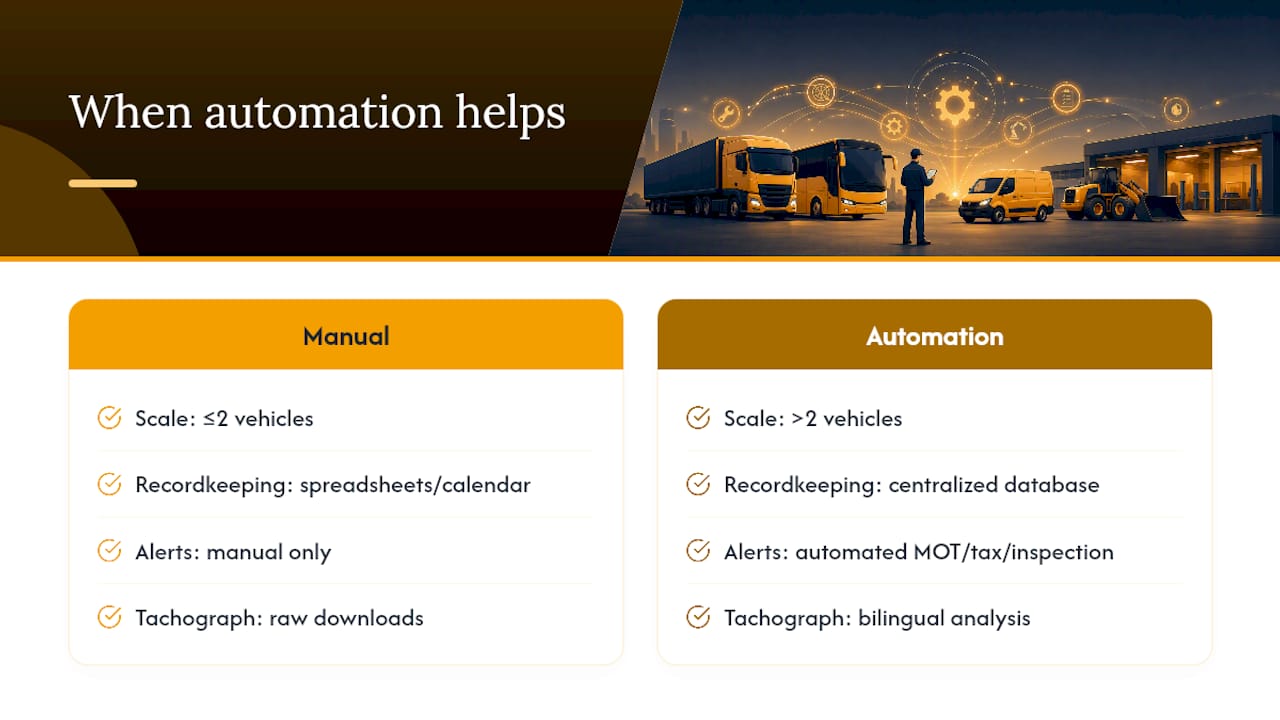
Spreadsheets work until they don’t, and the failure point is almost always recordkeeping under audit pressure, not the maintenance work itself. Automation earns its place when a fleet manager is manually cross-checking MOT dates, tachograph downloads, and PM intervals across more vehicles than one person can track reliably.
That’s the gap Operatorcompliance was built to close: automated alerts across MOT, tax, and inspection deadlines, plus bilingual tachograph analysis that turns raw driver data into an audit-ready report. For a small fleet running two vehicles, a shared calendar might still do the job. Past that, the administrative math stops working in your favor.
— Vytautas
A practical next step for transport managers
Everything covered here, multi-trigger scheduling, OEM-aligned intervals, audit-ready records, maps directly onto what Operatorcompliance does for transport managers day to day. Instead of stitching together a spreadsheet, a separate DVIR app, and a folder of MOT certificates, you get one dashboard that tracks vehicle compliance status, driver licence and CPC records, and tachograph analysis in a single view.
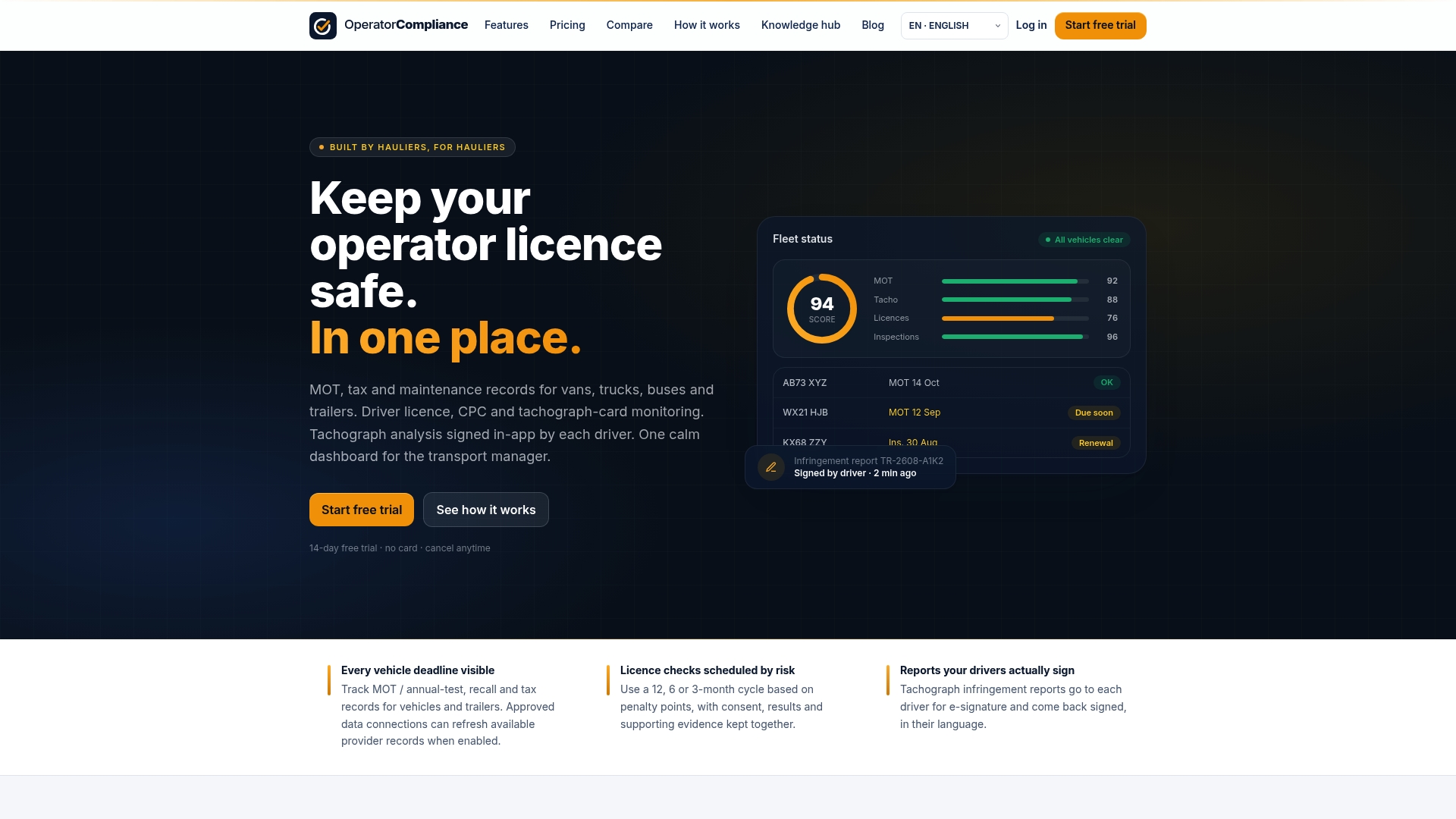
The custom alerts flag an upcoming MOT or a lapsing driver qualification before it becomes a missed deadline, and the exportable evidence packs are built to match DVSA and Traffic Commissioner expectations, so you’re not assembling proof under pressure during an actual audit. If your fleet includes hauliers or HGV operations, the compliance software for hauliers page walks through how the platform fits your specific vehicle mix. Start a free trial to see your own fleet’s compliance status on one dashboard within an afternoon.
Sources
For deeper detail on interval selection and program structure, the Fleet Preventive Maintenance Scheduling guide and Build a Fleet Maintenance Program cover PM design in more depth. For UK-specific compliance requirements, browse the Operatorcompliance knowledge hub for O-licence and roadworthiness guides.
- A literature review-based evaluation framework for maintenance strategy selection in heavy vehicles
- Fleet Preventive Maintenance Scheduling: Complete Guide to PM Programs
Recommended
fleet maintenance planning