· 11 min read
Avoid DVSA Audits: Four HGV Licence Categories UK Operators Must Track
UK guide to HGV licence categories: what each permits, Driver CPC, D4 medicals, and how compliance software keeps fleets audit ready.
Avoid DVSA Audits: Four HGV Licence Categories UK Operators Must Track
Four licence categories cover goods vehicles over 3.5 tonnes in the UK: C1, C1+E, C and C+E. C1 lets you drive vehicles between 3.5 and 7.5 tonnes; C covers rigid vehicles above 7.5 tonnes; C1+E and C+E add trailer combinations, up to 44 tonnes for a full artic. Commercial driving on any of these also demands Driver CPC and a Group 2 (D4) medical. Check your exact entitlement on Gov.
TL;DR:
- The C1 category covers vehicles between 3.5 and 7.5 tonnes, suitable for medium-sized vans, ambulances, and motorhomes, with a minimum age of 18 for hire or reward use.
- Category C allows drivers to operate rigid vehicles over 7.5 tonnes, while C+E grants entitlement to articulated lorries and drawbar trailers up to 44 tonnes, often used in long-haul and freight work.
- Medical checks, Driver CPC training, and license restriction codes are ongoing legal requirements, with medical renewals becoming more frequent for drivers over 45.
- Operator compliance relies on automated checks and centralized tracking of license expiry, medical, and CPC renewal dates to prevent roadside infractions and maintain audit readiness.
- Driving standards and licensing rules are separate for passenger vehicles; bus licenses (D1, D, D+E) follow different categories and requirements from goods vehicle licenses.
Table of Contents
- HGV licence categories explained: the weight thresholds that decide everything
- What can you actually drive on C1, C1+E, C and C+E?
- Medical checks, Driver CPC and the rules that keep you legal
- How to get your HGV entitlement: a realistic roadmap
- Class 1, Class 2 and what the old names actually mean
- Checking your entitlement and staying compliant day to day
- Why transport managers can’t just trust the photocard
- Restrictions and endorsements: automatics, modifications and what they mean for you
- Trucks versus buses: why PSV categories aren’t the same as HGV ones
- Renewing your licence: what stays valid and what needs refreshing
- Choosing your next step
- Keeping every driver’s entitlement audit-ready
- Sources
- FAQ
HGV licence categories explained: the weight thresholds that decide everything
Every HGV category exists because of weight, not vehicle shape. The DVLA splits entitlements by gross vehicle weight (GVW), and three figures do most of the work: 3.5 tonnes, 7.5 tonnes and 44 tonnes.
A vehicle becomes an HGV in UK law the moment its GVW passes 3.5 tonnes. Below that line you’re driving on a standard car licence (Category B). Cross it, and you need an LGV entitlement, plus the insurance and operator obligations that come with commercial goods vehicles. The 7.5 tonne mark splits medium rigid vehicles (Category C1) from the larger rigids (Category C), and it’s the point where many transport managers first bump into formal operator licensing questions. At the top end, 44 tonnes is the standard maximum train weight for an articulated lorry or drawbar combination running on six axles, the territory of Category C+E.
Your photocard driving licence lists every category you hold on the back, sometimes alongside restriction codes that limit how you can use that entitlement.
- 3.5 tonnes: the line between a car licence and an HGV entitlement
- 7.5 tonnes: separates C1 (medium rigid) from C (large rigid)
- 44 tonnes: the usual maximum for C+E articulated and drawbar combinations
- Restriction codes on the photocard can limit automatic gearboxes, trailer use, or specific vehicle types
What can you actually drive on C1, C1+E, C and C+E?
Matching your job to the right entitlement matters more than memorising legislation. Here’s what each category covers in practice.
-
Category C1 (3.5 to 7.5 tonnes). This is the entry point into professional goods driving. It covers medium rigid vehicles such as a 7.5 tonne box van, many ambulances, and larger motorhomes that tip over the car licence weight limit. Minimum age is normally 18, and anyone driving for hire or reward needs the Group 2 medical (D4) alongside the entitlement itself.
-
Category C1+E (C1 plus trailer). Add a trailer to a C1 vehicle and the combined weight can run up to 12 tonnes. This suits operators who tow a small plant trailer behind a horsebox-style vehicle, or businesses running medium vans with a loaded trailer for occasional heavy loads. It’s a narrower entitlement than most people realise, and worth checking carefully against the trailer weight you actually plan to pull.
-
Category C (rigid vehicles over 3.5 tonnes). Legally this covers everything from 7.5 tonnes upward on a rigid chassis, no trailer attached. In the trade this is still widely called “Class 2,” and it’s the backbone entitlement for waste collection, local and regional delivery, and skip lorries. Most fleet drivers who never touch an articulated unit hold this category.
-
Category C+E (articulated or drawbar, up to 44 tonnes). Known in the industry as “Class 1,” this is the full HGV entitlement. It covers articulated lorries, drawbar trailer combinations, and container haulage running at the UK’s standard 44 tonne maximum. Long-haul, international, and abnormal-load work almost always sits here, and it commands the highest driver rates of the four categories, reflecting the added skill of reversing and coupling a trailer safely.
Under the category schedules in UK legislation, these definitions aren’t marketing labels. They’re the legal scope of what you’re permitted to drive, and driving outside your category is a licensing offence regardless of how experienced you are behind the wheel.
Medical checks, Driver CPC and the rules that keep you legal
Holding the right category on your photocard is only half the picture. Commercial HGV driving carries ongoing legal obligations that sit on top of the entitlement itself.
Anyone driving Group 2 vehicles for hire or reward needs a D4 medical examination, completed by a doctor and checking eyesight standards, blood pressure, cardiovascular history and any condition that could affect safe driving. This isn’t a box-ticking formality; DVLA can and does refuse or revoke entitlements on medical grounds.
Professional drivers also need Driver CPC, which means passing the initial qualification and then completing 35 hours of periodic training every five years to keep driving commercially.
- Group 2 (D4) medical required for all Category C and D licences used commercially
- Driver CPC: initial qualification plus 35 hours periodic training every five years
- Operator licence, tachograph fitment and HGV-specific insurance become mandatory once you’re operating for hire or reward
A missed CPC deadline stops a driver working, not just risks a fine. Once the five year periodic training cycle lapses, that driver legally cannot drive commercially until it’s renewed, and DVSA treats operating without valid CPC as a serious compliance failure at the roadside.
How to get your HGV entitlement: a realistic roadmap
Getting from car licence to full HGV entitlement follows a fairly fixed sequence, and skipping steps rarely saves time; for professional drivers looking to advance safely, taking stages pour conducteurs professionnels can help recover points and improve skills.
- Book your D4 medical with a doctor before applying for provisional entitlement. Do this first, since a failed or delayed medical derails everything downstream.
- Apply for provisional entitlement for the category you’re targeting through DVLA.
- Pass the theory test, which covers multiple choice questions and a hazard perception element specific to LGV drivers.
- Complete practical training and pass the practical test, booked through DVSA test centres. Some learners go straight from a car licence to C+E via approved training providers, skipping the intermediate categories entirely.
Training costs vary by region and provider, and budgets should be planned flexibly since prices differ depending on category and whether tests are included.
Pro Tip: Book your D4 medical the same week you start looking at training providers. Medicals can take longer to arrange than people expect, and a delayed medical is the single most common reason a training plan slips by weeks.
Class 1, Class 2 and what the old names actually mean
Job adverts still say “Class 1” and “Class 2” far more often than “C+E” and “C.” The mapping is simple: Class 1 means C+E (articulated and drawbar work), and Class 2 means C (large rigid, no trailer). Some listings specify “automatic only,” which points to a restriction code on the licence rather than a separate category. When you see legacy terms in a job posting or training course title, translate them mentally before assuming what’s actually required.
Checking your entitlement and staying compliant day to day
Your photocard licence lists categories on the reverse, each with a start and expiry date and any restriction codes attached. DVLA’s online licence check service confirms exactly what’s current, which matters because photocards themselves expire separately from the underlying entitlement.
- Check restriction codes carefully; a code can limit you to automatic gearboxes or exclude certain trailer configurations
- D4 medicals need renewing periodically, and DVLA will write when yours is due
- Photocard expiry is separate from category expiry; renew before the card lapses to avoid gaps
- Operators should track these dates centrally rather than relying on individual drivers to self-report
Why transport managers can’t just trust the photocard
Individual drivers hold the legal responsibility for their own licence, medical and CPC status. Operators carry the practical risk when any of it lapses unnoticed.
A DVSA roadside check that finds a driver operating without valid Driver CPC or a lapsed medical doesn’t just penalise the individual. It exposes the operator’s systems, and it’s exactly the kind of gap that shows up in a traffic commissioner review of operator licence undertakings.
Centralised tracking closes that gap by pulling photocard entitlement checks, D4 medical expiry dates, CPC training hours and tachograph data into one place instead of a dozen spreadsheets. Automated DVLA checks and reminders catch a lapsing entitlement weeks before it becomes a roadside problem, and an audit-ready evidence pack saves hours when a traffic commissioner or DVSA audit lands. None of that removes the legal duty sitting with the driver and operator; it just makes it far harder to miss a deadline by accident.
Restrictions and endorsements: automatics, modifications and what they mean for you
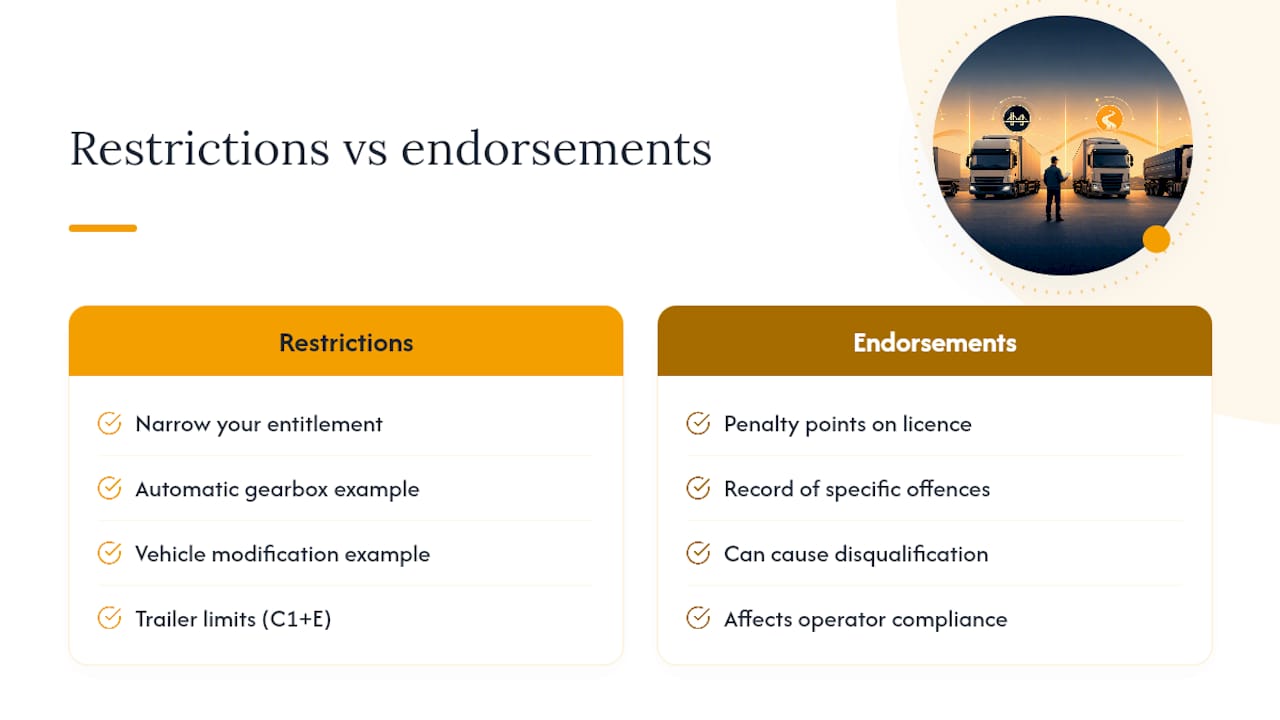
A restriction code on your photocard narrows your entitlement without changing which category letter appears next to it. The most common one drivers encounter is the automatic gearbox restriction, applied when someone passes their practical test in an automatic vehicle. Hold that restriction and you’re legally confined to automatic HGVs until you pass a manual test to remove it, which matters increasingly little given how many modern fleets run automatic or automated-manual transmissions anyway.
Other restrictions relate to vehicle modifications. Some drivers hold entitlements tied to specific adaptations, such as hand controls fitted for a medical condition, and the licence will specify that the entitlement only applies to a vehicle fitted with those adaptations. Trailer-related restrictions can also apply within C1+E, limiting the combination weight or trailer type covered.
Endorsements are a separate matter from restrictions. These record penalty points against specific offences, and enough accumulated points, or a conviction serious enough to trigger disqualification, can affect an HGV entitlement more severely than a car licence, given the higher public safety standard expected of professional drivers. DVSA and the traffic commissioner take a driver’s endorsement history into account when operator licence compliance comes under review, not just the driver’s own record.
Checking your photocard for both restriction codes and endorsements before starting a new role avoids an awkward conversation with an employer who assumed you held an unrestricted entitlement.
Trucks versus buses: why PSV categories aren’t the same as HGV ones
HGV categories (C1, C1+E, C, C+E) cover goods vehicles. Buses and coaches sit under an entirely separate set of PSV categories, D1, D1+E, D and D+E, which follow the same weight-threshold logic but apply to passenger-carrying vehicles instead of freight.
Category D1 covers minibuses carrying up to 16 passengers, while full Category D covers larger buses and coaches with no passenger limit beyond the vehicle’s own capacity. D+E and D1+E add trailer combinations, mirroring how C+E and C1+E work for goods vehicles. The medical and CPC requirements run in parallel too: PSV drivers need the same Group 2 (D4) medical standard and the same Driver CPC obligations as HGV drivers, since both fall under Group 2 vehicle categories for licensing purposes.
The practical difference that catches people out is that holding a full HGV entitlement gives you no automatic right to drive buses, and vice versa. They’re licensed separately, tested separately, and a driver moving between goods and passenger work needs to hold the correct category for whichever vehicle type they’re actually driving that day. Operators running mixed fleets, a haulage arm alongside a coach contract for example, need to track both licence families for their driver pool rather than assuming one qualification covers everything.
Renewing your licence: what stays valid and what needs refreshing
Three separate clocks run on an HGV entitlement, and mixing them up causes most of the compliance headaches transport managers deal with.
The photocard itself typically needs renewing every 10 years, similar to a standard car licence, purely as an identity document. Separately, the Group 2 (D4) medical has its own renewal cycle, which shortens as drivers get older; DVLA reviews medical fitness mor
hgv licence categories