· 10 min read
Prove 1mm HGV Tyre Tread Depth: Audit Ready Logs for UK Fleets
UK operators: meet the 1mm HGV tyre tread depth limit. Measure correctly, follow the 5mm axle rule, replace at 3mm, and keep audit ready logs.

Prove 1mm HGV Tyre Tread Depth: Audit Ready Logs for UK Fleets
The legal minimum tread depth for HGV tyres in the UK is 1mm in a continuous band across at least three-quarters of the tread and around the full circumference. Measure it now, and if any tyre falls short, take the vehicle off the road, log the failure, and have it replaced before the next journey. Most fleets treat 1mm as a floor, not a target. Industry practice usually pulls tyres well before that, often around 3mm.
TL;DR:
- Tyre tread depth must be 1mm in an unbroken band around three-quarters of the tyre circumference for HGVs over 3,500kg, with any patch below 1mm causing failure.
- Use a proper tread depth gauge to measure at multiple points along the tread and record the lowest reading to ensure compliance.
- Maintain a maximum 5mm tread difference between tyres on the same axle to prevent uneven wear and operational issues.
- Conduct daily visual inspections for obvious defects and measure with gauges monthly, especially after long hauls or load changes.
- Build strict, accurate logs of all measurements, repairs, and replacements to provide audit proof and avoid roadside prohibitions.
Table of Contents
- What the HGV Tyre Tread Depth Rule Actually Means
- How to Measure Tread Depth the Right Way
- The 5mm Axle Matching Rule Explained
- Daily Walkaround Checks for Tyre Compliance
- When to Replace Tyres: Legal Minimum vs. Safety Margin
- Why Tyres Wear Unevenly and How to Prevent It
- Regrooving and Retreading: What Counts as Compliant
- What Happens If DVSA Finds a Tyre Defect
- Turning Tyre Checks Into Audit-Ready Evidence
- Where to Verify These Rules Yourself
- The Real Problem Isn’t the Law, It’s the Gap Before It
- Sources
What the HGV Tyre Tread Depth Rule Actually Means
The wording matters more than most drivers realize. “Continuous band” means the 1mm depth has to run unbroken around the entire tyre. A single worn patch, even a small one, fails the tyre regardless of how healthy the rest of the tread looks. “Three-quarters of the tread breadth” means the check covers the central portion of the tyre face, not just the shoulder or the middle groove. This standard applies across England, Scotland, and Wales for any vehicle over 3,500kg gross weight.
It’s worth flagging because cars and light vans run to a different standard entirely. Passenger vehicles only need 1.6mm across the central three-quarters. Fleet managers who oversee mixed fleets sometimes assume the car figure applies to trucks too. It doesn’t, and mixing up the two thresholds during a self-audit can mask a genuine HGV defect.
How to Measure Tread Depth the Right Way
A tread depth gauge is the only tool that gives you a defensible number. Insert the pin into the groove, press the base flat against the tread shoulders, and read the measurement directly. Cheap analog gauges cost under £10 and are accurate enough for daily use; digital gauges cost more but remove any argument about reading precision.
The 20p coin test works for cars, but it’s a blunt instrument on HGV tyres. The wider tread and multiple groove patterns on a truck tyre mean a coin only tells you about one narrow strip. Use it as a rough sanity check on twin wheels where a full gauge reading is awkward to take, never as your primary method.
Take readings at several points, not one. Measure at the center and both edges of the tread, then repeat at three or four points around the circumference. Record the lowest number you find. That’s the figure that determines compliance, not the average.
- Check both tyres on twin-wheel setups, including the inner face that’s harder to see
- Wipe debris from the groove before inserting the gauge
- Note the tyre position (nearside front, offside rear inner, etc.) next to each reading
- Log the date, driver name, and vehicle registration with every measurement
Pro Tip: Keep a simple spreadsheet or logbook with columns for vehicle ID, tyre position, reading, and date. When a DVSA officer or auditor asks for history, a clean log beats a memory every time.
The 5mm Axle Matching Rule Explained
When two tyres sit on the same axle, the tread depth difference between them can’t exceed 5mm. Fit a fresh tyre next to one that’s worn down to 2mm, and you’ve likely broken the rule before you’ve even left the yard.
The mechanical reason is straightforward: tyres with different tread depths have different effective rolling diameters, which means they rotate at slightly different speeds under load. That mismatch drags on the differential, accelerates wear on the newer tyre, and can affect handling on tight turns or wet roads.
When replacing one tyre in a pair, it’s best to match the tread depth as closely as possible, replace both tyres together, or schedule the other replacement promptly to maintain proper performance.
Daily Walkaround Checks for Tyre Compliance
DVSA guidance treats tyre condition as a core item on every daily walkaround check, and drivers don’t need a gauge in hand to catch most problems.
- Look across the full tread width for visibly worn or bald patches
- Check for exposed cords or fabric showing through the rubber
- Inspect sidewalls for cuts, bulges, or lumps
- Clear and check for stones, debris, or foreign objects wedged between twin wheels
- Confirm tyre inflation looks correct and check wheel nut indicators for movement
A visual check is enough for the daily routine, but it shouldn’t be the only measurement your fleet takes. Run an actual gauge check monthly, and always after a long-haul run or a change in load pattern that could have shifted wear.
If a driver spots a defect, the vehicle doesn’t move until it’s resolved. Log the fault immediately, flag it to the maintenance team, and record the corrective action taken.
Pro Tip: Photograph any defect at the point of discovery. A date-stamped photo attached to the log entry removes any ambiguity later if the tyre’s condition is ever questioned.
When to Replace Tyres: Legal Minimum vs. Safety Margin
Running a tyre down to exactly 1mm is legal right up until it isn’t. Many operators set their replacement point at 3mm instead, and the gap between those two numbers is where most of the real risk sits.
Why the margin matters: Tread depth is what channels water away from the contact patch. As it drops, wet-braking distances and aquaplaning risk both climb, and the effect isn’t linear. A tyre near the legal floor performs markedly worse in heavy rain than one sitting a few millimeters above it.
Three replacement policies work for most fleets:
- Conservative: Replace at 3mm across the board. Higher tyre spend, lowest breakdown and incident risk.
- Balanced: Monitor closely between 2mm and 1.5mm, replacing as soon as a route or weather pattern calls for it.
- Legal-only: Run to 1mm. Cheapest on paper, but it leaves zero buffer for measurement error or a missed inspection cycle.
Why Tyres Wear Unevenly and How to Prevent It
Uneven wear is rarely random. Underinflation wears the shoulders faster; overinflation wears the center groove first. Misalignment drags one edge of the tread against the road surface. Mismatched tyre pairing on the same axle compounds both problems, and road camber adds a predictable pattern of its own, wearing the outer shoulder on steered axles over time on UK road surfaces.
Fixing it means building a maintenance rhythm rather than reacting to complaints:
- Check and correct tyre pressure weekly, not just at service intervals
- Schedule wheel alignment checks on a set cadence, especially after pothole damage or kerb strikes
- Pair tyres by remaining tread depth whenever you’re not replacing both at once
- Rotate tyres between axle positions where duty cycle and tyre type allow it
Brief drivers to report pulling, vibration, or uneven wear the moment they notice it, and keep every pressure check and alignment job in a log an auditor can review without a chase.
Regrooving and Retreading: What Counts as Compliant
Regrooving cuts fresh grooves into a worn tyre’s existing rubber base, while retreading bonds new tread rubber onto a worn casing. Both are legal for HGVs when the tyre carries the correct markings and the underlying casing passes inspection. A regrooved tyre must show it was manufactured for regrooving; a retread must carry its retreading mark and comply with the same tread pattern and depth rules as a new tyre.
Retreads suit predictable, lower-speed duty cycles, such as regional delivery runs, where casing damage risk is lower. Long-haul or high-speed motorway work usually calls for new tyres instead. Whichever you run, inspect retreads slightly more often. Note the retread date and casing history in your log, since a casing on its second or third life carries more inherent risk than a first-life tyre.
What Happens If DVSA Finds a Tyre Defect
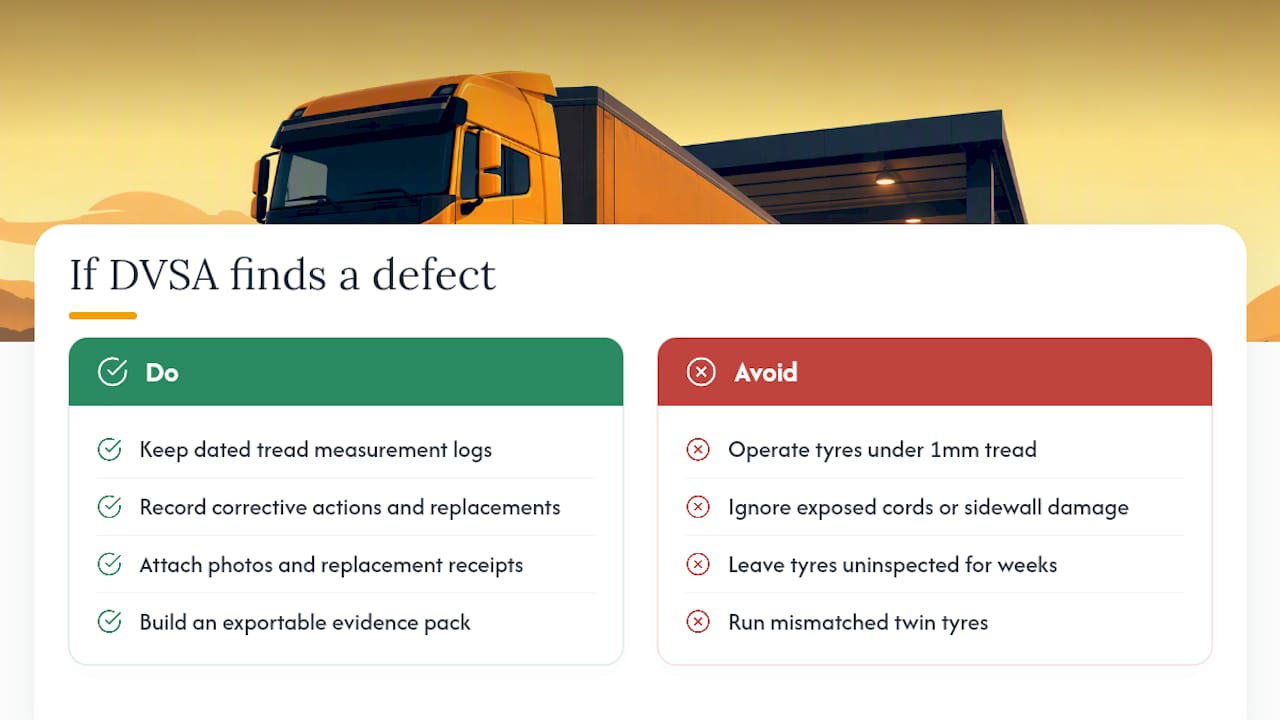
A tyre below 1mm, or one with exposed cords or sidewall damage, typically results in an immediate prohibition. The vehicle gets grounded on the spot, and the driver can’t continue the journey until the defect is fixed. Repeated tyre failures on an operator’s fleet draw attention from the Traffic Commissioner and can affect standing on your Operator Licence, including at renewal.
Inspectors look for the same things every time: measurable tread depth, sidewall integrity, and debris between twin wheels. The failures that come up again and again are avoidable ones, tyres left a few weeks too long, or a mismatched pair nobody caught.
The best defense is a clean paper trail. Keep dated measurement logs, records of corrective action, replacement receipts, and photos tied to each inspection. An exportable evidence pack built from that history is what turns a roadside question into a five-minute conversation instead of a detention.
Turning Tyre Checks Into Audit-Ready Evidence
Paper logs work until they don’t, usually right when an auditor asks for six months of history across forty vehicles. That’s the gap Operatorcompliance is built to close for hauliers running compliance on tight margins.
- Scheduled reminders flag tyres approaching your fleet’s replacement threshold before they hit the legal minimum
- Mobile checklists let drivers log tread readings and defects from the yard or roadside
- Photo evidence attaches directly to each inspection record, timestamped automatically
- Centralized logs pull every vehicle’s tyre history into one dashboard instead of forty separate notebooks
A typical workflow looks like this: a driver completes the daily walkaround on the app, flags a tyre nearing the threshold, the system raises a maintenance ticket, and once the tyre’s replaced, the whole chain, reading, ticket, receipt, gets bundled into an exportable pack ready for a Traffic Commissioner request. Explore how compliance software for hauliers handles this end to end, or check the full feature set built for transport managers running fleets of any size.
Where to Verify These Rules Yourself
Confirm the legal minimum directly through GOV.UK’s tyre defects guidance, daily check procedures via DVSA’s walkaround guidance, fleet policy templates from the FORS tyre management guide, and technical wear data from Michelin’s tread depth guidance.
The Real Problem Isn’t the Law, It’s the Gap Before It
The legal minimum for HGV tyres is clear enough that nobody should get caught out by the wording. What actually causes prohibitions and Traffic Commissioner scrutiny is the gap between the last measurement someone took and the moment a tyre quietly slips under 1mm. That gap is a scheduling failure, not a knowledge failure.
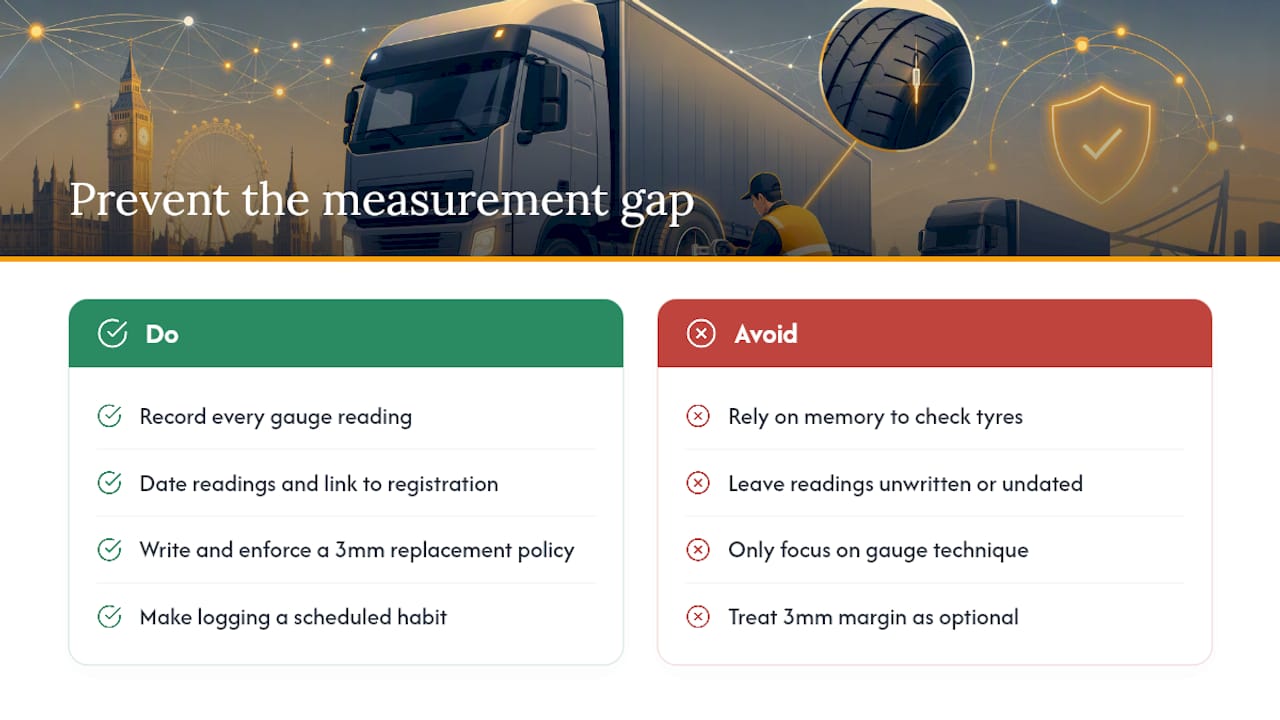
Most operators already know the 3mm safety margin exists. Fewer actually build a replacement policy around it, because writing the policy down and enforcing it against real vehicle schedules takes more discipline than knowing the number. The fleets that avoid roadside detentions aren’t the ones with the best drivers. They’re the ones whose measurement logs are boring, consistent, and complete, because nobody had to remember to check.
If there’s one place to spend effort, it’s not the gauge technique. It’s the log. A gauge reading that never gets written down, dated, and tied to a vehicle registration is worth almost nothing to an auditor six months later. Build the record-keeping habit first, and the tread depth compliance mostly takes care of itself.
— Vytautas
Sources
Recommended
hgv tyre tread depth