· 10 min read
OCRS Score Explained How DVSA Risk Scores Work
OCRS Score Explained for UK operators. Learn how DVSA calculates risk, what drives red and amber scores and how to monitor and improve yours.
A vehicle comes back from a routine delivery run. The driver says the roadside stop was quick, nothing dramatic, but it's the third DVSA stop your fleet has had in a short period. Your maintenance planner looks tidy. Your MOT dates are in hand. You're not seeing obvious chaos. So why does your operation seem to be getting pulled more often than the operator parked next to you?
That's usually the moment OCRS stops being an abstract acronym and starts becoming an operational issue.
For UK goods vehicle and PSV operators, OCRS sits in the background of enforcement targeting. It isn't a public scoreboard and it isn't a court finding. It is, in practical terms, part of how DVSA decides which vehicles are more likely to be worth a closer look. If you hold an operator licence, manage compliance, run a workshop, or carry the transport manager responsibilities yourself, that matters because extra stops create delay, expose gaps, and can pull a thread that leads into maintenance records, tachograph systems, driver management and, in the wrong circumstances, Traffic Commissioner scrutiny.
Many people get crossed up. They treat OCRS as if it were a single pass or fail mark. It isn't. The more useful way to think about it is as a time-weighted signal built from your recent compliance history and your encounters with enforcement and testing activity.
A practical OCRS score explained properly should help you answer four questions. What OCRS is. What events feed it. Why the score can stay stubborn for a while even after you improve. And what everyday controls, especially date-driven ones, move it in the right direction.
Table of Contents
- Introduction Why Your OCRS Matters Before DVSA Stops You
- What OCRS Is and How It Fits Operator Licence Compliance
- How DVSA Calculates Your OCRS Data Sources and Weighting
- Understanding OCRS Bands Thresholds and What Red Amber Green Mean
- What Drives Your Score Up Common Roadworthiness and Traffic Triggers
- How to Monitor and Reduce Your OCRS Step by Step
- Staying Audit Ready Evidence Packs and How OperatorCompliance Helps
Introduction Why Your OCRS Matters Before DVSA Stops You
A lot of fleets first pay attention to OCRS after a run of roadside attention. Not because anyone has had a dramatic prohibition, but because the pattern changes. A unit that would normally pass through the week unnoticed starts getting seen more often by enforcement.
That matters operationally before it matters legally. A roadside inspection can delay a load, unsettle a driver, and trigger extra internal work even when the outcome is clean. If the encounter uncovers defects, missing evidence, weak tachograph management or patchy defect reporting, the issue stops being a single stop and starts becoming a systems question.
OCRS is part of your real working day
For an operator, OCRS connects directly to the things that already sit on your desk:
- Vehicle and trailer dates: safety inspections, MOT or annual test planning, tax, and maintenance booking.
- Driver controls: licence checks, Driver CPC monitoring, tachograph card validity and induction records.
- Daily evidence: walkaround checks, defect reports, rectification notes and brake performance records.
- Ongoing review: tachograph analysis, sign-off, follow-up action, alerts and monthly compliance packs.
If those controls are weak, the score can reflect it over time. If they're strong and consistently evidenced, the score has cleaner material to work with.
Practical rule: OCRS rarely points to one isolated mistake. It usually points to a pattern in maintenance, drivers, records, or oversight.
Why new transport managers often find OCRS confusing
The confusion usually comes from two places. First, people mix OCRS up with an MOT result, a prosecution, or an operator licensing decision. Second, they assume that once a problem is fixed, the score should bounce back immediately.
Neither assumption helps. OCRS is better understood as a running risk picture. Recent events matter more than old ones, but old events don't vanish overnight. That's why a fleet can improve in the workshop and still sit in an uncomfortable place for a while.
If you're reading this because you've inherited a fleet, taken over compliance from a previous manager, or you're an owner-operator trying to tighten systems before the next DVSA contact, you need a view that is calm and practical. That's the point here.
What OCRS Is and How It Fits Operator Licence Compliance
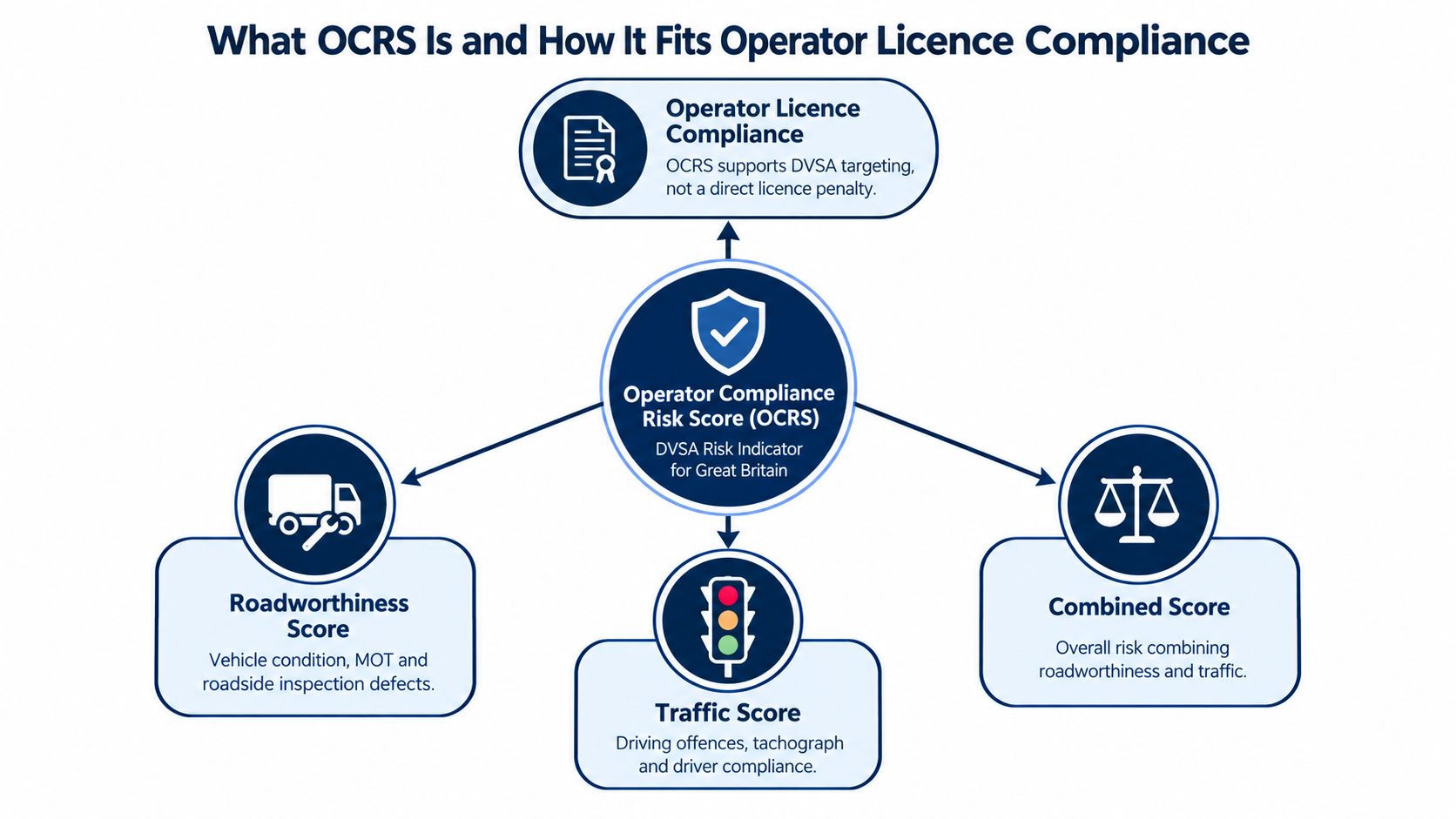
OCRS means Operator Compliance Risk Score. DVSA uses it in Great Britain to target which vehicles are more likely to be inspected. It is built from three linked outputs: a roadworthiness score, a traffic score and a combined score. The score is calculated over a rolling 3-year period, using a base score derived by dividing total offence or defect points by total encounters, and the system uses red, amber and green bands to indicate high, medium and low risk, as set out in DVSA guidance on using the OCRS system.
What OCRS is not
This is where a lot of unnecessary worry starts. OCRS is not:
- An MOT result: a vehicle can pass a test and the operator can still have wider OCRS issues.
- A prosecution: the score is a risk indicator, not a criminal outcome.
- An Earned Recognition badge: it's separate from that framework, although operators often compare the two. If you need that distinction laid out plainly, this guide on OCRS and Earned Recognition is a useful companion.
- A public league table: it's not there for customers to browse and rank you.
A simple analogy helps. Think of OCRS as a risk thermometer. It rises when the system sees compliance events that cause concern. It cools when your record improves and your encounters are cleaner. It isn't a one-off verdict.
How it sits alongside operator licence duties
Your operator licence undertakings don't disappear into OCRS, but they do connect to it in day-to-day practice. If you've undertaken to keep vehicles fit and serviceable, observe drivers' hours rules, and keep proper records available, the quality of those controls influences the sort of encounters DVSA sees.
That's why OCRS matters to more than the transport office. Workshop planners, fleet engineers, drivers, administrators and external maintenance providers all affect the evidence trail. A missed inspection date, a poor walkaround culture, weak tachograph follow-up or missing documents can all create an enforcement picture that doesn't match the story you think your business is telling.
OCRS is best read as a signal to investigate. It tells DVSA where to look, and it should tell you the same.
How DVSA Calculates Your OCRS Data Sources and Weighting
The calculation matters because it changes how you respond. If you think OCRS is just a list of punishments, you'll only react to bad news. If you understand the mechanics, you'll manage the flow of evidence and encounters more intelligently.
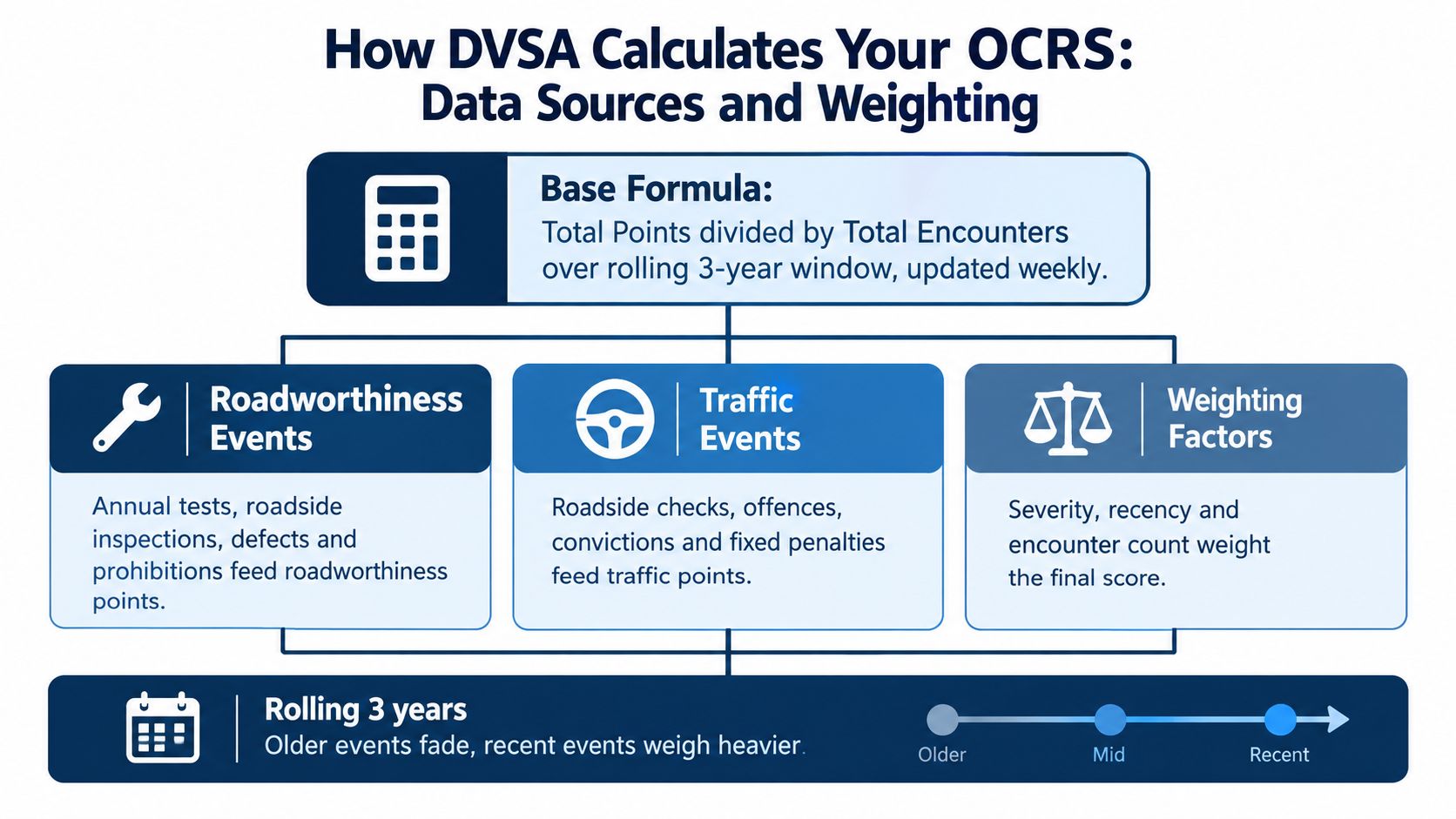
The government's current guidance states that the OCRS framework uses specific event types to populate each score. The roadworthiness score draws on vehicle tests, MOTs, roadside inspections, site visits and desk-based assessments. The traffic score draws on roadside inspections, prosecutions, weighing checks, site visits and desk-based assessments. The same guidance also states that an operator with a high OCRS is more likely to have vehicles inspected, and explains time decay in the score: after 12 months a score falls by a quarter, and then it is halved in the final 12 months. That guidance appears in GOV.UK's explanation of how you're scored.
What goes into each score
The two main score families reflect two different parts of compliance.
| Score type | What feeds it |
|---|---|
| Roadworthiness | Vehicle tests, MOTs, roadside inspections, site visits, desk-based assessments |
| Traffic | Roadside inspections, prosecutions, weighing checks, site visits, desk-based assessments |
| Combined | The overall view built from the other two |
This is why OCRS can feel awkward to diagnose if you only look at one department. A workshop might have tightened defect rectification, while the traffic side still shows problems in driver hours, loading or tachograph management. The combined view doesn't care which internal team owns the issue. It reflects the operator.
Why recency matters more than history alone
A common mistake is to ask, “How do we clear the score?” That wording suggests a reset button. OCRS doesn't work like that. It behaves more like a weighted timeline.
An older event still matters within the rolling period, but its effect reduces with age. That creates two practical consequences:
- Recent poor events bite harder.
- Sustained clean performance matters more than one good month.
So if your fleet had a cluster of defects, prohibitions or traffic issues, a burst of housekeeping next week won't make the score forget. But it does start the cooling process.
A short explainer can help if you want to show this internally:
Why encounter count matters in practice
Because the base score is built around points against encounters, operators need to think about both sides of the equation. The focus usually goes on avoiding points, which is sensible. But clean encounters also matter because they contribute to the wider picture DVSA sees.
That doesn't mean chasing inspections. It means making sure that when the fleet is seen, whether at roadside, test, site visit or desk review, the records and standards hold up. In practical fleet terms, your PMI planner, walkaround reporting, brake evidence, tachograph controls and sign-off discipline all shape what those encounters become.
Understanding OCRS Bands Thresholds and What Red Amber Green Mean
Most operators don't struggle with the colours themselves. Green sounds good, red sounds bad. Confusion comes from what the bands mean in enforcement terms.
These bands are risk indicators, not verdicts
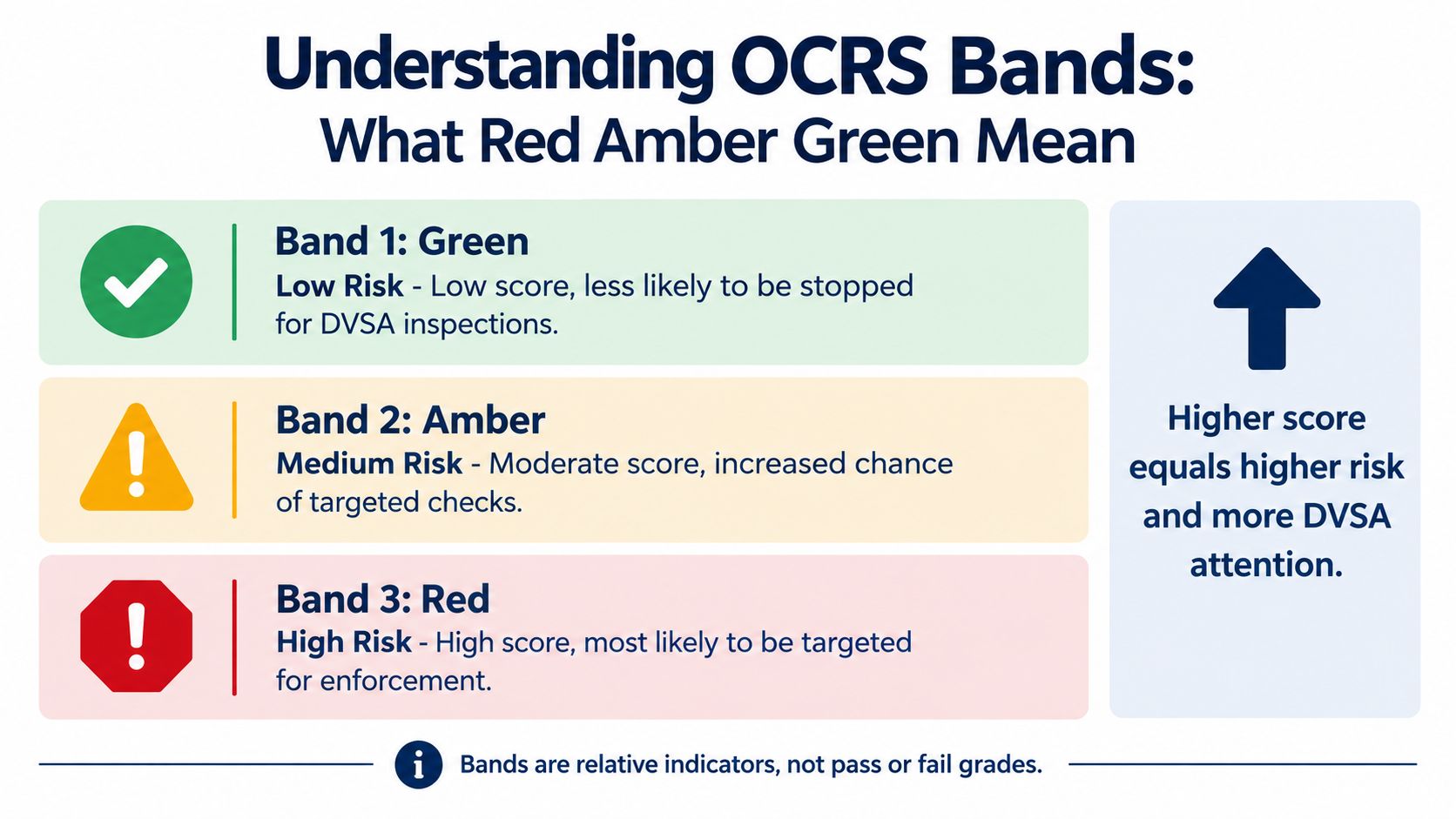
The red, amber and green bands indicate high, medium and low risk within the OCRS system, as covered earlier from DVSA's OCRS guidance. In plain language, a higher-risk band means DVSA is more likely to see your vehicles as worth stopping.
That's the practical meaning to keep in mind. A red band doesn't by itself prove unlawful operation. A green band doesn't mean you can stop paying attention. The bands help direct enforcement attention.
An amber band often frustrates operators most. It can reflect genuine improvement that hasn't had enough time and enough clean operational evidence to shift the overall signal.
Why scores can feel slow to improve
Transport managers often get challenged by directors. “We fixed that months ago. Why are we still amber?” The answer sits in the time-weighted nature of the system.
A score can remain high because older events still sit within the rolling window and taper away gradually. That creates a long tail. So a fleet that now has tighter maintenance control, stronger driver oversight and better records may still carry the shadow of earlier failures.
That doesn't mean the changes aren't working. It means the score is behaving exactly as a risk measure should. It is looking for consistency, not a short burst of tidy paperwork.
How to read movement sensibly
Don't read the band in isolation. Read it against operational reality:
- If the band worsens: look for recent defects, roadside findings, missed dates or unresolved tachograph issues.
- If the band holds steady despite improvements: check whether old events are still decaying through the system.
- If the band improves: don't assume the work is finished. Keep the controls in place that produced the cleaner result.
For management reporting, the useful question isn't “Are we green yet?” It's “What is our current risk picture telling us about control quality?”
What Drives Your Score Up Common Roadworthiness and Traffic Triggers
If you want an OCRS score explained in a way that helps you act, this is the part to keep close. The score only becomes useful when you connect it to the daily causes behind it.
Roadworthiness issues usually start with planning and evidence
On the roadworthiness side, operators often get caught by a mix of mechanical condition and weak paperwork. The workshop may have done the repair, but if the evidence is thin or the inspection discipline is inconsistent, the operator still has a problem.
GOV.UK's maintenance guidance says safety inspection records for commercial goods and passenger-carrying vehicles must be kept for at least 15 months, including vehicles sold, removed from the operator licence or otherwise disposed of. The record must also include any defect report, the rectification work and the repairer, and a signed brake-performance printout should be attached to the inspection record, as stated in the
ocrs score explainedDVSA OCRSoperator compliancefleet compliancetransport manager