· 10 min read
Operator Licence Check: A Practical UK Compliance Guide
Run a proper UK operator licence check using the DVSA register. Covers evidence, driver checks, tachograph links and audit-ready records.
A Tuesday morning roadside check rarely starts with a dramatic failure. The examiner asks for the operator licence number, the driver's documents, the vehicle records and the name of the Transport Manager. If the answer is buried in an inbox, the maintenance evidence sits in a workshop folder and the tachograph analysis hasn't been signed off, a licence that looks valid on paper can still leave uncomfortable questions.
A proper operator licence check is a recurring control loop. It connects the live DVSA register with driver entitlement, Driver CPC, tachograph records, maintenance dates, defect reporting and documented management action. The point isn't to create another spreadsheet. It's to leave a clear trail showing what was checked, by whom, when it was checked, what failed and what happened next.
Table of Contents
- What an Operator Licence Check Actually Covers
- Using the DVSA Public Register Step by Step
- Evidence the Licence Check Must Support
- Driver and Tachograph Card Checks Behind the Licence
- Tying Tachograph Downloads and Analysis into the Loop
- Using Enforcement Data as a Feedback Signal
- A Repeatable Cadence and a Practical Next Step
What an Operator Licence Check Actually Covers
At the roadside, the licence number is only the starting point. The operator must be able to show that the business is operating within its authority and that the systems supporting the licence are active, understood and evidenced.
Under UK operator licensing rules, anyone using goods vehicles over 3,500 kg gross weight in business must hold an operator's licence. The licence continues every five years only when the operator pays the relevant fee and confirms the operation's details to the Traffic Commissioner. DVSA guidance also expects licence holders to maintain systems for the safe and legal operation of vehicles under the licence, which is why a register lookup alone is inadequate. See the GOV.UK guide to maintaining roadworthiness for the underlying maintenance expectations.
Start with the licence type
Your control loop must identify whether the operation holds:
- Standard National, for qualifying UK operations.
- Standard International, where the licence supports the relevant international work.
- Restricted, where the operator's authority is limited to the circumstances allowed by that licence.
The evidence loop applies to all three. The detail and risk profile may differ, but each operator still needs a reliable record of its authority, operating arrangements, vehicle control and management oversight.
The nominated Transport Manager, where one is required, should own the master check. A CPC-qualified Transport Manager can delegate collection of documents, but shouldn't delegate responsibility for knowing whether the evidence is complete and credible. Pull the operator record from the DVSA-backed register every week, reconcile it against the internal operator file, then review exceptions rather than just marking a task complete.
Practical rule: A paper file can contain every document and still fail if nobody can explain the checking cadence, the exceptions or the corrective action.
The operator licence undertakings guidance is useful when mapping each undertaking to an owner and an evidence source. The rest of the process should follow that map, moving from the live licence record to the people, vehicles and records operating beneath it.
Using the DVSA Public Register Step by Step
A vehicle can be ready for dispatch while the operator record is wrong. The GOV.UK operator licence search service should therefore be the starting point for each review. The DVSA-backed national register is updated weekly and provides the authoritative GB dataset for goods and public service vehicle operator licences. Treat an internal spreadsheet as a working copy, not the final authority.
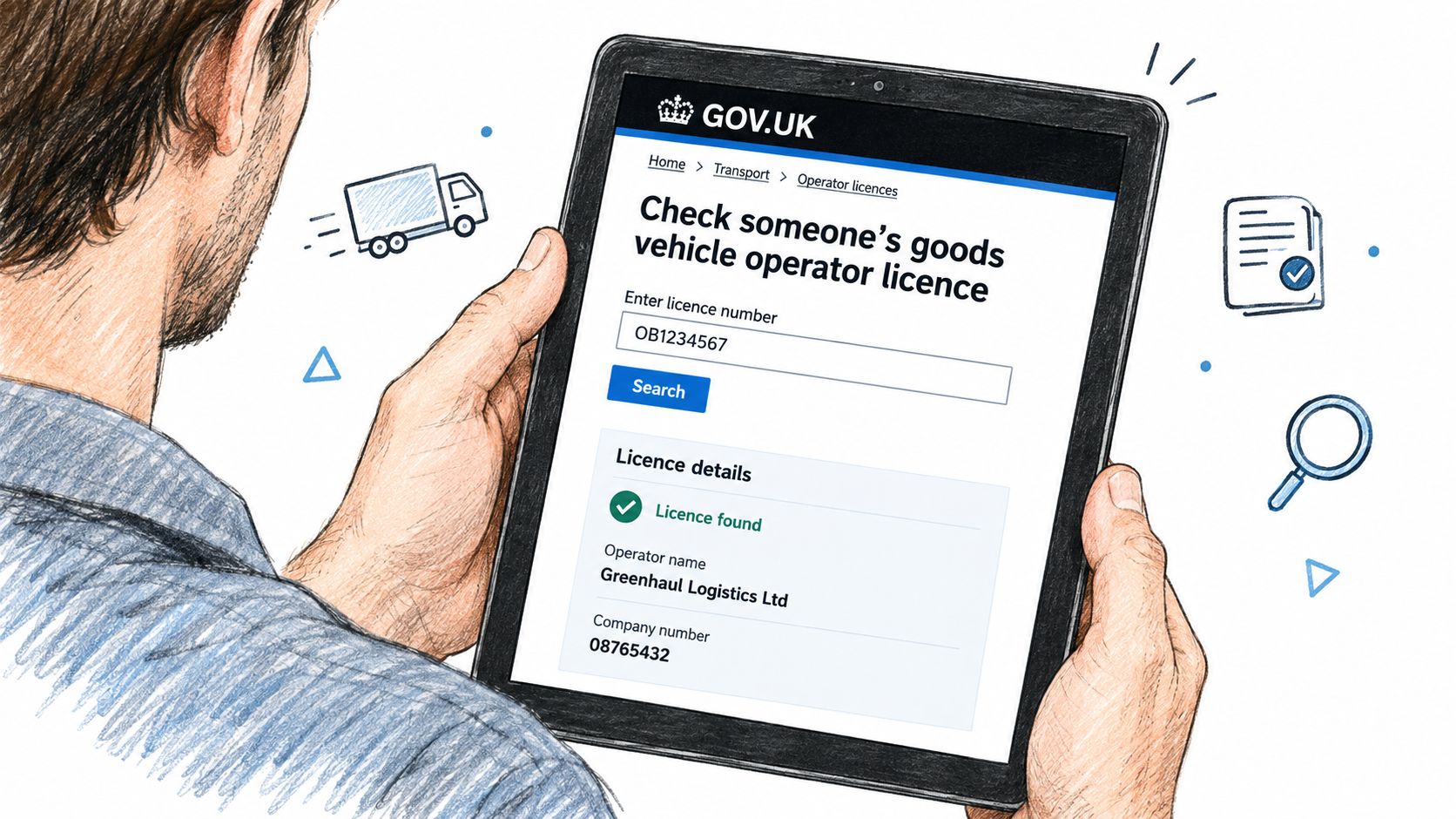
Use licence number OB1234567 only as an internal training reference. It is not a live record. For the actual search, save the fields that can change the operation:
- Legal operator name and company number: match both against Companies House. A trading name, parent company or former legal entity can leave the wrong business attached to the fleet.
- Operating centre: compare the registered address with the yard in use. A move, extra yard or informal parking arrangement may require formal action.
- Licence type, issue date and status: record the register entry and compare it with the operator's certificate.
- Vehicle authority: check the authorised total against the current fleet snapshot. Fleet growth must not exceed that authority.
- Trailer authority: record it separately. Trailer numbers are easily missed when the file focuses on powered vehicles.
- Transport Manager nomination: confirm that the named person is current and that internal responsibilities match the nomination.
Save the result as a PDF or another fixed record, including the date, time, licence number and name of the person who completed the search. That capture records what the operator knew at the time and gives the next review a clear comparison point. Repeat the check weekly, then investigate changes rather than closing a task because the search was completed.
A blank or mismatched result may indicate expired authority, an incorrect business name or another company operating the vehicles. A new trading address, former Transport Manager, reduced vehicle authority or dormant status needs prompt investigation. Changes affecting operator licence undertakings must be notified to the Traffic Commissioner within 28 days. An increase in authority or an operating-centre change may require a variation, not an informal fleet-file edit. The GOV.UK goods vehicle operator licensing guide explains the formal framework.
Keep the register capture with the related driver, tachograph and maintenance evidence. The value of the check is the audit trail created when those records agree, or when an exception shows who acted and why. For adjacent vehicle-history work, a fleet administrator can use a used car check with Digital Footprint Check, but it does not verify legal authority on the DVSA register.
Evidence the Licence Check Must Support
A register entry can look correct while the operator's evidence is weak. The licence grants authority, while maintenance, driver and management records show whether the operator is meeting its undertakings. A useful check therefore follows one trail from the DVSA register to the records that support continued compliance.
Start with a written maintenance inspection schedule. It should reflect the actual operation and follow the inspection principles in the DVSA guidance, including the relevant Annex VI frequencies. Every vehicle and trailer needs a planned next inspection date, a named maintenance provider or workshop owner, and a defined response when work becomes overdue. The operator licence maintenance-record guidance sets out the supporting evidence expected alongside completed inspection reports.
A defect record should make the vehicle's status clear at every stage:
- Defect reported: The driver records the issue during the daily walkaround or when it becomes apparent.
- Vehicle controlled: The operator decides whether the vehicle is withdrawn, restricted or allowed to continue under a suitable control.
- Repair raised: A repair order identifies the defect and required work.
- Repair completed: The workshop records the work carried out and the person who completed it.
- Walkaround re-checked: The driver or another competent person confirms that the vehicle is suitable before use.
Keep related brake-testing reports, wheel-fixing retorque records and other supporting documents with the inspection report. Safety inspection records must be retained for at least 15 months, including records for vehicles removed from the operator licence, as confirmed by DVSA maintenance investigation guidance.
Drivers' hours records provide another test of whether the system operates in practice. The applicable EU and GB tachograph rules cover driving, breaks, rest and recording, including the 4.5-hour driving break requirement and daily rest arrangements involving 9 or 10 hours, depending on the permitted pattern. Where working time arrangements depend on an opt-out, file the signed document with the driver's compliance record rather than relying on payroll to produce it later.
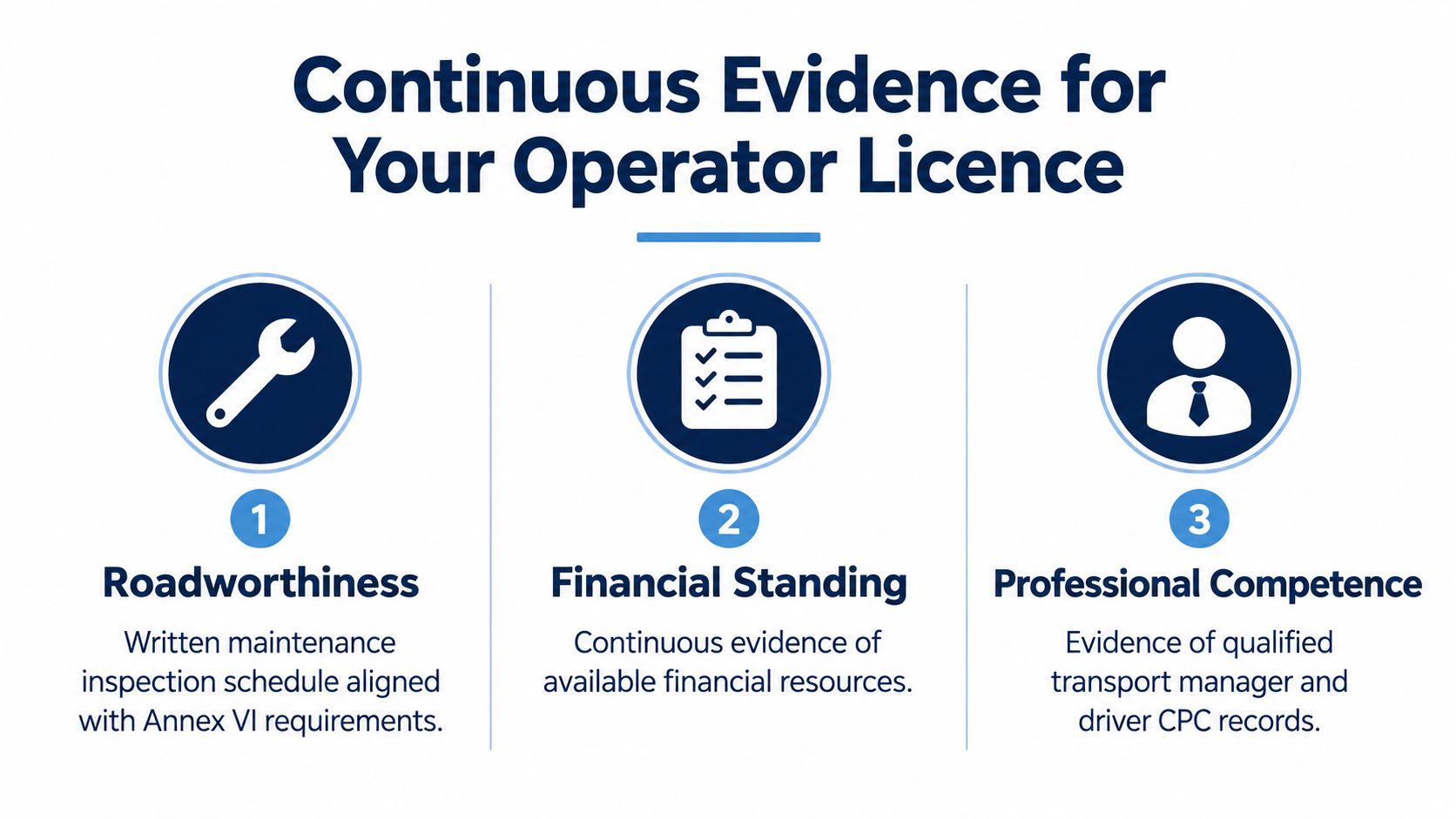
Keep drivers' hours and related records for 15 months. Any change affecting the undertakings, including maintenance and safety inspection arrangements, must be notified to the Traffic Commissioner within 28 days, as reflected in the Traffic Commissioner operator-licensing undertakings material.
The register shows what the licence allows. The evidence shows whether the operator remains fit to hold it.
Driver and Tachograph Card Checks Behind the Licence
A clean register entry doesn't help if the operator can't produce reliable evidence for the driver sitting in the cab. For each named vocational driver, keep a retrievable record covering the driving licence, Driver CPC status where applicable and digital tachograph card.
The first check is the GB photocard driving licence. Confirm that the categories match the vehicle being driven, such as C, C+E, C1 or C1+E. Then check the Driver CPC card where the role requires vocational qualification, followed by the current digital tachograph driver card. These documents answer different questions, so one shouldn't be treated as proof of the others.
Use the right verification route
The GOV.UK share driving licence service allows the driver to obtain a check code so the operator can view current entitlement information. Use the code to verify categories, endorsements, medical expiry information and relevant accumulation. The code is temporary evidence usable for 21 days, so store the result and retain a copy of the underlying licence information rather than treating the code as a permanent record.
For larger fleets, DVLA Access to Driver Data can support continuous entitlement monitoring once the operator has the required approval, consent and setup. Don't describe that as automatic by default. The service depends on the operator's approved arrangement and documented mandates.
A risk-banded cadence is more defensible than applying the same review to every driver:
| Risk band | Photocard / categories | Driver CPC | Tachograph card |
|---|---|---|---|
| Standard | Annual entitlement review, with evidence retained | Check current status and expiry | Check validity and record the date |
| Increased | Review every six months where the driver is approaching CPC expiry or has recent endorsements | Confirm expiry planning and action | Confirm card validity and download control |
| Elevated | Review every three months for a driver under an operator review condition or returning after absence | Record the reason for tighter oversight | Reconfirm card status before allocation |
Log the reason for the selected cadence in the compliance file. The Transport Manager should approve exceptions, while line managers must stop allocation when the evidence is missing or expired.
Tying Tachograph Downloads and Analysis into the Loop
A downloaded tachograph file has little evidential value until someone can show when it was obtained, how it was assessed and what followed. The control loop must connect driver and vehicle data with named decisions, so a Traffic Commissioner can trace the record from download to corrective action.
The regulated cycle requires driver card downloads every 28 calendar days and vehicle unit downloads every 90 calendar days, with the download day counted as day one. Retain tachograph data for 12 months. Keep a fallback process for periods when a vehicle unit has no driver card inserted. The GOV.UK drivers' hours and tachographs guidance sets out the applicable rules.
Use a controlled workflow, with a separate record for each stage:
- Download: Save driver-card and vehicle-unit files in a controlled location. Record the download date, driver or vehicle identifier, and any exception or failed attempt.
- Analyse: Assess driving time, breaks, rest, working time and periods of availability against the applicable rules. Produce an infringement report for each relevant driver and vehicle unit.
- Remediate: Send the finding to the driver, record the explanation and agreed corrective action, and obtain dated sign-off. Repeated issues require escalation, not another silent filing.
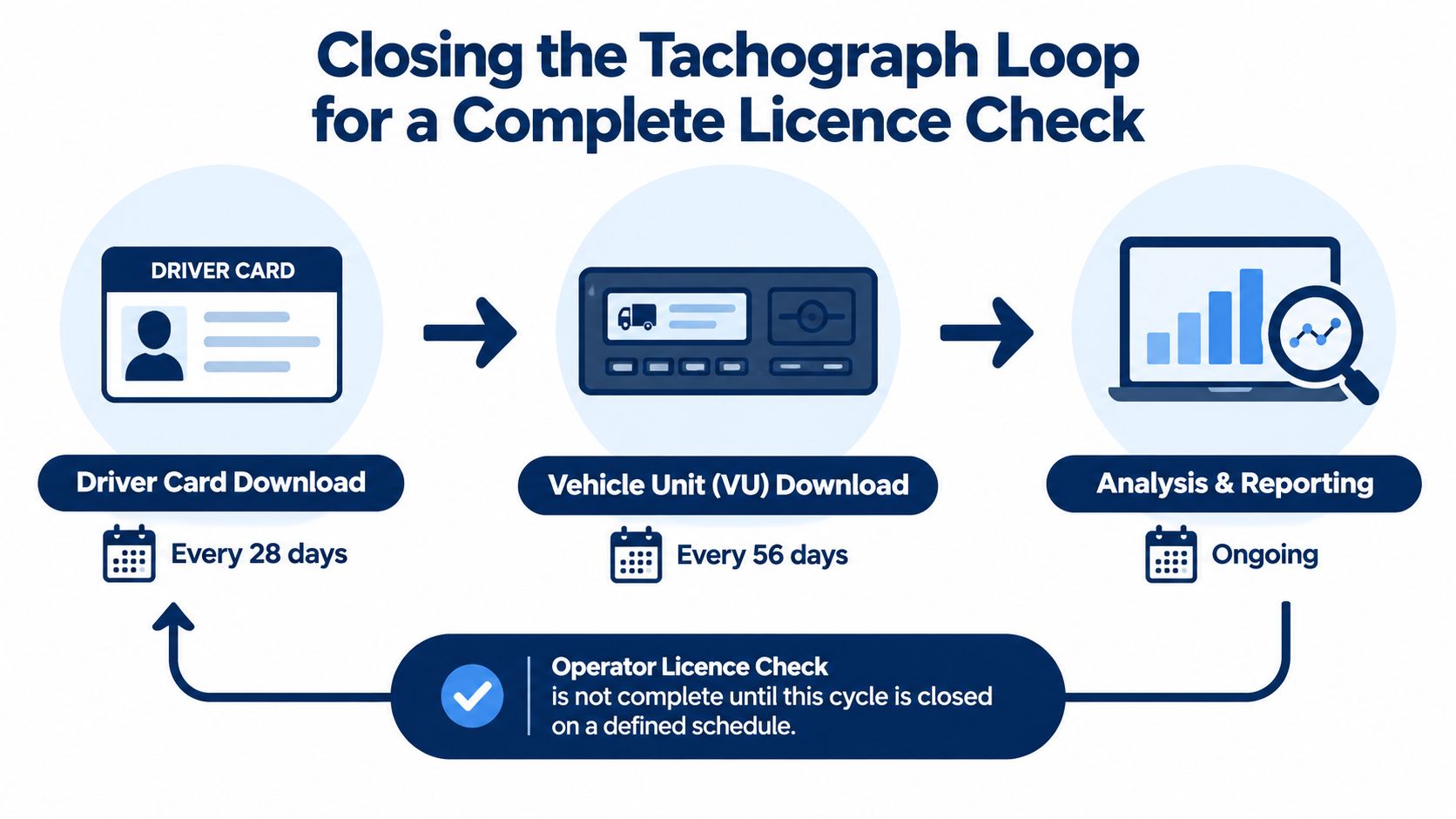
At a Traffic Commissioner hearing, an analyst's report carries more weight when it identifies the driver, period, infringement, explanation, action owner and completion date. If tampering is suspected, retain recalibration evidence. Tachograph units require recalibration every two years, or sooner after repair where that applies.
Review unresolved infringements as a trend, not as isolated events. A driver with uncleared infringements for two consecutive periods should trigger an interim compliance review. That pattern does not prove operator-level failure, but it shows the loop is not closing and requires management attention. A defined tachograph analysis software workflow can organise ingestion, review and sign-off. It does not replace the operator, Transport Manager or tachograph analyst.
Using Enforcement Data as a Feedback Signal
Enforcement data is the feedback signal behind the licence check. It tells the operator whether internal controls are preventing defects, hours offences and overloading issues from reaching roadside checks and site visits.
Start each week by pulling the live register entry for the operator and any linked entity. Compare the legal name, operating centre, vehicle and trailer authority, Transport Manager nomination and licence status against the internal file. Save the result in a date-stamped folder and assign every mismatch to a named owner.
DVSA's annual operator-level road-safety offence publication covers roadside checks and site visits, including mechanical defects, drivers' hours, overloading and fines. Use the DVSA operator road-safety offences data as an intelligence layer, not as a replacement for current operational records.
Read the two signals together
| Signal | What it tells you | Lead time before public inquiry |
|---|---|---|
| Register unchanged | The public authority appears stable | It doesn't sh |
operator licence checkDVSA registerUK haulage compliancetransport manageroperator licence undertakings