· 11 min read
POA Tacho Symbol: A UK Operator Compliance Guide
POA tacho symbol explained for UK operators - what the Period of Availability means, when it applies, and how to evidence it during a tachograph review.
A Monday morning download can turn up a surprisingly awkward question. The transport manager sees a square crossed by a diagonal line on a driver's activity record and needs to decide whether it represents a genuine waiting period, incorrectly recorded work, or an attempted way to make the day appear more compliant than it was.
That symbol is Period of Availability, usually shortened to POA. It has a legitimate place in UK haulage and passenger transport, but only when the circumstances support it. The important work starts after recognising the icon. You need to understand why it was selected, what the driver was doing, and which records prove that the entry reflects the journey.
Table of Contents
- What the POA Tacho Symbol Looks Like on a Driver Card
- The Three-Part Legal Test for Period of Availability
- When the Symbol Is Used Correctly in UK Depot Operations
- Evidence to Keep When a POA Block Appears
- Where POA Goes Wrong and Why Misuse Persists
- Connecting POA to Your Wider Operator Licence Controls
- Using Compliance Software to Review POA Patterns and Act
What the POA Tacho Symbol Looks Like on a Driver Card
The POA tacho symbol is a square with a diagonal line running through it. On a digital tachograph activity display, it sits alongside the more familiar symbols for driving, rest or break, and other work. The driving icon is represented by a steering wheel, rest uses a bed, and other work commonly appears as crossed hammers or a wrench-style activity symbol.
The POA icon can be easy to overlook because it appears less often in routine depot work. It may appear in the daily activity timeline on a printout as a distinct block, or in the on-screen card view when the driver scrolls through recorded activities. Depending on the tachograph software or analysis display, manually entered activity and downloaded recorded blocks may use different colours, so the colour is a visual aid rather than the legal test.

A printout shows activity as a timeline, with the relevant symbol over the period to which it relates. That makes the surrounding activities important. A POA block immediately after driving, followed by other work, may tell a different story from a block that matches a documented ferry booking or planned crew change.
For a practical introduction to the symbols, timelines and activity bars, use this guide to reading a tachograph printout. The useful question isn't “Which icon is this?” Ask instead, “What was the driver required to do during this period?”
In plain English, POA means waiting time whose duration is known in advance, during which the driver isn't working but must remain available to resume duties. GOV.UK guidance gives examples including accompanying a vehicle on a ferry, waiting while other workers load or unload, and sitting beside the driver during a team-driving arrangement. It also makes clear that POA does not count as a break or rest period.
The Three-Part Legal Test for Period of Availability
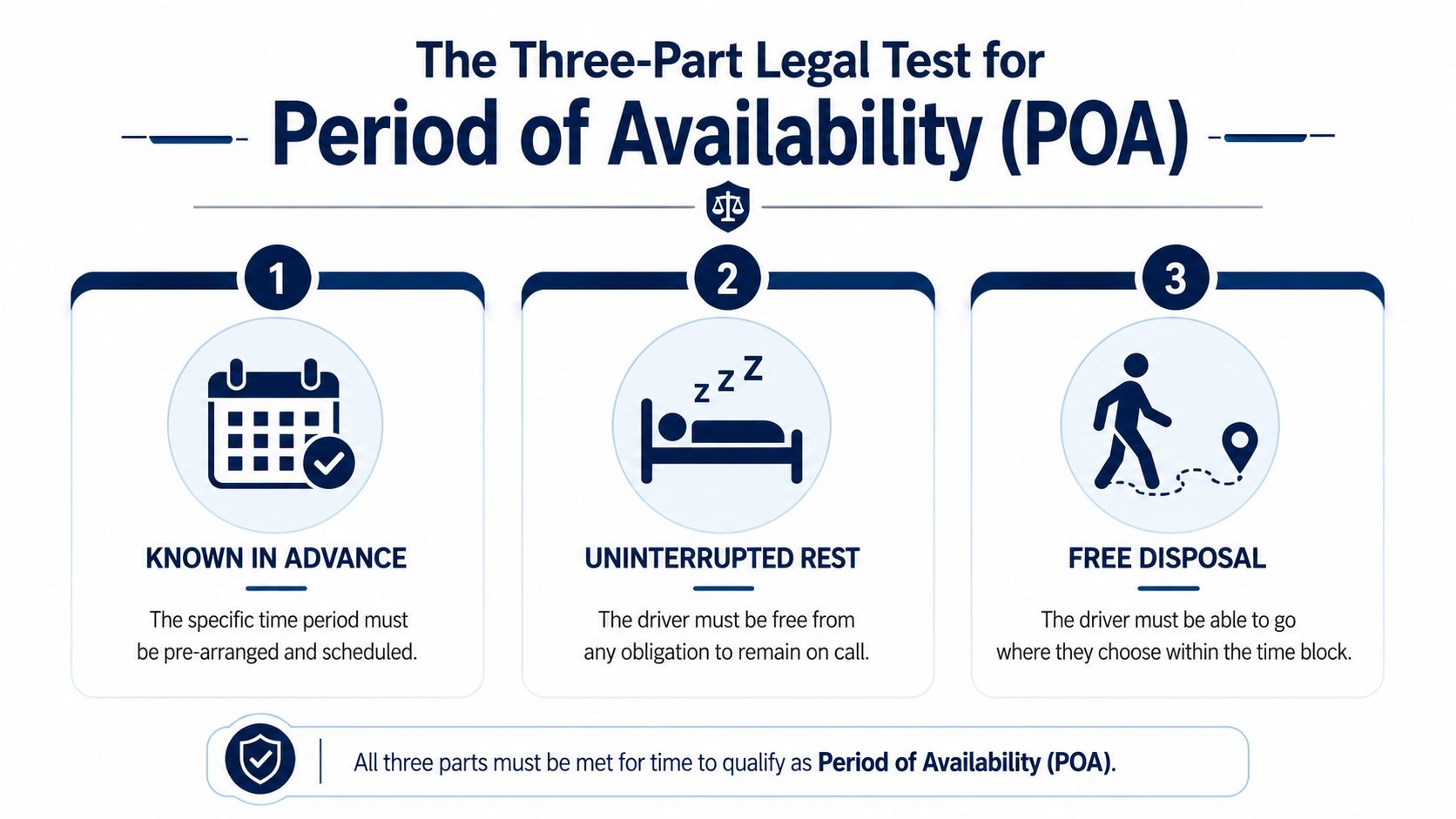
A POA entry needs more than a stationary vehicle and a driver who isn't turning a wheel. Treat it as a three-part test. If one part fails, the period needs to be considered under another activity category.
The duration must be known in advance
The driver must know the expected duration before departure or before the period begins. A confirmed ferry crossing, booked loading window or planned handover can support this limb. An RDC clerk saying, “Wait there and we'll call you when we can,” doesn't establish a known duration.
The wording matters because POA isn't a general code for inconvenience. A delay can last a long time and still be other work if nobody could tell the driver how long it would last at the outset.
The driver must not be working
During POA, the driver can't be loading, unloading, completing delivery paperwork, supervising an operation that requires active involvement, checking the vehicle or carrying out another employer task. Those activities belong in other work.
A driver who waits beside a bay for a known slot may have a POA period before the slot starts. If they then help move pallets, check load security or complete paperwork, that activity must be recorded accurately rather than left inside the POA block.
The driver must remain available
The driver must be available to resume work when required. That doesn't mean the driver is carrying out work throughout the wait. It means they can't treat the time as completely their own rest period while being unavailable for the planned resumption of duties.
Practical rule: A POA entry must make sense from the driver's point of view and from the paperwork. If the driver couldn't explain when work would restart, the entry is difficult to defend.
The official UK position is especially important here. POA isn't a break or rest period, so it doesn't reset rest obligations in the way genuine rest does. The three limbs must be supported by the actual circumstances and the available evidence, not solely by the symbol selected on the tachograph.
For a broader explanation of drivers' hours categories, use this tachograph rules guide.
When the Symbol Is Used Correctly in UK Depot Operations
The cleanest way to understand POA is to compare a defensible wait with a similar-looking wait that fails the test.
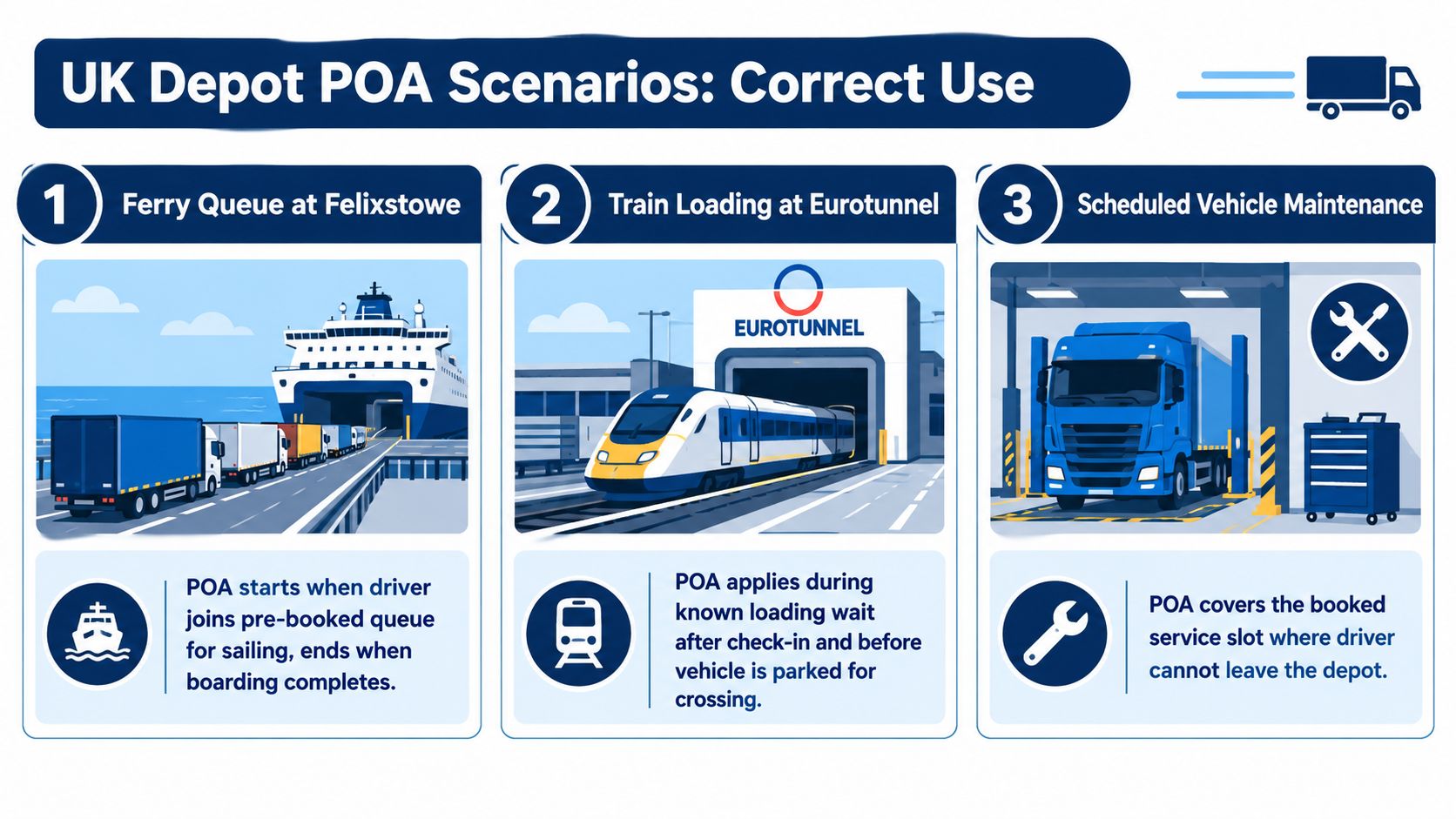
At Felixstowe, a driver joins a queue for a pre-booked ferry sailing. The sailing time and expected crossing are known before the wait begins. The driver isn't loading, completing paperwork or carrying out checks, and remains available to move the vehicle when instructed. The three limbs are present, so POA may be appropriate for the qualifying waiting period.
The same port scenario changes if the sailing has been missed and the driver is told only to wait for the next available space. The duration is now uncertain. If the driver starts checking documents, securing freight or assisting port staff, the activity also becomes work rather than POA.
A national retailer's RDC gives a driver a confirmed delivery slot. The driver arrives, parks as directed and waits near the vehicle until called forward. The booking supports the known duration, the driver isn't working during the wait, and they remain available for the next instruction. That is the sort of operational detail an analyst should look for before accepting the entry.
If the driver has no confirmed slot and the warehouse says the bay is unavailable, the same parked vehicle doesn't automatically qualify. Nor does a driver qualify while completing delivery notes or supervising loading. Those actions need their own activity treatment.
Team driving creates another familiar example. The second driver sits beside the driver during a planned run, isn't operating the vehicle, and is ready to take over at the agreed point. GOV.UK identifies this type of arrangement as a POA example where the duration and circumstances are known in advance.
A meal at a truckstop is different. The driver isn't available to resume duties in the same way and is using the time for recuperation. It should not be relabelled as POA because the vehicle is stationary.
For a visual example of the operational situations commonly discussed around POA, review the following video:
The same discipline applies at ports, terminals and depots. A planned wait can be POA. An unknown delay, active task or genuine rest period needs a different classification.
Evidence to Keep When a POA Block Appears
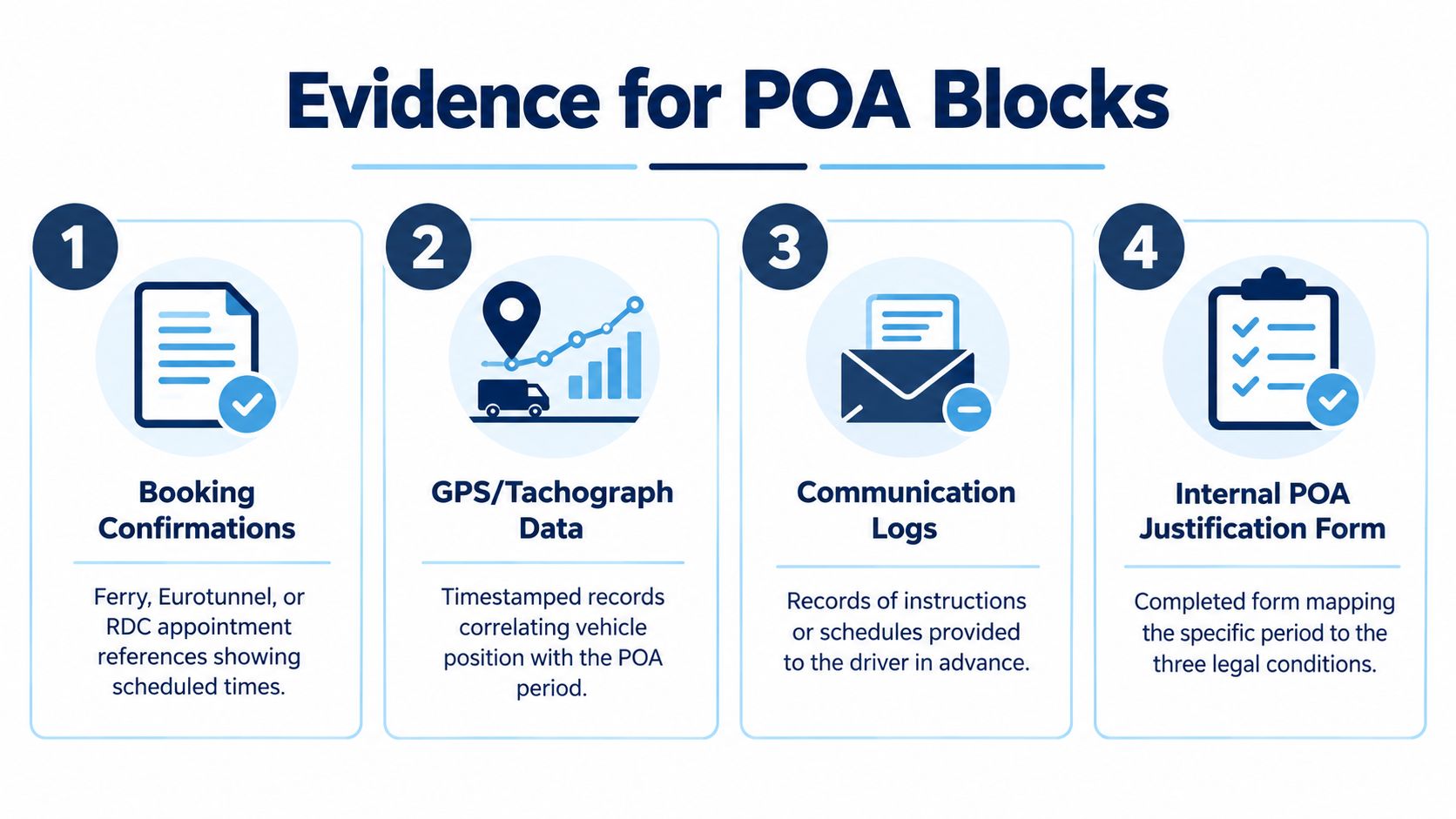
A POA block should arrive at sign-off with a short explanation and supporting evidence. The transport manager's job isn't to collect paperwork for its own sake. Each document should answer one part of the legal test.
Start with the schedule. Keep the ferry booking, sailing reference, Eurotunnel information, RDC appointment or crew rota that shows what was expected before the period began. This helps establish that the duration wasn't guessed retrospectively.
Then match the event to the vehicle record. Gate arrival times, depot access records, tachograph printouts and relevant journey data can show whether the vehicle was where the driver said it was. A GPS record can support the timeline, but it doesn't by itself prove that the driver wasn't working.
A concise driver statement is useful where the raw data leaves a question. It should state what the driver was waiting for, when they were told the expected duration, whether they carried out any work and how they remained available. Keep it factual, dated and linked to the specific journey.
A practical review file
Before sign-off, assemble:
- The tachograph record: Identify the POA start and finish, surrounding driving and other activities.
- The booking evidence: Attach the relevant sailing, rail, RDC or scheduled crew reference.
- The operational timeline: Record arrival, check-in, call-forward and departure details.
- The driver explanation: Clarify anything the downloads can't show.
- The reviewer decision: Note why the three conditions are accepted, queried or corrected.
This evidence should sit within the operator's wider audit trail, not in an analyst's private inbox. A useful resource on organising defensible records is this audit trail compliance guide, particularly when several people contribute to review, correction and sign-off.
Traffic Commissioner expectations extend beyond tachograph selection. Operators must maintain vehicles and trailers in a fit and serviceable condition, operate an effective defect-reporting process and retain complete maintenance records. A Traffic Commissioner decision involving Richard Thomas Lusher Ltd shows that these undertakings are operationally material, not optional administration, as set out in the published Traffic Commissioner decision.
Where POA Goes Wrong and Why Misuse Persists
POA becomes risky when a fleet treats it as a productivity cushion. Long, repetitive blocks that appear at similar points on many journeys, entries immediately before or after driving, and periods with no booking or operational explanation deserve closer review.
Delivery pressure explains why the habit develops. A driver waits at an unknown bay, the planner wants the day to fit, and someone later selects POA because “waiting” feels less serious than work. That shortcut creates a record that may not match what happened.
The most challengeable patterns are usually:
- Long repeated blocks: Similar POA periods recur without matching appointments or sailing schedules.
- Off-pattern placement: POA appears just before driving or beside another activity in a way that seems designed to improve available time.
- Missing evidence: The card shows POA, but nobody can produce a booking, rota or driver explanation.
- Mixed activity: Paperwork, loading or vehicle checks sit inside an otherwise uninterrupted POA block.
| Pattern on Card | Why It Fails | Evidence Expected | Examiner Question |
|---|---|---|---|
| Repeated long POA blocks | The entries may reflect a routine coding habit rather than known waiting periods | Booking or schedule records matching each event | What fixed the duration before each wait began? |
| POA beside driving | The block may be being used to create the appearance of additional available time | Journey plan and operational timeline | What happened between the two activities? |
| POA during active loading | Loading and supervision are work | Bay records, defect or loading paperwork, driver account | Was the driver actually free from work? |
| Unexplained terminal wait | An unknown delay doesn't meet the known-duration limb | Gate times and contemporaneous instructions | When was the expected finish communicated? |
An analyst should challenge the record while the driver, planner and depot can still explain it. Silence isn't evidence that the entry was correct.
Connecting POA to Your Wider Operator Licence Controls
POA review belongs inside the operator-licence control system. It shouldn't sit in a separate spreadsheet that nobody checks until an audit is announced. The entry can affect tachograph analysis, working-time calculations, driver discussions and the evidence supporting the transport manager's management system.
The download calendar is the first control. GOV.UK says vehicle-unit data should be downloaded at least every 90 calendar days, and driver-card data at least every 28 calendar days, with additional downloads needed before a vehicle is transferred or a driver leaves. The same guidance states that the vehicle unit holds an average of 365 days of data and the driver card holds an average of 28 days before the oldest data is overwritten. These intervals should be monitored with named responsibility and overdue escalation through the official vehicle operator responsibilities guidance.
Put the decision into the compliance pack
A useful monthly pack should show:
- Download status: Which driver cards and vehicle units were received, reviewed or overdue.
- POA exceptions: Blocks that lack a booking, show unusual repetition or need clarification.
- Infringement sign-off: The named manager's review, decision and follow-up action.
- Driver communication: Briefing, correction or retraining evidence where a pattern is found.
- Supporting undertakings: Links to maintenance, defect reporting and driver monitoring records.
The transport manager must also keep vehicle maintenance records for at least 15 months and provide them to the Traffic Commissioner if requested, according to GOV.UK transport manager responsibilities. That same guidance gives the 90-day vehicle-unit and 28-day driver-card download intervals, so the controls belong in one managed calendar rather than disconnected reminders.
A POA anomaly should feed into the infringement report, driver debrief and monthly evidence pack. The reviewer should record whether the entry was accepted, corrected or referred for further investigation. Software can organise that workflow, but the operator and transport manager remain responsible for deciding what the activity represented.
Using Compliance Software to Review POA Patterns and Act
A tachograph platform can turn downloaded driver-card and vehicle-unit files into searchable activity records. The useful capability isn't merely displaying the square with a diagonal line. It is helping an analyst find POA blocks that need a human explanation.
Set a review routine around the fleet's actual risk
poa tacho symbolperiod of availabilitytachograph complianceUK operator licencetachograph analysis