· 10 min read
Safety Inspection Certificate: A UK Operator Guide
Learn what a UK safety inspection certificate is, who issues it, what it must contain, and how to store and present it in audit-ready compliance packs.
The transport manager has the maintenance file open when the DVSA examiner asks for the latest safety inspection certificate. The certificate is there, but the inspector's signature is missing, the brake-test printout has been filed with the wrong annual test, and someone has overwritten the odometer reading in pen. The vehicle may have passed its inspection, yet the evidence now looks uncertain.
That's where many operator-licence systems fall apart. A safety inspection certificate isn't an isolated sheet of paper. It's one record in a wider chain covering planned inspections, walkaround checks, defect reports, repairs, brake-test evidence, driver monitoring and retained audit files. This guide sets out what the certificate needs to prove, how it should sit beside the annual test certificate, and how to keep the evidence retrievable when DVSA or the Traffic Commissioner asks for it.
Table of Contents
- Why the Certificate Matters on Audit Day
- What a Safety Inspection Certificate Actually Is
- Required Content of a Compliant Certificate
- Annual Test Certificate vs Periodic Safety Inspection
- Inspection Intervals, ISO-Week Planning and 15-Month Retention
- Worked Examples for an HGV and a PSV
- Storing Certificates in a Monthly Compliance Pack
- Tying It All to Operator Licence Undertakings
Why the Certificate Matters on Audit Day
A missing signature might look like an administrative oversight at the depot. During a maintenance investigation, it can raise a more serious question: did the inspection happen as recorded, and who accepted responsibility for the vehicle's condition?
The operator licence undertaking requires operators to maintain vehicles in a fit and serviceable condition. Section 13 of the Goods Vehicles (Licensing of Operators) Act 1995 gives the Traffic Commissioner powers to act where maintenance arrangements fall short. The response depends on the circumstances and evidence, but the consequences can extend beyond an informal warning to restrictions on the operator's authority.
The DVSA Guide to Maintaining Roadworthiness requires commercial-goods and passenger-vehicle operators to retain maintenance records, including safety inspection reports, driver defect reports, rectification evidence and related repair records, for at least 15 months. Those records must also be retrievable when requested. The official DVSA roadworthiness guide was first published on GOV.UK on 22 April 2014 and its current version was updated on 28 April 2025.
Practical rule: Treat every certificate as evidence that someone planned, completed, reviewed and closed an inspection properly.
What an examiner sees
An examiner won't assess the certificate in isolation. They'll compare the inspection date with the maintenance planner, check whether defects were reported by drivers, look for repair completion evidence and examine whether the vehicle was released to service by an identifiable person.
A certificate that says “pass” but has no brake-test evidence, no signature or no linked rectification record creates an evidential gap. In a public inquiry, several gaps across different vehicles can be interpreted as a weakness in the operator's system rather than a series of unrelated clerical errors.
The useful standard is simple. A third party should be able to select a vehicle, follow its inspection history, identify every defect, see the supporting test evidence and confirm when the vehicle was released. If the file only makes sense to the fitter who completed it, it isn't sufficient.
What a Safety Inspection Certificate Actually Is
A safety inspection certificate is the written record produced after a periodic safety inspection carried out under the operator's maintenance arrangements. It records what the technician examined, what condition the vehicle was in, which defects were found and whether the vehicle was considered roadworthy when released.
The legal foundation is the operator's undertaking to keep vehicles fit and serviceable. The DVSA guide provides the operational framework for inspection systems, intervals and records. Traffic Commissioner guidance then helps show what a credible maintenance system looks like in practice. Those layers shouldn't be blurred. The operator licence undertaking is the binding commitment, DVSA guidance explains the expected system, and shop-floor controls are the methods used to deliver it consistently.
The certificate is not the annual test
The annual test certificate is issued by a DVSA-authorised testing station after the statutory test. It confirms the vehicle met the applicable minimum standard at the time of that test. It doesn't replace routine maintenance or demonstrate that the vehicle remained roadworthy throughout the year.
The periodic safety inspection is different. The operator arranges it at planned intervals, using a written schedule and the latest relevant inspection guidance. The person carrying out the inspection records the examination and signs the declaration. A brake-test printout, where required, supports the record, but it isn't the certificate itself.
A sound certificate normally identifies the vehicle, date and mileage, lists the inspection items, records defects and repairs, names the inspector and confirms the vehicle's status. Where an external maintenance provider is used, the provider's details should also be clear.
Why wording matters
The certificate should make the release decision understandable. “Passed” on its own tells an auditor very little. A better record shows whether defects were found, whether they were repaired before release, and where the supporting evidence is filed.
That distinction matters when a driver later reports a defect or when a vehicle is stopped at the roadside. The certificate doesn't excuse a defective vehicle. It shows what the operator's system required and what the inspection found at that point in time.
Required Content of a Compliant Certificate
A certificate has to identify the vehicle and the inspection clearly enough for another person to verify the record. The DVSA maintenance investigation guidance lists the technical information expected in a complete safety inspection record, including the vehicle identity, inspection date, mileage where appropriate, inspection items, conditions, defects, repairs, inspector details and signed roadworthiness declaration. The DVSA maintenance investigation questions also point to attached brake-test evidence such as a roller brake tester or decelerometer printout.
The fields that matter
A pro forma should capture:
- Vehicle identity: Registration mark, VIN and the fleet or unit number should match the vehicle presented.
- Inspection timing: Record the date, location and odometer reading at the time of inspection.
- Inspection scope: State which schedule was used, such as the operator's HGV or PSV schedule.
- Technical findings: List each inspected item and its condition, not merely a general pass statement.
- Defect outcome: Record every defect, the decision taken and whether the vehicle passed or failed.
- Repair trail: Attach or reference the defect report, job card and rectification evidence.
- Inspector identity: Include the examiner's name, signature and qualification reference where held.
- Provider information: Identify the external maintenance provider if the inspection was outsourced.
- Release declaration: Include a signed statement confirming that defects were repaired and the vehicle was roadworthy before release.
The gaps that cause trouble are usually mundane. The qualification reference gets omitted, the mileage box stays blank and the certificate doesn't cross-reference the repair record. Each omission weakens the audit trail.
A missing signature means the record isn't properly authenticated. A missing odometer reading makes it harder to prove that the inspection occurred at the expected point in the vehicle's use. A missing rectification reference leaves the operator unable to demonstrate that a failed item was repaired before the vehicle returned to service.
Never allow a technician to overwrite an original entry. Strike through an error once, enter the correction clearly and preserve the original record according to the operator's document-control process.
Annual Test Certificate vs Periodic Safety Inspection
The annual test and periodic safety inspection answer different questions. The annual test certificate confirms the vehicle met the test standard at the time of examination. The periodic inspection record shows how the operator manages roadworthiness between statutory tests.
| Aspect | Annual Test Certificate | Periodic Safety Inspection |
|---|---|---|
| Arranged by | The vehicle is presented for the statutory test at an authorised testing station. | The operator schedules the inspection under its maintenance arrangements. |
| Signed by | The authorised testing-station process produces the test certificate. | The inspecting technician or contractor signs the inspection record. |
| Purpose | Confirms the vehicle met the applicable test standard at the time of test. | Records the operator's continuing maintenance and roadworthiness control. |
| Defects | Test failures and advisories arise from the statutory examination. | Defects are recorded, repaired and linked to release-to-service evidence. |
| Supporting evidence | The certificate records the statutory test result. | Brake-test printouts and repair records support the inspection record. |
| Whole-year meaning | It doesn't prove roadworthiness for the rest of the year. | It forms part of the evidence that the operator managed the vehicle between tests. |
The HGV and trailer annual test guidance is useful when planning the statutory test, but it shouldn't be used as a substitute for the periodic inspection process.
A Traffic Commissioner will look at the relationship between the two records. If an annual test certificate is present but scheduled safety inspections are late or incomplete, the annual pass won't repair the weakness in the operator's maintenance system.
File both documents sequentially in the vehicle record. Put the annual test certificate alongside the relevant periodic inspections, brake evidence and rectification records. That creates a continuous chain rather than a folder containing unrelated certificates.
Inspection Intervals, ISO-Week Planning and 15-Month Retention
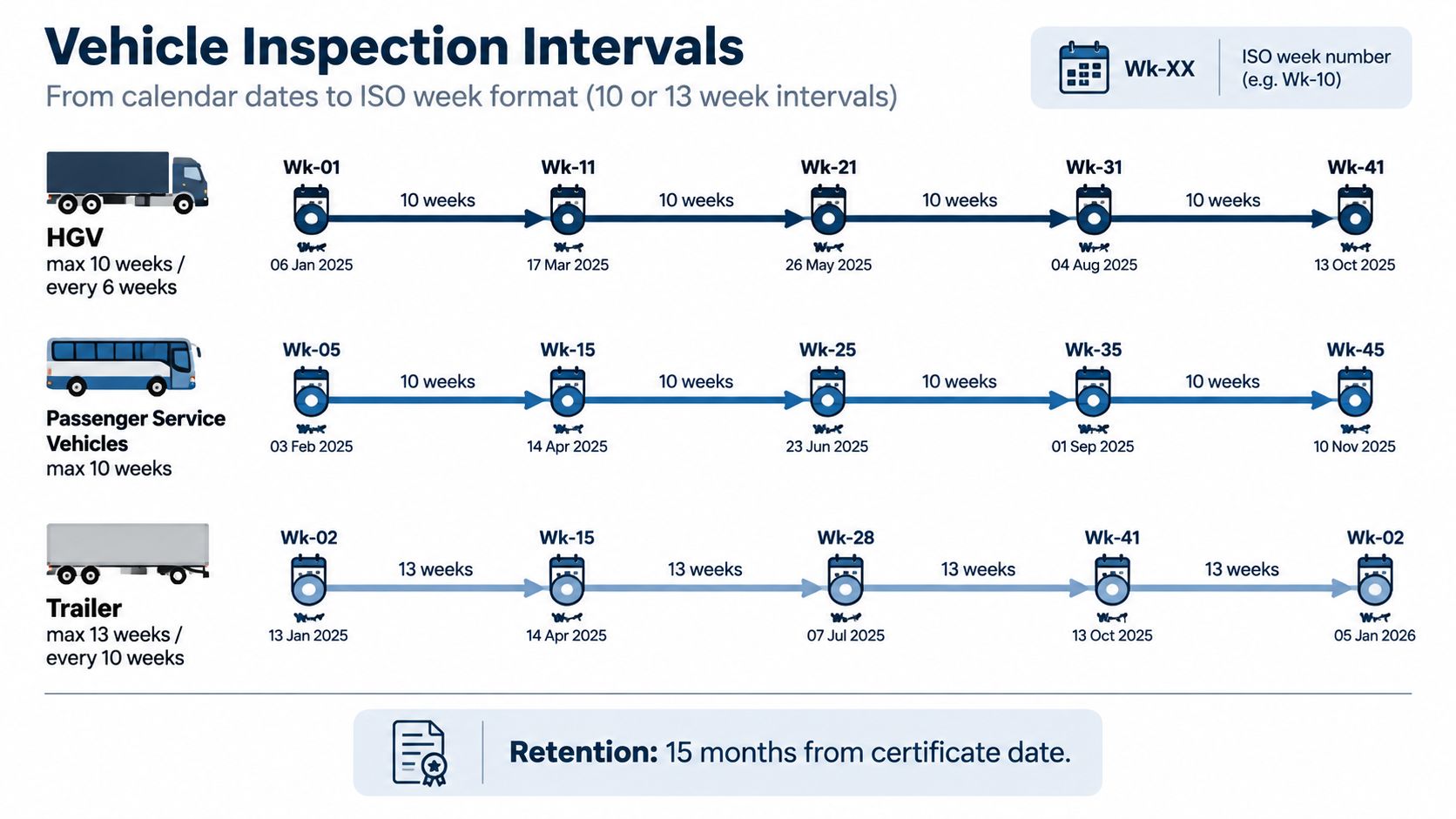
Inspection planning works best when it's tied to a clear vehicle schedule rather than a collection of diary reminders. The operator's written maintenance system should define the inspection frequency for each vehicle type, taking account of use, mileage, operating conditions and risk. The interval must be applied consistently and reviewed when the vehicle's work changes.
ISO-week planning helps because the planner works from a repeatable weekly reference rather than a date that shifts around bank holidays, workshop closures or driver holidays. The operator should set the next due week from the completed inspection, then record any early completion without disguising the actual date.
Handling early, late and VOR inspections
An early inspection is usually straightforward. Record the date it happened and calculate the next due point from the operator's approved schedule. Don't backdate the certificate to make the planner look tidy.
A late inspection needs an explanation and corrective action. Keep the original due date, document why the inspection was missed, record the vehicle's status during the gap and attach evidence of the completed inspection and any resulting repairs. If the vehicle was off the road, retain the VOR record and show how the operator controlled its return to service.
The DVSA safety inspection interval guidance can support the planning process, but it doesn't remove the operator's responsibility to set and manage a defensible schedule.
Retention and retrieval
The DVSA guide requires the full maintenance file to be retained for at least 15 months, including safety inspection reports, driver defect reports, rectification evidence and related repair records. The retention period applies to the evidence chain, not just the certificate page.
An audit-ready planner should flag upcoming work well before the due week, identify the vehicle and trailer, capture the inspector's signature and store supporting documents under the parent inspection. It should also make overdue inspections visible rather than moving them to a new date.
The GOV.UK vehicle operator maintenance investigations framework expects maintenance evidence to cover a span including at least four scheduled PMIs. That means a single correctly filed certificate isn't enough. Your system has to show continuity.
The video below provides another practical maintenance-planning reference.
Worked Examples for an HGV and a PSV
A certificate becomes easier to judge when you follow the inspection from the workshop floor to the compliance file. The form should reflect the work completed, not provide a box for a technician to tick.
The articulated tractor unit
For a 44-tonne articulated tractor unit, the fitter starts by confirming the registration mark, VIN, unit number, mileage and inspection schedule. The examination covers steering, suspension, tyres, wheels, lights, bodywork, coupling equipment, fifth wheel, trailer connections, mirrors, vehicle security, fluid leaks, warning systems and braking components.
The roller brake tester produces a printout showing the braking test results. That printout is attached to the parent safety inspection record, not filed separately with the next annual test. The certificate records the condition of each relevant item and identifies the technician by name and signature.
During the inspection, the fitter finds that the nearside slack adjuster is out of range. The certificate records the defect and shows a fail or hold decision. A defect report or workshop job card identifies the repair, and the rectification record confirms what was adjusted or replaced before release.
The transport manager should be able to open one vehicle record and see:
- Inspection record: The date, mileage, schedule, findings and signed declaration.
- Brake evidence: The roller brake tester printout linked to that inspection.
- Defect report: The nearside slack-adjuster defect with a clear reference.
- Rectification evidence: The repair details and release decision.
- Technician details: The inspector�
safety inspection certificateDVSA roadworthinessoperator licence compliancesafety inspection intervalsmonthly compliance pack