· 1 min read
Avoid 28 & 90 day data loss: company tachograph card steps UK fleets
UK operators' playbook: prevent VU data loss. 28/90 day download limits, renewal and replacement steps, an audit ready checklist, and automation tips.
# Avoid 28 & 90 day data loss: company tachograph card steps UK fleets

A company tachograph card is DVLA's electronic key to your vehicle units, not a driving authorisation. It lets you lock in and lock out VU data and pull off downloads securely, but it never replaces a driver card and it holds no daily driving records. If yours is due to expire, check the date now and renew through the official GOV.UK digital service well ahead of time.
***
> **TL;DR:**
>
> - Applying for or renewing a company tachograph card should be done through GOV.UK well before the expiry date to avoid lockouts from vehicle units.
> - The company card only enables locking in or out vehicle units for data access and should never be used as a driver card or for storing daily activity records.
> - Lock in immediately when a vehicle enters the fleet and lock out before it leaves, with secure storage and one designated administrator to prevent administration errors.
> - Missing the 28 and 90 day download limits risks data overwriting, enforcement action, and gaps in compliance records, making regular downloads essential.
> - Using automated compliance systems and centralized registers reduces audit risk, ensures renewals are timely, and prevents common administrative mistakes.
***
## Table of Contents
- [What a tachograph company card is and who issues it](#what-a-tachograph-company-card-is-and-who-issues-it)
- [How to apply, renew and replace a company card](#how-to-apply-renew-and-replace-a-company-card)
- [Using the card day to day: lock in, lock out and custody](#using-the-card-day-to-day-lock-in-lock-out-and-custody)
- [Lost, stolen, damaged or malfunctioning cards: what to do and when](#lost-stolen-damaged-or-malfunctioning-cards-what-to-do-and-when)
- [Download rules: the 28 and 90 day limits, and why they exist](#download-rules-the-28-and-90-day-limits-and-why-they-exist)
- [Your company card checklist for audit-ready admin](#your-company-card-checklist-for-audit-ready-admin)
- [Where operators actually go wrong with company cards](#where-operators-actually-go-wrong-with-company-cards)
- [Managing company cards without the manual chasing](#managing-company-cards-without-the-manual-chasing)
- [Sources](#sources)
- [FAQ](#faq)
## What a tachograph company card is and who issues it
DVLA issues the company card in the name of the operator, not an individual driver. It typically stays valid for five years, and it works as the electronic authorisation key that lets an operator access data stored on a vehicle unit (VU).
That is its entire job. It does not store a driver's daily activity, speed, or distance records the way a driver card does, and it should never be handed to a driver as a substitute for their own card.
The card does two practical things:
- **Locks in** on a VU to signal that the vehicle is now under that operator's control, protecting the data recorded from that point onward.
- **Locks out** when the vehicle leaves the fleet, sealing off the operator's data from whoever takes it over next, whether that's a hire company, a buyer, or another haulier.
Get lock in and lock out wrong and you either lose access to data you need for an audit, or you leave your commercial data exposed to the next operator. Confusing the company card with a driver card is one of the most common mistakes new compliance officers make, and it's an easy one to avoid once you know the distinction.
## How to apply, renew and replace a company card
Every application, whether it's a first card, an extra card, a renewal, or a replacement, goes through the same channel: the [Gov](https://www.gov.uk/apply-company-tachograph-card). There's no separate paper route for most operators, and trying to shortcut the process through a third party rarely ends well.
**Statistic callout:** Apply for renewal well in advance of your current card's expiry to avoid being locked out of your own vehicle units. Miss that window and you risk being locked out of your own vehicle units, right when you need to authorise a download or investigate an incident.
The process breaks down into three scenarios:
1. **First-time and additional cards.** Apply via GOV.UK with your operator licence details ready. Processing takes time, so build the lead time into your fleet onboarding plan.
2. **Renewals.** Apply before expiry, not after. DVLA guidance on company tachograph card information (INS169B) sets out the full renewal procedure, including what happens if you leave it too late.
3. **Damaged or malfunctioning cards.** Test the card in a different VU first to rule out a fault with the machine rather than the card itself. If it's genuinely faulty, INS169B explains how to return it to DVLA, and a replacement fee may apply if the damaged card isn't returned with your application.
## Using the card day to day: lock in, lock out and custody
The company card only needs to go into a vehicle unit when you're authorising a VU-level download or setting the lock in/out status. Downloading a driver card's data is a separate action and doesn't require the company card at all.
Where the card matters most is at points of change: vehicle handover, hire return, or sale. Lock out before a hired vehicle goes back, and lock in the moment a new one joins the fleet.
- Lock in immediately when a vehicle enters your operation, whether owned, leased, or hired.
- Lock out before a vehicle leaves your control, especially at end of hire or point of sale.
- Never leave a vehicle in an "unlocked" state longer than necessary. It's an open door to someone else's data landing in your VU history, or yours ending up in theirs.
- Store cards in one secure, named location per depot. A locked cabinet or safe with restricted access beats a card sitting in a cab door pocket.
**Pro Tip:** *Name one card administrator per operator licence. When one person owns renewals, custody, and lock in/out records, duplicate cards and missed expiries all but disappear.*
## Lost, stolen, damaged or malfunctioning cards: what to do and when
Report a lost or stolen card as soon as you notice it's gone, and apply for a replacement through GOV.UK within seven calendar days. Delay here creates a compliance gap that's hard to explain during a DVSA check.
While the driver waits for the replacement, they can keep driving using printouts, for up to 15 days.
1. Print a VU record twice a day, once at the start and once at the end of the working period.
2. Annotate each printout with the driver's name, licence number, and signature.
3. Keep every printout together with the vehicle's records until the new card arrives.
As the employer, your job doesn't stop once the driver has a workaround. Collect the printouts, combine them with the corresponding VU downloads, and adjust rota or route planning if the missing card is going to affect drivers' hours compliance. A tool such as the [tachograph card reader guide](https://operatorcompliance.co.uk/blog/tachograph-card-readers) is worth reviewing if your depot handles these downloads manually, since a slow handover process often turns a minor card loss into a genuine hours-tracking headache.
## Download rules: the 28 and 90 day limits, and why they exist
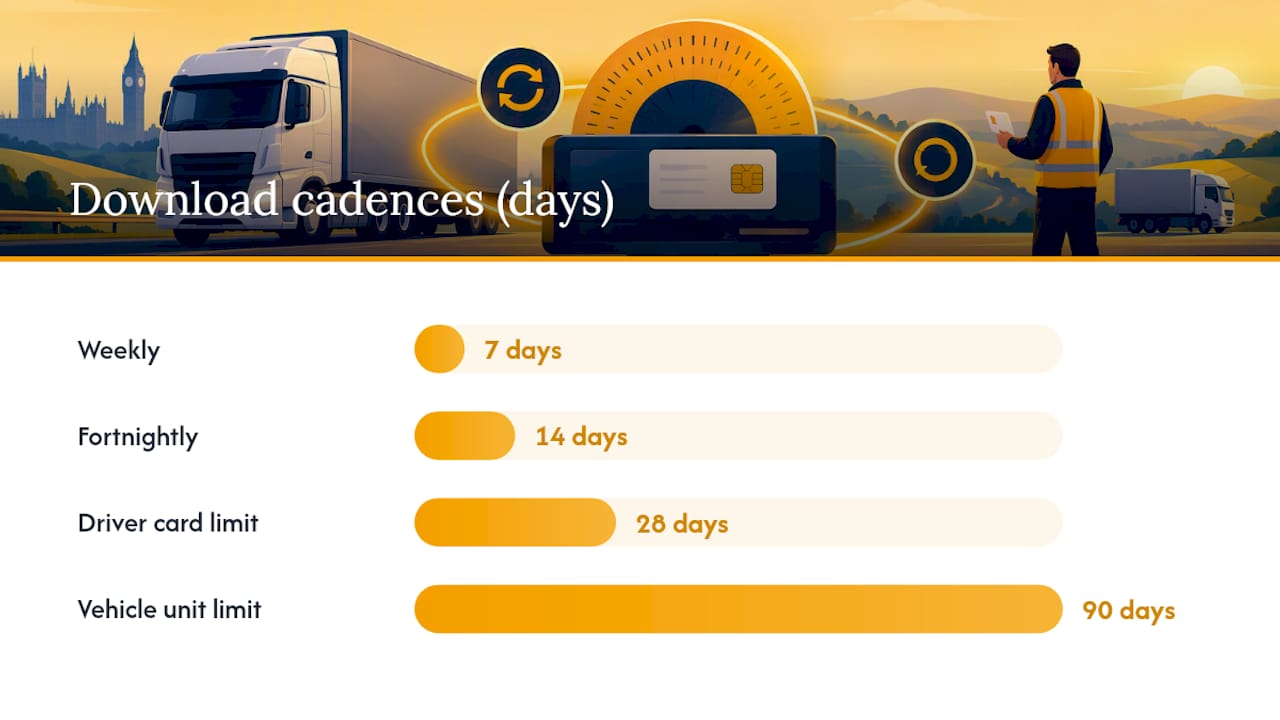
Statutory maximums are fixed and non-negotiable: 28 days between driver card downloads, and 90 days between vehicle unit downloads, under [Commission Regulation (EU) No 581/2010](https://www.legislation.gov.uk/eur/2010/581/pdfs/eur_20100581_adopted_en.pdf).
**Statistic callout:** Failing to download driver card data regularly risks older records being overwritten before retrieval. The same risk applies to vehicle unit data if not downloaded within the maximum allowed interval. Once it's gone, it's gone, and that's a gap you cannot explain away at a roadside check or an [Operator Compliance Risk Score](https://operatorcompliance.co.uk/knowledge-hub/tachograph-download-rules-28-and-90-days) review.
Regular downloads do more than tick a legal box:
- They protect you against enforcement action where the evidence simply doesn't exist because it was overwritten.
- They feed your OCRS profile with clean, complete data rather than gaps that invite scrutiny.
- They give you time to spot and correct drivers' hours infringements before they become a pattern.
Set your own internal cadence tighter than the legal maximum. Weekly or fortnightly downloads, especially where remote download kit is fitted, leave you well clear of both limits and give you a genuine buffer for holidays, sickness, or a depot that's simply had a busy month.
## Your company card checklist for audit-ready admin
Most of the risk around company cards comes down to poor administration, not a lack of knowledge. Fix the process once and it stays fixed.
- Name one card administrator per operator licence, and make renewal diarising part of their job description, triggered the day a new card arrives rather than the week it expires.
- Centralise custody: one secure location per depot, one register of who holds which card and why.
- Consolidate downloads wherever you can. [Remote download systems](https://operatorcompliance.co.uk/blog/tacho-remote-download) cut how often the company card needs physically handling, which lowers the risk of loss or damage while keeping its legal role intact.
- Tag every .DDD file to the vehicle and driver it came from, and store the archive somewhere a DVSA examiner or traffic commissioner can be shown quickly.
**Pro Tip:** *If your depots run on separate spreadsheets or separate card registers, you're creating audit risk you don't need. One shared system beats five local habits every time.*
Software built for this job, such as [tachograph analysis tools](https://operatorcompliance.co.uk/features/tachograph-analysis), flags expiries automatically and builds the audit pack for you, so nobody's relying on memory or a sticky note on a noticeboard.
## Where operators actually go wrong with company cards
The pitfalls I see repeated most often aren't complicated. They're depots running on separate card registers, drivers unclear on whose card goes where, and renewal dates tracked by memory rather than by a system.
Fix the administration, not the driver. One named administrator, a renewal calendar that triggers on receipt, and remote downloads instead of manual ones remove almost all of the enforcement risk that company cards create.
> *— Vytautas*
## Managing company cards without the manual chasing
Operatorcompliance is the alternative to spreadsheets and paper diaries for tracking tachograph company cards. It automates expiry reminders so renewals happen before the 15 working day deadline, centralises every .DDD file by vehicle and driver, and builds an audit-ready compliance pack you can hand to a DVSA examiner or traffic commissioner without a scramble.
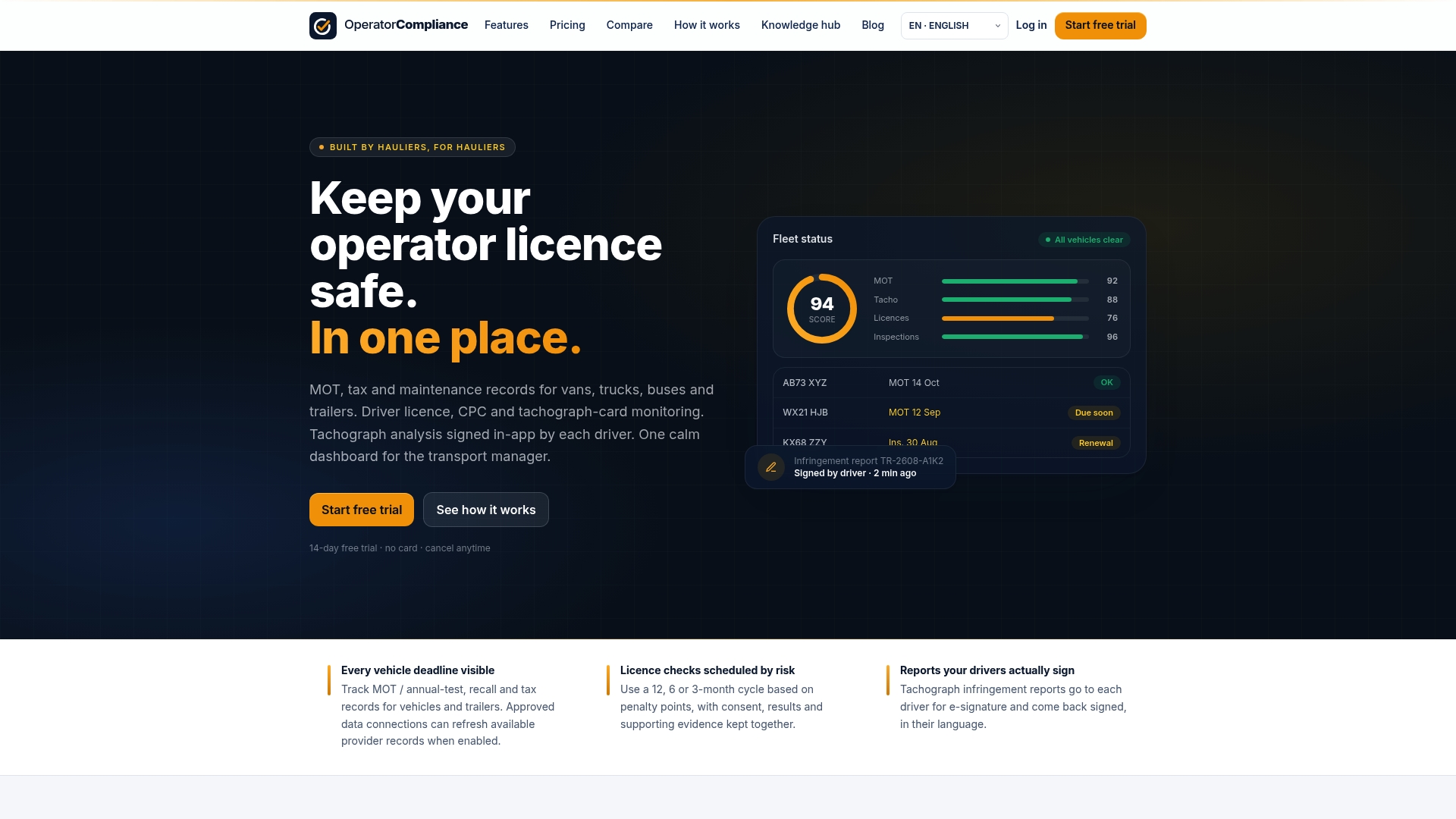
That means one dashboard instead of five depot habits, and no more relying on a DVLA reminder letter that might arrive late or not at all. Plans start at [£9 a month for owner-drivers](https://operatorcompliance.co.uk/for/owner-drivers), with Standard and Professional tiers scaling up for larger fleets, and full details sit on the [pricing page](https://operatorcompliance.co.uk/pricing). If you run an HGV, PSV or van fleet and want tachograph cards, downloads and audit evidence handled from one place, take a look at [how it works](https://operatorcompliance.co.uk/how-it-works) and start a trial today.
## Sources
For the definitive rules, go straight to the primary sources: the GOV.UK company tachograph card service for applications and renewals, INS169B for card care and returns, and Commission Regulation 581/2010 for the statutory download intervals. Operatorcompliance's [knowledge hub](https://operatorcompliance.co.uk/knowledge-hub/drivers-hours-rules-explained) covers the practical side of drivers' hours and download scheduling in more depth.
- [Apply for a company digital tachograph card](https://www.gov.uk/apply-company-tachograph-card)
- [COMMISSION REGULATION (EU) No 581/2010 of 1 July 2010](https://www.legislation.gov.uk/eur/2010/581/pdfs/eur_20100581_adopted_en.pdf)
## FAQ
### How much does a company tachograph card cost to get?
Application costs are set by DVLA and shown on the GOV.UK service at the time of applying, so check there for the current fee. A separate replacement fee can apply if a damaged card isn't returned with your application, as set out in INS169B.
### Can you drive using a company tachograph card?
No. A company card authorises an operator to access and protect VU data; it isn't a driving authorisation and can't be used in place of a driver card. Drivers still need their own valid driver card, or printouts, to record activity legally.
### What is a digital tachograph company card?
It's an electronic card issued in the operator's name by DVLA, used to lock in and lock out vehicle units and to authorise downloads of VU data. It doesn't hold daily driving records the way a driver card does, and it typically stays valid for around five years.
### What are the four types of tachograph card?
The four are the driver card, the company card, the workshop card, and the control card, each serving a different role in the digital tachograph system. Drivers hold driver cards for their own records; operators hold company cards to manage VU access; workshops and enforcement bodies hold the other two.
## Recommended
- [Tachograph download rules: 28/90 days](https://operatorcompliance.co.uk/knowledge-hub/tachograph-download-rules-28-and-90-days)
- [How to Operate a Digital Tachograph the Right Way](https://operatorcompliance.co.uk/blog/how-to-operate-a-digital-tachograph)
- [Tachograph Card Readers: The Operator's Practical Guide](https://operatorcompliance.co.uk/blog/tachograph-card-readers)
- [Tacho Remote Download Guide for UK Fleets](https://operatorcompliance.co.uk/blog/tacho-remote-download)
This article is general guidance for UK operators and transport managers, not legal or professional advice. Regulations change, so always confirm the current requirements with GOV.UK, DVSA and your traffic commissioner before acting.

A company tachograph card is DVLA's electronic key to your vehicle units, not a driving authorisation. It lets you lock in and lock out VU data and pull off downloads securely, but it never replaces a driver card and it holds no daily driving records. If yours is due to expire, check the date now and renew through the official GOV.UK digital service well ahead of time.
***
> **TL;DR:**
>
> - Applying for or renewing a company tachograph card should be done through GOV.UK well before the expiry date to avoid lockouts from vehicle units.
> - The company card only enables locking in or out vehicle units for data access and should never be used as a driver card or for storing daily activity records.
> - Lock in immediately when a vehicle enters the fleet and lock out before it leaves, with secure storage and one designated administrator to prevent administration errors.
> - Missing the 28 and 90 day download limits risks data overwriting, enforcement action, and gaps in compliance records, making regular downloads essential.
> - Using automated compliance systems and centralized registers reduces audit risk, ensures renewals are timely, and prevents common administrative mistakes.
***
## Table of Contents
- [What a tachograph company card is and who issues it](#what-a-tachograph-company-card-is-and-who-issues-it)
- [How to apply, renew and replace a company card](#how-to-apply-renew-and-replace-a-company-card)
- [Using the card day to day: lock in, lock out and custody](#using-the-card-day-to-day-lock-in-lock-out-and-custody)
- [Lost, stolen, damaged or malfunctioning cards: what to do and when](#lost-stolen-damaged-or-malfunctioning-cards-what-to-do-and-when)
- [Download rules: the 28 and 90 day limits, and why they exist](#download-rules-the-28-and-90-day-limits-and-why-they-exist)
- [Your company card checklist for audit-ready admin](#your-company-card-checklist-for-audit-ready-admin)
- [Where operators actually go wrong with company cards](#where-operators-actually-go-wrong-with-company-cards)
- [Managing company cards without the manual chasing](#managing-company-cards-without-the-manual-chasing)
- [Sources](#sources)
- [FAQ](#faq)
## What a tachograph company card is and who issues it
DVLA issues the company card in the name of the operator, not an individual driver. It typically stays valid for five years, and it works as the electronic authorisation key that lets an operator access data stored on a vehicle unit (VU).
That is its entire job. It does not store a driver's daily activity, speed, or distance records the way a driver card does, and it should never be handed to a driver as a substitute for their own card.
The card does two practical things:
- **Locks in** on a VU to signal that the vehicle is now under that operator's control, protecting the data recorded from that point onward.
- **Locks out** when the vehicle leaves the fleet, sealing off the operator's data from whoever takes it over next, whether that's a hire company, a buyer, or another haulier.
Get lock in and lock out wrong and you either lose access to data you need for an audit, or you leave your commercial data exposed to the next operator. Confusing the company card with a driver card is one of the most common mistakes new compliance officers make, and it's an easy one to avoid once you know the distinction.
## How to apply, renew and replace a company card
Every application, whether it's a first card, an extra card, a renewal, or a replacement, goes through the same channel: the [Gov](https://www.gov.uk/apply-company-tachograph-card). There's no separate paper route for most operators, and trying to shortcut the process through a third party rarely ends well.
**Statistic callout:** Apply for renewal well in advance of your current card's expiry to avoid being locked out of your own vehicle units. Miss that window and you risk being locked out of your own vehicle units, right when you need to authorise a download or investigate an incident.
The process breaks down into three scenarios:
1. **First-time and additional cards.** Apply via GOV.UK with your operator licence details ready. Processing takes time, so build the lead time into your fleet onboarding plan.
2. **Renewals.** Apply before expiry, not after. DVLA guidance on company tachograph card information (INS169B) sets out the full renewal procedure, including what happens if you leave it too late.
3. **Damaged or malfunctioning cards.** Test the card in a different VU first to rule out a fault with the machine rather than the card itself. If it's genuinely faulty, INS169B explains how to return it to DVLA, and a replacement fee may apply if the damaged card isn't returned with your application.
## Using the card day to day: lock in, lock out and custody
The company card only needs to go into a vehicle unit when you're authorising a VU-level download or setting the lock in/out status. Downloading a driver card's data is a separate action and doesn't require the company card at all.
Where the card matters most is at points of change: vehicle handover, hire return, or sale. Lock out before a hired vehicle goes back, and lock in the moment a new one joins the fleet.
- Lock in immediately when a vehicle enters your operation, whether owned, leased, or hired.
- Lock out before a vehicle leaves your control, especially at end of hire or point of sale.
- Never leave a vehicle in an "unlocked" state longer than necessary. It's an open door to someone else's data landing in your VU history, or yours ending up in theirs.
- Store cards in one secure, named location per depot. A locked cabinet or safe with restricted access beats a card sitting in a cab door pocket.
**Pro Tip:** *Name one card administrator per operator licence. When one person owns renewals, custody, and lock in/out records, duplicate cards and missed expiries all but disappear.*
## Lost, stolen, damaged or malfunctioning cards: what to do and when
Report a lost or stolen card as soon as you notice it's gone, and apply for a replacement through GOV.UK within seven calendar days. Delay here creates a compliance gap that's hard to explain during a DVSA check.
While the driver waits for the replacement, they can keep driving using printouts, for up to 15 days.
1. Print a VU record twice a day, once at the start and once at the end of the working period.
2. Annotate each printout with the driver's name, licence number, and signature.
3. Keep every printout together with the vehicle's records until the new card arrives.
As the employer, your job doesn't stop once the driver has a workaround. Collect the printouts, combine them with the corresponding VU downloads, and adjust rota or route planning if the missing card is going to affect drivers' hours compliance. A tool such as the [tachograph card reader guide](https://operatorcompliance.co.uk/blog/tachograph-card-readers) is worth reviewing if your depot handles these downloads manually, since a slow handover process often turns a minor card loss into a genuine hours-tracking headache.
## Download rules: the 28 and 90 day limits, and why they exist
Statutory maximums are fixed and non-negotiable: 28 days between driver card downloads, and 90 days between vehicle unit downloads, under [Commission Regulation (EU) No 581/2010](https://www.legislation.gov.uk/eur/2010/581/pdfs/eur_20100581_adopted_en.pdf).

**Statistic callout:** Failing to download driver card data regularly risks older records being overwritten before retrieval. The same risk applies to vehicle unit data if not downloaded within the maximum allowed interval. Once it's gone, it's gone, and that's a gap you cannot explain away at a roadside check or an [Operator Compliance Risk Score](https://operatorcompliance.co.uk/knowledge-hub/tachograph-download-rules-28-and-90-days) review.
Regular downloads do more than tick a legal box:
- They protect you against enforcement action where the evidence simply doesn't exist because it was overwritten.
- They feed your OCRS profile with clean, complete data rather than gaps that invite scrutiny.
- They give you time to spot and correct drivers' hours infringements before they become a pattern.
Set your own internal cadence tighter than the legal maximum. Weekly or fortnightly downloads, especially where remote download kit is fitted, leave you well clear of both limits and give you a genuine buffer for holidays, sickness, or a depot that's simply had a busy month.
## Your company card checklist for audit-ready admin
Most of the risk around company cards comes down to poor administration, not a lack of knowledge. Fix the process once and it stays fixed.
- Name one card administrator per operator licence, and make renewal diarising part of their job description, triggered the day a new card arrives rather than the week it expires.
- Centralise custody: one secure location per depot, one register of who holds which card and why.
- Consolidate downloads wherever you can. [Remote download systems](https://operatorcompliance.co.uk/blog/tacho-remote-download) cut how often the company card needs physically handling, which lowers the risk of loss or damage while keeping its legal role intact.
- Tag every .DDD file to the vehicle and driver it came from, and store the archive somewhere a DVSA examiner or traffic commissioner can be shown quickly.
**Pro Tip:** *If your depots run on separate spreadsheets or separate card registers, you're creating audit risk you don't need. One shared system beats five local habits every time.*
Software built for this job, such as [tachograph analysis tools](https://operatorcompliance.co.uk/features/tachograph-analysis), flags expiries automatically and builds the audit pack for you, so nobody's relying on memory or a sticky note on a noticeboard.
## Where operators actually go wrong with company cards
The pitfalls I see repeated most often aren't complicated. They're depots running on separate card registers, drivers unclear on whose card goes where, and renewal dates tracked by memory rather than by a system.
Fix the administration, not the driver. One named administrator, a renewal calendar that triggers on receipt, and remote downloads instead of manual ones remove almost all of the enforcement risk that company cards create.
> *— Vytautas*
## Managing company cards without the manual chasing
Operatorcompliance is the alternative to spreadsheets and paper diaries for tracking tachograph company cards. It automates expiry reminders so renewals happen before the 15 working day deadline, centralises every .DDD file by vehicle and driver, and builds an audit-ready compliance pack you can hand to a DVSA examiner or traffic commissioner without a scramble.

That means one dashboard instead of five depot habits, and no more relying on a DVLA reminder letter that might arrive late or not at all. Plans start at [£9 a month for owner-drivers](https://operatorcompliance.co.uk/for/owner-drivers), with Standard and Professional tiers scaling up for larger fleets, and full details sit on the [pricing page](https://operatorcompliance.co.uk/pricing). If you run an HGV, PSV or van fleet and want tachograph cards, downloads and audit evidence handled from one place, take a look at [how it works](https://operatorcompliance.co.uk/how-it-works) and start a trial today.
## Sources
For the definitive rules, go straight to the primary sources: the GOV.UK company tachograph card service for applications and renewals, INS169B for card care and returns, and Commission Regulation 581/2010 for the statutory download intervals. Operatorcompliance's [knowledge hub](https://operatorcompliance.co.uk/knowledge-hub/drivers-hours-rules-explained) covers the practical side of drivers' hours and download scheduling in more depth.
- [Apply for a company digital tachograph card](https://www.gov.uk/apply-company-tachograph-card)
- [COMMISSION REGULATION (EU) No 581/2010 of 1 July 2010](https://www.legislation.gov.uk/eur/2010/581/pdfs/eur_20100581_adopted_en.pdf)
## FAQ
### How much does a company tachograph card cost to get?
Application costs are set by DVLA and shown on the GOV.UK service at the time of applying, so check there for the current fee. A separate replacement fee can apply if a damaged card isn't returned with your application, as set out in INS169B.
### Can you drive using a company tachograph card?
No. A company card authorises an operator to access and protect VU data; it isn't a driving authorisation and can't be used in place of a driver card. Drivers still need their own valid driver card, or printouts, to record activity legally.
### What is a digital tachograph company card?
It's an electronic card issued in the operator's name by DVLA, used to lock in and lock out vehicle units and to authorise downloads of VU data. It doesn't hold daily driving records the way a driver card does, and it typically stays valid for around five years.
### What are the four types of tachograph card?
The four are the driver card, the company card, the workshop card, and the control card, each serving a different role in the digital tachograph system. Drivers hold driver cards for their own records; operators hold company cards to manage VU access; workshops and enforcement bodies hold the other two.
## Recommended
- [Tachograph download rules: 28/90 days](https://operatorcompliance.co.uk/knowledge-hub/tachograph-download-rules-28-and-90-days)
- [How to Operate a Digital Tachograph the Right Way](https://operatorcompliance.co.uk/blog/how-to-operate-a-digital-tachograph)
- [Tachograph Card Readers: The Operator's Practical Guide](https://operatorcompliance.co.uk/blog/tachograph-card-readers)
- [Tacho Remote Download Guide for UK Fleets](https://operatorcompliance.co.uk/blog/tacho-remote-download)
This article is general guidance for UK operators and transport managers, not legal or professional advice. Regulations change, so always confirm the current requirements with GOV.UK, DVSA and your traffic commissioner before acting.
tachograph company card