· 9 min read
Avoid DVSA Checks: Attestation of Activities Rules for UK Fleets
UK guide to attestation of activities: when it is valid, how to complete the EC template, carry the original, and keep 28 days of records.
Avoid DVSA Checks: Attestation of Activities Rules for UK Fleets
An attestation of activities is only valid when a driver genuinely could not record a period on the tachograph, using the unmodified European Commission template, signed by both operator and driver before the journey starts. DVSA accepts it for UK use, but treats it as a document worth checking, not a routine substitute for proper tachograph entries.
TL;DR:
- Attestations must be completed and signed before the activity begins, using the original, unmodified European Commission template, with both signatures from driver and operator.
- The form is only valid for genuine technical or practical impossibilities, such as absence from the vehicle or tachograph faults, not for convenience or habitual use.
- Repeated reliance on attestations instead of proper tachograph entries can signal tachograph management issues that are likely to attract increased scrutiny during audits.
- Accurate record-keeping involves cross-referencing attestations with payroll, holiday, and tachograph data, and keeping signed originals accessible for inspection.
- Digital tools and software that automatically read downloads and store signed records help maintain an audit-ready record set and reduce common errors.
Table of Contents
- What is the attestation of activities form?
- When can you use an attestation instead of a manual entry?
- How to complete an attestation correctly
- Practical examples and common mistakes to avoid
- Record-keeping obligations and what enforcement checks look for
- How operators keep audit-ready records without relying on paper
- Why strict attestation practice matters more than operators think
- Manage attestations and drivers’ hours records without the paper chase
- Sources
- FAQ
What is the attestation of activities form?
The form of attestation of activities is a standard European Commission document that accounts for periods a driver could not log on the tachograph, whether through holiday, sickness, or a technical fault. Its legal footing sits within the EU’s driving time framework, and it only works as intended when nothing about the wording has changed.
Regulation (EU) No 165/2014 makes manual tachograph entries the primary recording duty for drivers; the attestation exists as a fallback, not a parallel option. UK secondary legislation carries these obligations into domestic law through the Drivers’ Hours Regulations, amended in 2022 to reflect the retained EU framework after Brexit.
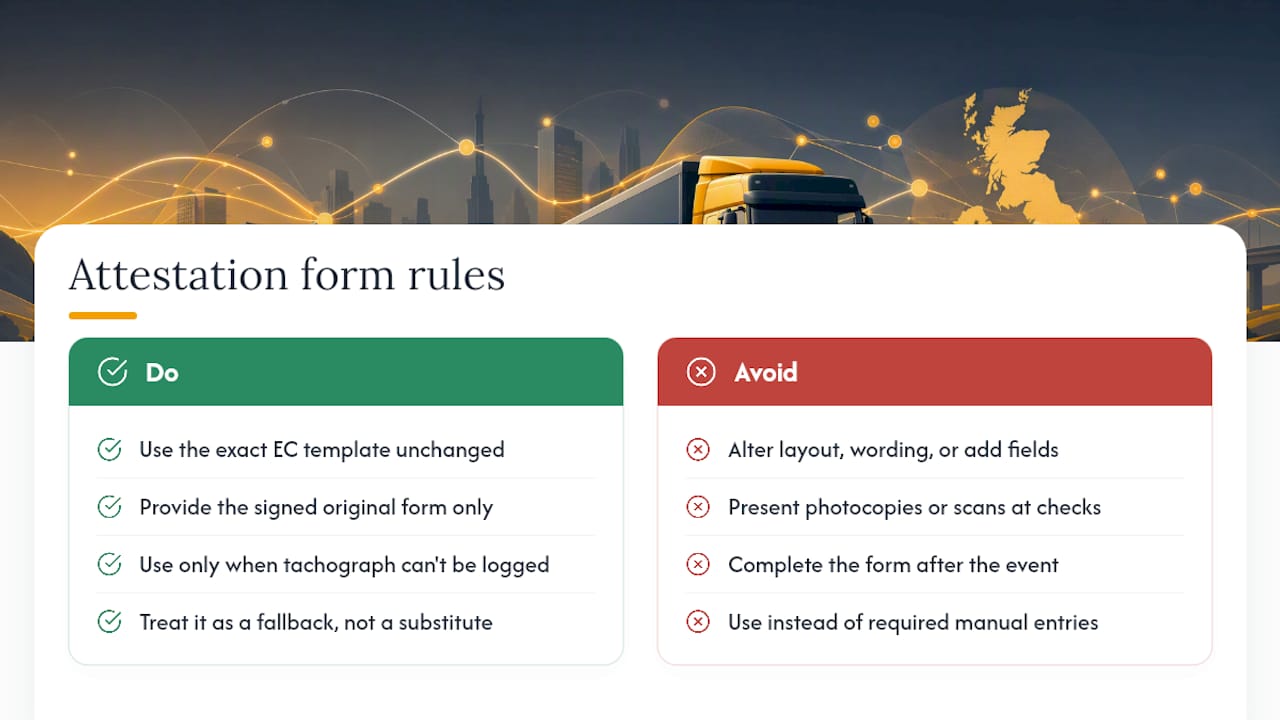
Crucially, the European Commission’s template must stay exactly as published. Altering the layout, adding fields, or rewording sections invalidates it. Only a signed original counts. Photocopies, scans presented in place of the original, or forms filled in after the event carry no weight at a roadside check.
When can you use an attestation instead of a manual entry?
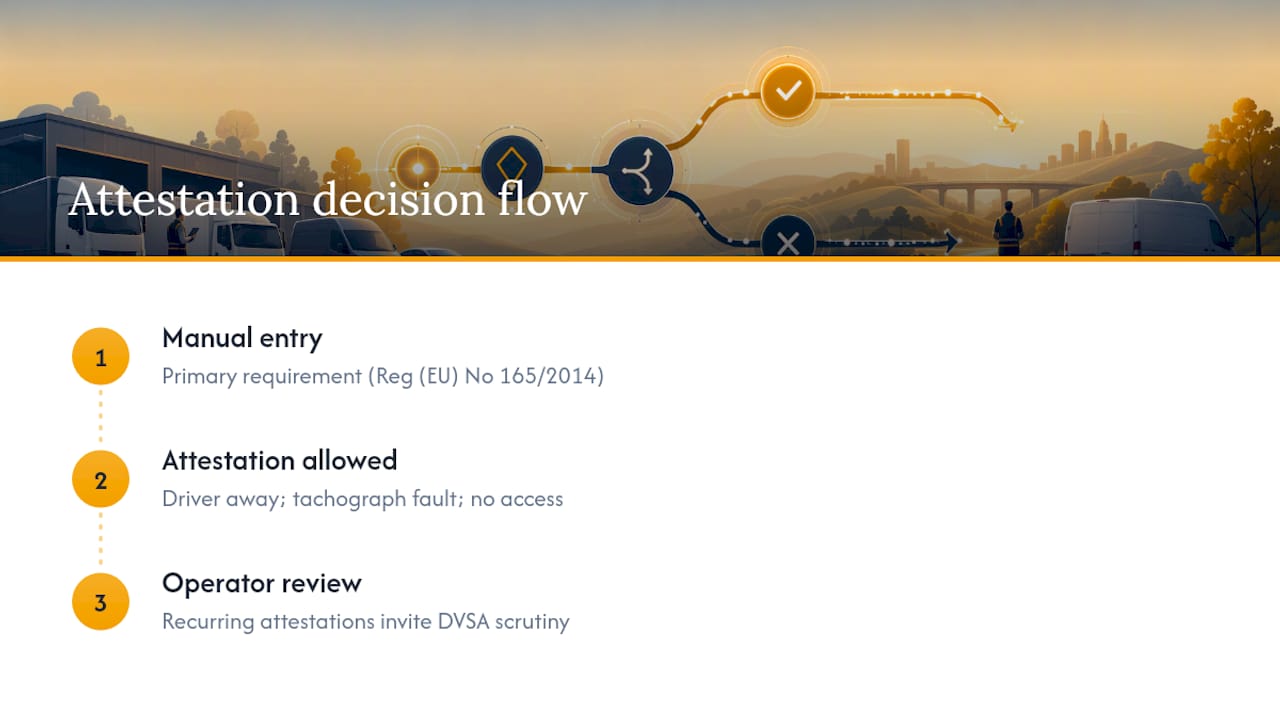
Attestations exist for genuine technical or practical impossibility, not convenience. Typical valid scenarios include a driver being away from the vehicle for the entire period in question, a tachograph fault that prevents manual entry, or the driver having no access to the vehicle at all during annual leave or sickness.
Digital tachograph entries remain the primary legal requirement under Regulation (EU) No 165/2014, and that hierarchy matters during enforcement. A driver who could reasonably have made a manual entry but used an attestation instead has not met the standard the rules expect.
Operators who see attestations appearing week after week for the same driver or vehicle should treat that as a warning sign, not a pattern. A one-off attestation for a broken card reader is defensible. A recurring reliance on attestations instead of manual entries points to a tachograph management problem that DVSA will notice during any audit, and it invites closer scrutiny of every other record you hold.
How to complete an attestation correctly
Getting the paperwork right matters more than most operators assume, because a badly completed attestation is often treated the same as no record at all. Follow this sequence every time:
- Complete it before the journey. The form must be filled in and signed before the driver sets off, not backdated afterwards to cover a gap someone spotted later.
- Get both signatures. The company representative and the driver both sign. If the driver is self-employed, they sign twice, once as the “company” and once as the driver, confirming both roles on the same document.
- Keep the template unmodified. Company name, address, and driver details go in the existing fields. Nothing about the form’s structure changes.
- Use one form per activity. Holiday, sickness, and other work each need a separate attestation with its own dates.
- Carry the original. The driver keeps the signed original in the vehicle and presents it during any DVSA check, not a copy stored on a phone.
Practical examples and common mistakes to avoid
Picture a driver taking a week’s annual leave. That week needs one attestation covering the whole leave period, dated correctly and signed before the leave begins, not a separate form for each day. Compare that with a driver who spends a single afternoon on warehouse duties away from the cab. That situation needs its own attestation, covering only that activity and that timeframe, kept distinct from any leave or sickness record.
The mistakes that cause rejection are almost always avoidable:
- Using a modified or reformatted version of the template instead of the original layout.
- Signing the form after the activity has already taken place.
- Combining two different activities, such as sickness and other work, on a single form.
- Leaving the signed original at the depot rather than carrying it in the vehicle.
Pro Tip: Keep a small stock of blank, unmodified attestation templates in every cab. A driver who has to search for the correct form under pressure is far more likely to fill in the wrong version or skip a signature.
Record-keeping obligations and what enforcement checks look for
Drivers must hold full records covering the current day and the previous 28 calendar days, and that requirement applies to attestations just as much as tachograph printouts or digital downloads, according to Gov. An attestation is not a one-off favour to a driver; it becomes part of the formal record set an examiner can ask for on the spot.
An incomplete or incorrectly filled attestation is often treated the same as a missing tachograph record, which can lead straight to a prohibition notice or a penalty rather than a polite request to fix the paperwork. The safest approach is to cross-reference every attestation against payroll, holiday bookings, and sickness records, and to store it alongside the relevant tachograph downloads so an auditor can see the full picture in one place rather than piecing it together from separate systems.
How operators keep audit-ready records without relying on paper
A short internal policy solves most of this: name one signatory, store every signed original centrally, and log the specific reason for each attestation rather than leaving the “why” to memory. Cross-checking attestations against tachograph data closes the gap examiners look for first.
Digital tools help here in a concrete way. Tachograph analysis software that reads .DDD downloads automatically flags gaps that might otherwise need a paper attestation, and e-signed reports remove the risk of a form going missing between depot and cab. A multilingual driver app also cuts down on completion errors among drivers who are more confident reading forms in Polish, Romanian, Lithuanian, or Bulgarian than in English.
Why strict attestation practice matters more than operators think
Most enforcement findings on attestations come down to the same handful of errors, repeated across different fleets: a missing signature, a form filled in days late, or activities mixed together on one sheet. None of these are complicated to fix, which is exactly why examiners treat them so unsympathetically when they appear.
The operators who avoid trouble are the ones who treat the attestation as a genuine exception, not a habit. Keep signed originals centrally, link every attestation to a payroll or holiday record, and review how often they get used. If the number keeps climbing, the real problem usually sits with tachograph management, not with the paperwork covering for it.
— Vytautas
Manage attestations and drivers’ hours records without the paper chase
Certain compliance software gives transport managers one place to store signed attestations alongside the tachograph data that backs them up, which matters when DVSA asks for both at once during an audit. Rather than chasing paper originals across depots, everything sits against the driver record it belongs to.

The platform reads digital tachograph (.DDD) downloads automatically, flags drivers’ hours issues before they become infringements, and lets drivers e-sign infringement reports and attestations in the app itself. Central storage means a signed original is never sitting in a glovebox when an examiner asks for it, and the audit-ready compliance pack pulls the relevant records together in the format DVSA and traffic commissioners expect. With driver-facing screens available in English, Polish, Romanian, Lithuanian and Bulgarian, fewer forms come back incomplete in the first place.
If your fleet is filling in attestations more often than it should, start by seeing how Operatorcompliance’s features fit your current tachograph and driver-hours workflow, and check what a properly linked record set looks like before your next audit.
Sources
- Drivers’ hours: recording of other work
- Form of attestation of activities - EU Transport
- Regulation (EU) No 165/2014 (tachographs)
FAQ
What are the tachograph rules for UK operators in 2026?
The core obligations remain those set under Regulation (EU) No 165/2014 as retained in UK law, with manual entries as the primary duty and attestations reserved for genuine technical or practical impossibility.
What is the 6 and 9 hour rule?
This refers to the maximum uninterrupted driving periods before a break is required under drivers’ hours rules, though the exact break structure depends on the vehicle category and journey type rather than a single fixed figure.
Can drivers opt out of the Working Time Directive?
Mobile workers covered by road transport working time rules cannot opt out of the maximum average working week in the same way some other sectors can, since the road transport rules are set separately from the general Working Time Regulations.
Are manual tachograph entries a legal requirement?
Yes. Manual entries are the primary legal requirement under Regulation (EU) No 165/2014, and an attestation of activities only applies when making a manual entry was genuinely impossible.
Does DVSA accept the attestation of activities form?
Yes, DVSA accepts the standard European Commission template for domestic use, but subjects attestations to secondary checks against other records rather than accepting them at face value.
Recommended
- Knowledge hub - O-licence and roadworthiness guides
- Safety inspection intervals explained
- Tacho Analysis Software for UK Fleets: A Practical Guide
This article is general guidance for UK operators and transport managers, not legal or professional advice. Regulations change, so always confirm the current requirements with GOV.UK, DVSA and your traffic commissioner before acting.
attestation of activities