· 10 min read
Capture Audit Trail Logs: A 48 Hour Test for Compliance Teams
Compliance guide to audit trail logs. Learn what to record, how to make logs immutable and verifiable, retrieval SLAs, and a fleet evidence example.
Capture Audit Trail Logs: A 48 Hour Test for Compliance Teams
Audit trail logs are the chronological record of who did what, when, to which system object, and with what result. That record has to be immutable and time-synced against a trusted clock to hold up under scrutiny. Their value is immediate: they let you reconstruct an incident after the fact, hand a regulator evidence instead of an explanation, and catch anomalies before they become breaches. Everything past this point is about building and proving that record.
TL;DR:
- Synchronous log writes are essential for financial or privileged actions to prevent data loss during crashes, despite added latency.
- Time synchronization across all logging systems must be maintained within a few hundred milliseconds to ensure accurate event ordering.
- Logs should be indexed, quickly retrievable, and protected through cryptographic chaining to meet regulatory retention and verification standards.
- Automated integrity checks, regular attestation, and retrieval drills are necessary to keep audit trails trustworthy and audit-ready.
- Centralized, correlated logs with enforced access controls convert raw data into meaningful signals for security monitoring and compliance evidence.
Table of Contents
- What Audit Trail Logs Actually Record
- Why Audit Trails Matter for Security and Compliance
- Standards and Regulations Shaping Audit Log Design
- Building Audit Trails That Survive Scrutiny
- Keeping Logs Usable: Retention, Access, and Integrity Checks
- Turning Logs Into Signals: Monitoring and SIEM Integration
- Common Failure Points in Audit Logging at Scale
- Operatorcompliance: Audit-Ready Records in Fleet Operations
- Audit Your Audit Trail: A Verification Checklist
- Treat the Trail as a Control, Not a Filing Cabinet
- Keep Fleet Records Audit-Ready Without the Manual Chasing
- Sources
What Audit Trail Logs Actually Record
An audit-grade log entry needs a fixed set of fields, or it is not really an audit log. It is just a diagnostic message with delusions of grandeur.
The mandatory fields are: the actor (user or service identity), the action taken, the timestamp, the object affected, and the outcome or result. A strong log also captures a justification or “reason” field, especially for privileged actions like permission changes or data deletions. Datadog’s audit logging framework treats a series of these entries, tied together, as the audit trail itself, centralized for investigation rather than scattered across servers.
Several log types get lumped together but serve different purposes:
- System or kernel logs track OS-level events like process starts, privilege escalations, and reboots.
- Application audit logs record business-logic events, like a claims adjuster approving a payout.
- Database change or transaction logs capture row-level inserts, updates, and deletes, often with before/after values.
- Access and authorization logs show who authenticated, from where, and what they were granted or denied.
- Cloud provider audit trails log control-plane activity, like someone modifying a storage bucket’s permissions.
Not every log needs audit status. A debug log that helps a developer trace a null pointer exception is diagnostic. It becomes an audit log only when it is protected from tampering, retained on a schedule, and treated as evidence rather than noise.
Why Audit Trails Matter for Security and Compliance
Auditors, incident responders, and regulators all read logs differently, but they all depend on the trail being complete and untampered.
In an incident, a clean trail turns a multi-day forensic slog into a same-day timeline. Investigators reconstruct what an attacker touched, in what order, and whether data left the environment. That same trail supports non-repudiation: a user who denies making a change loses that argument when the log shows their identity, timestamp, and IP address attached to the action.
Compliance work runs on the same data:
- Auditors treat logs as evidential material, not supporting color, when verifying that controls actually operated as designed.
- Change-control reviews use logs to confirm that a production deployment matched the approved ticket.
- Regulatory examiners request log excerpts directly, rather than trusting a written summary of what happened.
A mature logging program cuts audit friction dramatically, because instead of reconstructing history from memory or emails, teams pull an indexed, timestamped record on demand.
Standards and Regulations Shaping Audit Log Design
Every major framework treats logging as a control, not a convenience, and each one adds specific constraints on what you log and how you protect it.
NIST’s audit trail glossary ties logging directly to detection and response capability. That means logs must capture enough context to support an investigation, not just prove an event occurred. ISO/IEC 27001 formalizes this through controls A.8.15 and A.8.16, which cover logging and monitoring, and auditors use these specifically to check whether logs are both generated and actively reviewed, not just archived.
PCI DSS Requirement 10 is the most prescriptive of the bunch for anyone touching payment card data. It specifies what must be logged (access to cardholder data, use of privileged accounts, initialization of audit logs themselves), how long to retain it, and who can view versus modify the records. Financial-sector guidance under SOX, SEC, and FINRA rules pushes further, generally expecting immutable storage and multi-year retention windows, commonly six to seven years for certain financial records.
| Standard | Core logging requirement | Typical retention expectation |
|---|---|---|
| NIST CSF | Logs support detection and incident response | Varies by agency/sector policy |
| ISO/IEC 27001 | Logging and active monitoring, not just storage | Set by organizational risk assessment |
| PCI DSS Requirement 10 | Access, privileged-use, and log-initialization events | At least one year, three months immediately available |
| Financial regulation (SOX/SEC/FINRA-adjacent guidance) | Immutable, independently verifiable records | Six to seven years for many financial records |
The pattern across all four: logs need to be indexed and retrievable quickly, not just retained somewhere. An auditor asking for six months of access logs expects an answer measured in hours, not a data archaeology project.
Building Audit Trails That Survive Scrutiny
Architecture decisions made early determine whether your trail is defensible later or just a pile of timestamped text.
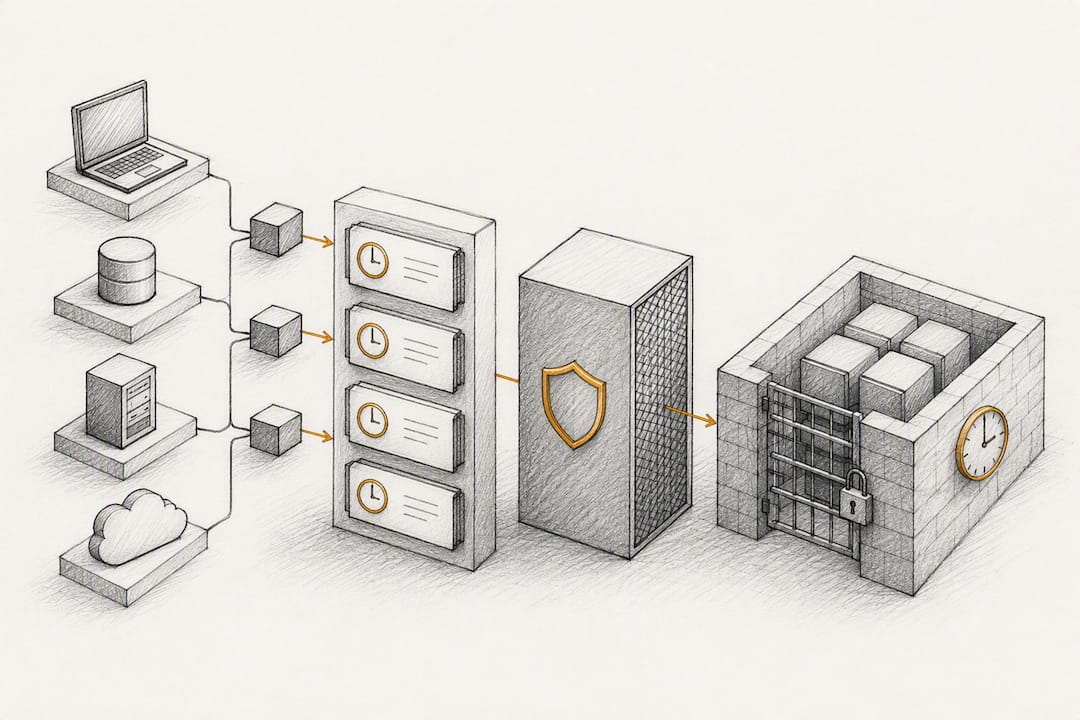
The first fork is synchronous versus asynchronous writes. Synchronous logging (the log write completes before the triggering action is confirmed) guarantees you never lose an audit record, but it adds latency to every transaction. Asynchronous pipelines are faster and scale better, but they risk dropping events during a crash or backpressure spike. For anything touching financial transactions or privileged access, the compliance answer usually favors synchronous writes, or at minimum a durable queue with delivery guarantees.
Here’s a practical build sequence:
- Choose an immutability pattern. Object lock or WORM (write once, read many) storage prevents edits at the storage layer. Append-only log structures prevent them at the application layer.
- Add cryptographic protection. Per-record hashing, with each record’s hash chained to the previous one, makes tampering detectable even if someone gets write access.
- Standardize your schema. Consistent field names across every log source, with timezone-aware timestamps (ISO 8601 with explicit offset, never local time with no zone marker), keep correlation possible across systems.
- Lock down time synchronization. Every logging component needs to draw from the same authoritative time source.
That last point deserves emphasis. Unsynchronized clocks across servers, containers, and third-party services routinely make event ordering unreliable during forensic reconstruction, because two events that happened seconds apart in reality can appear reversed in the log.
Pro Tip: Run an NTP or GNSS-based time source with drift alerts set at a few hundred milliseconds. If a server’s clock silently drifts past that threshold, your timeline reconstruction for that window becomes legally shaky, even if every other control worked.
Keeping Logs Usable: Retention, Access, and Integrity Checks
A well-architected trail still fails an audit if nobody maintains it operationally.
Retention policy should be tied to actual regulatory exposure, not a blanket “keep everything forever” default, which creates privacy and storage liabilities. Access needs strict separation: the people who can write application code should not be the same people who can alter or delete audit logs, and viewing logs should require a different privilege tier than generating them.
- Run automated integrity verification on a schedule, comparing current hash chains against stored baselines.
- Perform periodic attestation, where a designated owner formally signs off that the current period’s logs are complete and unaltered.
- Test tamper-detection routines deliberately, by attempting a controlled unauthorized edit in a sandbox and confirming the system flags it.
- Run retrieval drills against a defined SLA, so you know your real time-to-produce before a regulator tests it for you.
Pro Tip: Set an internal SLA of 48 hours for producing a requested log segment. Some financial frameworks expect near-immediate access to recent records, and a slow retrieval process during an actual examination reads as a red flag even when the underlying data is fine. Accessibility and retrieval speed matter to auditors as much as integrity does.
Turning Logs Into Signals: Monitoring and SIEM Integration
Raw logs sitting in storage don’t detect anything. They need to be centralized, parsed, and correlated before they become useful.
Centralization means pulling every log source, cloud control-plane events, application logs, database change logs, into one indexed system where fields are searchable across sources. Correlation is where the real value shows up: linking a login from an unusual location, a privilege escalation ten minutes later, and a bulk data export right after turns three unremarkable log lines into an obvious incident.
- SIEM platforms enrich raw logs with context (threat intelligence, identity data) so analysts see meaningful alerts instead of noise.
- SOAR tools can automate the response once a correlated pattern crosses a threshold, cutting response time from hours to minutes.
- Storage tiering (hot, warm, cold) controls ingestion cost, but every tier still needs to meet your retrieval SLA.
- Centralized log management is what makes audit trails operational rather than purely archival.
The tradeoff to watch: aggressive cost-cutting on log ingestion often means dropping or sampling low-priority events, which can quietly create the blind spot that turns into an unreconstructible incident later.
Common Failure Points in Audit Logging at Scale
Most audit trail failures aren’t dramatic breaches. They’re quiet gaps that only surface when someone actually needs the record.
- Time drift across distributed systems breaks event ordering; mitigate with authoritative NTP or GNSS sources and active drift monitoring, not a one-time setup.
- Volume overload tempts teams to log everything or, worse, sample randomly; define your critical event list explicitly instead, covering privileged actions, data access, and configuration changes.
- Privacy conflicts arise when logs capture personal data that GDPR or similar rules restrict; redaction or pseudonymization at write time preserves evidential value while limiting exposure.
- Cloud dependency risk shows up when you can’t independently verify a provider’s audit log is complete, since platform logs require explicit configuration and aren’t automatically comprehensive.
None of these are exotic problems. They’re the ones that show up in nearly every mature environment eventually, which is exactly why they need a standing mitigation, not a one-time fix.
Operatorcompliance: Audit-Ready Records in Fleet Operations
Transport compliance is a clean real-world test of every principle above. A vehicle operator licence depends on records that regulators can pull apart line by line.
Map the same five fields, who, what, when, object, result, onto fleet data: a driver’s CPC check, a MOT pass or fail, a tachograph download timestamp. Each needs an actor, an action, a time, and an outcome tied to a specific vehicle or driver record. Operatorcompliance structures this by design.
- A unified dashboard shows compliance status across the fleet at a glance, rather than scattered spreadsheets.
- Bilingual, e-signed tachograph analysis reports create a defensible record of driver hours and vehicle usage.
- Exportable evidence packs align with DVSA and Traffic Commissioner expectations for audit-ready documentation.
Transport managers should treat every MOT renewal, licence check, and tachograph upload as an audit event worth timestamping and retaining, not a task to close and forget.
Audit Your Audit Trail: A Verification Checklist
Run this sequence before you assume your logging is compliance-ready:
- Confirm required fields exist on every log source: actor, action, timestamp, object, result.
- Verify time synchronization across every logging component against an authoritative source.
- Run an integrity attestation, checking hash chains or WORM configuration against baseline.
- Execute a retrieval drill, timing how fast you can produce a requested log segment.
- Review retention settings and access controls, confirming write and view privileges stay separated.
| Check | Suggested owner | Suggested cadence |
|---|---|---|
| Required fields present | Log/platform engineering | Monthly |
| Time sync verified | Infrastructure/SRE | Weekly |
| Integrity attestation | Security or compliance officer | Monthly |
| Retrieval drill | Compliance officer | Quarterly |
| Retention and access review | Compliance officer | Quarterly |
Treat the Trail as a Control, Not a Filing Cabinet
Most logging programs over-invest in volume and under-invest in retrievability. Teams brag about petabytes ingested while nobody has actually timed how long it takes to produce a six-month-old access record for a regulator.
Integrity and retrieval speed matter more than log volume ever will. A trail nobody can prove is unaltered, or produce inside a reasonable SLA, isn’t evidence. It’s just data with good intentions. Build for the audit you’ll actually face, not the one that looks impressive in a dashboard.
— Vytautas
Keep Fleet Records Audit-Ready Without the Manual Chasing
Everything above applies directly to transport compliance, where the DVSA doesn’t care how organized your spreadsheet looks. It cares whether you can produce the record. Operat
audit trail logs