· 10 min read
15 months' audit evidence for daily walkaround checks, UK operators
Practical DVSA aligned checklist for daily walkaround checks. Spot safety-critical defects, record tamper evident evidence, and retain audit ready records...
15 months’ audit evidence for daily walkaround checks, UK operators
Daily walkaround checks are a legal requirement for every UK HGV, PSV and van operator, and they must be completed before the vehicle’s first use. The check must cover visibility, lights, tyres, brakes, steering, load security and documentation. Any safety-critical defect gets reported immediately and the vehicle stays off the road until it’s fixed, with every check, including “nil” reports, kept on file.
TL;DR:
- Drivers must take at least 10 to 20 minutes for a thorough walkaround, starting at a fixed point and checking all key safety components systematically.
- Recording all checks, including nil defect reports, and keeping records for a minimum of 15 months is essential for legal compliance and audit readiness.
- Immediate vehicle decommissioning is required for safety-critical defects like worn tyres, brake faults, or major lighting failures, while minor issues should be scheduled for repair.
- Digital record systems with tamper-evident features, photo attachments, and easy export functions significantly improve audit compliance and reduce record-keeping errors.
- Regular driver training on why each check matters, building check time into schedules, and conducting unannounced spot checks help maintain high compliance levels.
Table of Contents
- What does a daily walkaround check actually cover?
- How to perform a walkaround check that actually catches problems
- Recording, reporting and legal duties operators can’t skip
- Common defects and what to do about them right now
- What makes walkaround records genuinely audit-ready?
- What transport managers should actually prioritise, day to day
- How OperatorCompliance keeps your walkaround checks audit-ready
- Sources
What does a daily walkaround check actually cover?
A proper walkaround follows the same route every time, which is exactly what DVSA guidance recommends: start at one point on the vehicle and work round it methodically rather than jumping between areas at random. That consistency is what stops drivers missing things when they’re tired, rushed, or doing the check in the dark on a wet car park.
Here’s what the DVSA’s HGV walkaround guidance expects to be covered, area by area:
- Cab and front view: mirrors clean and correctly angled, windscreen free of cracks or obstructions, cameras and sensors working, and the right documents on board (licence, digital tachograph card, operator details).
- Lights, indicators and reflectors: every bulb working, lenses not cracked, reflectors clean and present on both sides.
- Wipers and washers: blades not perished or split, washer fluid topped up, and a working de-icer in winter months.
- Tyres and wheels: tread depth legal across the full width, no cuts, bulges or embedded objects, wheel nuts present and not showing signs of movement, and tyre-pressure warning indicators checked where fitted.
- Brakes and air system: air pressure builds correctly and gauges read normally, with a simple functional check where it’s safe to do so before moving off.
- Steering, suspension and bodywork: no obvious play in the steering, no leaning or sagging on one side, no loose panels or trailing bodywork.
- Load security and tail-lifts: straps, curtains or barriers doing their job, and tail-lift mechanisms operating smoothly with no hydraulic leaks.
PSV operators have extra items to work through. DVSA guidance for buses and coaches specifically calls out emergency exits (unobstructed and opening correctly), first-aid and fire extinguisher provisions, and accessibility equipment such as wheelchair ramps and securing points, all of which must be tested, not just glanced at.
Once the check is done, it gets recorded, even when nothing’s wrong. A “nil defect” entry is just as much a legal record as a defect report, and skipping it because there’s nothing to write down is one of the most common gaps auditors find. Sign it, date it, and file it the same way every day.
How to perform a walkaround check that actually catches problems
A rushed five-minute glance around the cab isn’t a walkaround check, it’s a liability. DVSA’s own guidance treats the inspection as a technical task, one where the driver should understand why each component matters, not just tick a box because it’s there.
- Pick a fixed starting point. Front of the vehicle is the DVSA-recommended starting position, moving clockwise so nothing gets checked twice and nothing gets skipped.
- Look, listen and feel at each stop. Look for damage or wear, listen for air leaks or unusual noise from the brake system, and feel for play in the steering or wheel nuts that move under hand pressure.
- Use a second pair of eyes for high items. Roof-mounted lights, trailer connections and anything above head height are easier and safer to check with an assistant, particularly in the dark.
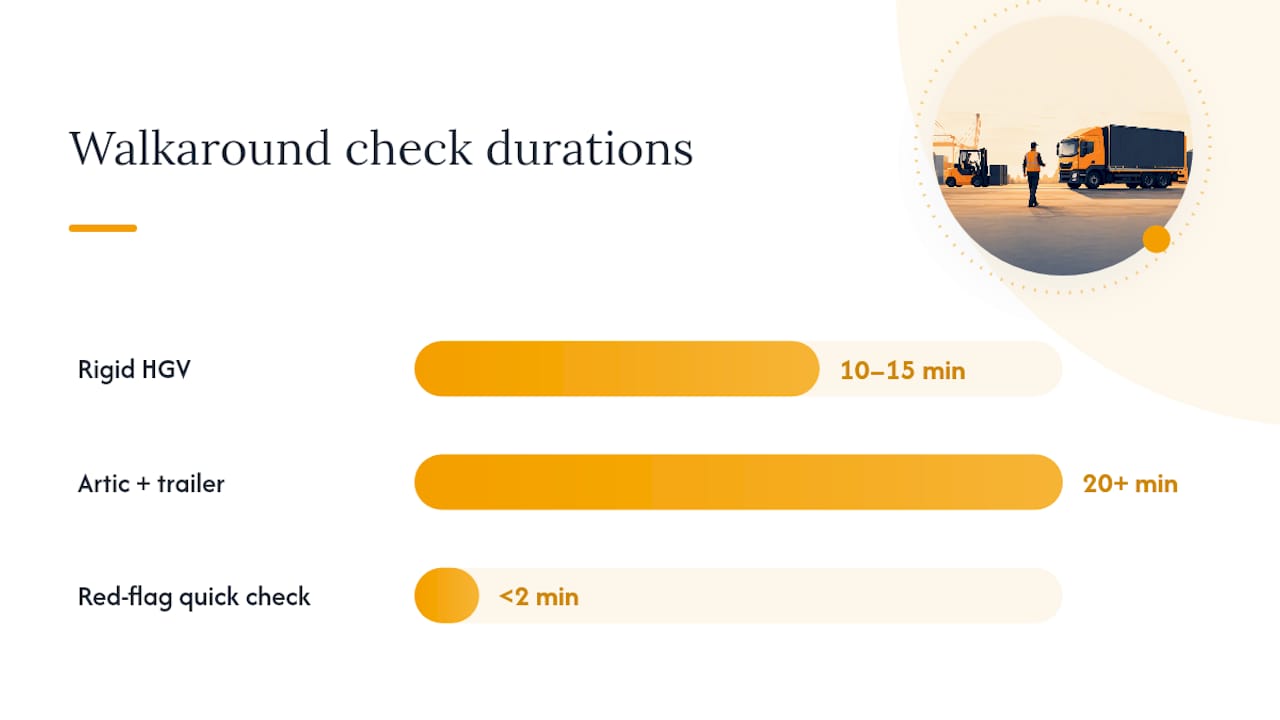
- Allow realistic time. A rigid HGV typically takes 10 to 15 minutes; an artic with a trailer swap can run to 20 minutes or more. This time counts as “other work” under drivers’ hours rules, so it must be built into the working day, not squeezed in unpaid.
- Repeat the check at every handover. If a second driver takes over the same vehicle later in the shift, they carry out their own fresh walkaround rather than relying on the first driver’s sign-off.
Pro Tip: Rotate who leads a monthly refresher on “why” each item matters, not just “what” to check. Drivers who understand that a worn wheel bearing causes a specific noise, or that a hairline windscreen crack spreads under vibration, spot defects that a pure checklist mentality misses entirely.
Transport managers should watch for the tick-box trap: checks completed in under two minutes, every day, with zero defects ever recorded. Traffic Commissioners treat that pattern as a red flag rather than a sign of a well-maintained fleet, because it usually means the check isn’t happening properly at all.
Recording, reporting and legal duties operators can’t skip
The driver performs the check and signs it; the operator owns the system that makes sure checks happen, get recorded, and get acted on. That split of responsibility is set out clearly in DVSA’s Guide to Maintaining Roadworthiness, which requires operators to put processes in place, train staff to use them, and retain evidence for scrutiny.
A defect report worth relying on in an audit needs a few fixed fields every time:
- Date and timestamp of the check
- Vehicle registration or fleet ID
- Driver identification
- A description of the defect (photo attached where possible)
- Driver signature and, once fixed, a rectification sign-off from whoever authorised the vehicle back into service
Records, including nil returns, must be kept for at least 15 months and be available at the operating centre on request. Sloppy or missing records don’t just look bad, they carry real consequences: DVSA can issue prohibition notices, fines follow for unroadworthy vehicles caught on the road, and gaps in your records feed directly into your Operator Compliance Risk Score. Persistent problems can trigger a Traffic Commissioner public inquiry, which puts the O-licence itself on the table.
Electronic records are entirely acceptable, and increasingly the norm. DVSA’s PSV walkaround guidance confirms that digital systems satisfy the requirement provided they’re tamper-evident, meaning nobody can quietly edit a defect report after the fact and make it look like the check happened cleanly when it didn’t.
Common defects and what to do about them right now
Not every defect is equal, and treating a cracked mirror the same way as a bald tyre wastes time on one and risks lives on the other. The line that matters is safety-critical versus manageable.
Take the vehicle out of service immediately for:
- Tyres below the legal tread depth, with cuts exposing the cords, or a puncture
- Any brake fault, warning light, or air pressure that won’t build to the correct level
- Play or resistance in the steering that wasn’t there yesterday
- A major lighting failure affecting more than one function, especially in low light or bad weather
Document and schedule for defects that don’t threaten immediate safety, such as a cracked (but not obstructing) wing mirror casing, a small dent, or a slow-leak washer fluid reservoir. Log it with a clear owner, a repair deadline, and check it doesn’t deteriorate before that date arrives.
Whichever category it falls into, a photo speeds everything up. A picture of a tyre wall alongside a short note takes seconds and gives a maintenance controller far more to work with than “tyre looks a bit off”. Once repaired, the vehicle needs a formal re-check and sign-off before it goes back into service, not just a mechanic’s nod in the yard.
What makes walkaround records genuinely audit-ready?
Paper defect books have a habit of going missing at exactly the wrong moment: the page ripped out, the book left in a cab that’s now three counties away, or a signature that’s illegible when a Traffic Commissioner asks to see it. None of that helps you during an audit.
A digital system worth relying on needs a specific set of features, not just a scanned form:
- Tamper-evident timestamps that can’t be backdated or edited after submission
- Driver and vehicle identifiers attached to every single record automatically
- Photo attachments tied directly to the defect entry
- A rectification workflow that tracks who fixed it and who signed it back into service
- One-click exportable audit packs, ready to hand over the moment DVSA or the Traffic Commissioner asks
Pro Tip: Ask any digital system one question before you commit to it: “Can I export three months of records for one vehicle in under a minute?” If the answer’s no, it isn’t audit-ready, it’s just a paper form with a screen.
OperatorCompliance’s features build around exactly this structure, with a driver app for daily checks, timestamped defect logging, and export-ready compliance packs, available in English, Polish, Romanian, Lithuanian and Bulgarian for mixed-nationality driver teams.
What transport managers should actually prioritise, day to day
Most transport managers already know the rules. The gap isn’t knowledge, it’s discipline under pressure, when a run’s late and someone’s tempted to wave a vehicle through without a proper look.
Three things separate fleets that pass audits comfortably from those that scrape through. First, train drivers to understand the mechanics behind each check, not just memorise a list, because a driver who knows why a slack brake pedal matters will catch it faster than one following a script. Second, build check time into the roster explicitly, so nobody feels they’re stealing minutes from a delivery window to do something that’s legally required anyway. Third, digitise the paperwork, because a system that timestamps and photographs a defect the moment it’s found removes the temptation to “sort it later” and forget.
Beyond that, run occasional spot checks yourself. Turning up unannounced tells you far more about real compliance culture than reviewing a stack of tidy paperwork ever will. And review defect trends monthly. A single flat tyre is bad luck; the same trailer showing lighting faults three months running is a maintenance contract problem, not a driver problem.
— Vytautas
How OperatorCompliance keeps your walkaround checks audit-ready
Daily walkaround checks generate exactly the kind of paperwork that gets lost, disputed, or quietly forgotten under operational pressure. OperatorCompliance closes that gap with a driver app built for the check itself: timestamped entries, photo attachments on defects, and a rectification workflow that records who fixed what and who signed it back into service.

Everything feeds into an exportable, audit-ready compliance pack, so when DVSA or a Traffic Commissioner asks for 15 months of records, you’re producing a clean export rather than digging through a filing cabinet. The same dashboard tracks MOT and annual test dates, PMI schedules and driver licence checks alongside the walkaround records, giving transport managers one place to see fleet-wide compliance status rather than piecing it together from five separate systems. If your drivers work across languages, the platform supports English, Polish, Romanian, Lithuanian and Bulgarian, which matters when a mixed-nationality team all need to understand the same defect form the same way.
If you’re running a haulage operation and want to see how this fits your fleet size, the compliance software for hauliers page walks through setup, and how it works explains what’s involved in getting a fleet live within an afternoon.
daily walkaround checks