· 8 min read
UK Operator Audit: Make Driver Compliance Training Export Ready
Prepare UK driver compliance training records for DVSA and Traffic Commissioner audits: prove 35 CPC hours, keep DQCs and signed registers, and export an...
UK Operator Audit: Make Driver Compliance Training Export Ready
Operators must hold verifiable Driver CPC records for every driver, including 35 hours logged across a rolling five-year cycle, a valid Driver Qualification Card, and signed evidence for any internal training that supports the O-licence. DVSA and Traffic Commissioner auditors want to see this centralised and ready to export, not scattered across filing cabinets and someone’s memory. The Gov and DVSA’s earned recognition standards set the benchmark, and audit-ready platforms such as Operatorcompliance make hitting that benchmark far less painful.
TL;DR:
- Operators need centralized, easily exportable records of Driver Qualification Cards, CPC hours, training certificates, and signed evidence for all drivers.
- Managing staggered five-year CPC cycles requires proactive planning, with alerts set at 12, 6, and 3 months before deadlines to prevent lapses.
- Auditors focus on up-to-date documentation, ongoing CPC tracking, signed training registers, and documented corrective actions during inspections.
- Digital compliance platforms streamline record keeping, combining licence checks, tachograph data, acknowledgements, and automated alerts into one accessible system.
- Running a thorough pre-audit check involves verifying driver documents, CPC logs, signed registers, tachograph files, and having ready export packs for inspection.
Table of Contents
- What driver training records must you keep?
- How do you track training across the five-year CPC cycle?
- What do DVSA and Traffic Commissioner auditors actually check?
- How does compliance software keep your training records audit-ready?
- A transport manager’s week-before-audit checklist
- Get your driver training records audit-ready with Operatorcompliance
- Sources
What driver training records must you keep?
Auditors sampling your driver files aren’t looking for a folder of good intentions. They want specific, dated, attributable evidence for each driver on your operator licence, and they want it fast.
At minimum, keep the following on file for every HGV, PSV or van driver covered by your O-licence:
- Driver Qualification Card (DQC) copies, with expiry dates tracked so nobody drives on an expired card.
- Driver CPC hours log showing the 35-hour cycle broken down by module, date, provider and hours completed, as required under the Vehicle Drivers (Certificates of Professional Competence) Regulations 2007.
- Training certificates from providers approved by the Joint Approvals Unit for Periodic Training (JAUPT), since only JAUPT-registered courses count towards the 35-hour requirement.
- Signed attendance registers for any internally delivered sessions, whether that’s a formal induction or a toolbox talk on load security.
- Induction checklists covering tachograph use, walkaround checks and vehicle-specific procedures for new starters.
- Verification records for agency drivers, showing who checked their CPC status, when, and what evidence was sighted before they went out on the road.
Retention matters as much as collection. Keep originals or verified digital copies for the full CPC cycle plus a reasonable buffer, and back up scanned certificates somewhere that survives a hard drive failure or a departing member of staff taking the paperwork with them. A spreadsheet on one laptop is not a records system; it’s a single point of failure waiting for an audit date.
How do you track training across the five-year CPC cycle?
The 35-hour rule sounds simple until you’re managing forty drivers on staggered cycles, half of them agency staff who rotate through every few months. Spacing hours evenly, rather than cramming them near the deadline, is what separates operators who sail through an audit from those who get flagged for poor management.
Build a forward planner around three alert points:
- 12 months before cycle end — check how many hours each driver still needs and book provisional courses.
- 6 months before cycle end — chase any driver who hasn’t started, and confirm provider availability.
- 3 months before cycle end — treat any driver still short of hours as urgent, with a named manager responsible for closing the gap.
Mid-cycle hires need their existing DQC and hours history verified against their previous employer’s records, not a fresh assumption that the clock starts from zero. Agency and temporary drivers deserve the same scrutiny: record the date you checked their licence and CPC status, and note what evidence you actually saw, per DVSA’s operator compliance audit guidance.
Choosing which modules to run isn’t guesswork either. Pull your tachograph infringement data and incident logs first, then pick training that addresses the actual risks your fleet shows, rather than whatever course happens to have space next Tuesday. Whether you log this on signed paper registers, scanned PDFs, or a central digital tracker, someone needs to own the process: one person logging completed hours, another verifying attendance, and a six-monthly internal check to catch drivers slipping behind schedule.

Pro Tip: Run your CPC tracker like a rolling MOT diary, not a New Year’s resolution. Check it monthly, not once a year when someone remembers the audit is coming.
What do DVSA and Traffic Commissioner auditors actually check?
Audit sampling isn’t random guesswork on the inspector’s part. DVSA’s operator compliance audit standards typically focus on driver records covering recent months, cross-checked against maintenance and tachograph sampling periods, to build a picture of ongoing management rather than a single good day.
Expect auditors to look for:
- Up-to-date DQCs for every driver, with no gaps in the paperwork.
- Clear evidence that CPC hours are tracked, planned and progressing steadily, not left until the last quarter.
- Signed internal registers for induction and toolbox-talk training, with dates and named attendees.
- Documented checks on agency and temporary drivers before they were deployed.
- An internal audit log showing corrective actions, dates and the person responsible when a gap was found.
The Senior Traffic Commissioner’s statutory guidance on driver conduct is explicit on one point worth repeating: cramming the 35 hours into the final months of the cycle isn’t automatically a breach, but it’s treated as a negative feature that suggests weak ongoing management. Missing signed evidence, or an inability to explain why a driver received particular training, reads the same way to an inspector. Operators who can point to a documented internal audit, complete with dates and named owners for corrective action, present a far stronger case than those relying on “we’re pretty sure we did that.”
How does compliance software keep your training records audit-ready?
Paper trails work until someone leaves, a filing cabinet floods, or an auditor asks for three months of records with two days’ notice. Digital compliance platforms address this by turning scattered certificates and registers into one searchable record per driver.
Such platforms typically incorporate these features:
- Licence checks alongside Driver CPC and DQC tracking, consolidating expiry dates and hours logged on a single dashboard.
- Digital tachograph (.DDD) downloads that flag drivers’ hours infringements, with driver acknowledgements.
- Multilingual driver apps to capture acknowledgements and inductions effectively.
- Automated deadline alerts that notify well before a CPC cycle ends.
- Support for DVSA earned recognition and OCRS reporting, plus live compliance scoring reflecting fleet status.
The practical workflow runs from completed training straight through to an exportable audit pack: a driver finishes a module, the certificate gets logged, and the record is ready to hand over or screen-share when an auditor asks.
| What auditors sample | How compliant software addresses it |
|---|---|
| DQC currency and CPC hours logged | Centralised tracking with automated alerts before expiry |
| Signed training and induction evidence | Stored driver acknowledgements linked to profiles |
| Tachograph and infringement links | .DDD downloads analysed with signed infringement reports |
| Earned Recognition/OCRS evidence | Live compliance scores and exportable reporting |
None of this replaces good management. It means the evidence of that management is accessible in the format auditors expect.
A transport manager’s week-before-audit checklist
Before any audit, I run through the same short list: pull every DQC on file and check none have quietly expired, confirm each driver’s CPC hours log is current rather than backdated in a panic, and check signed induction and toolbox-talk registers are all present and dated. I also pull a handful of recent tachograph downloads and make sure infringement debriefs were actually signed off, not just filed.
If the auditor wants to check remotely, screen-sharing a tachograph file or exporting a compliance pack on the spot beats promising to “email it over later.” Spacing CPC hours out regularly is better practice, as clustering them late can suggest weak management and highlights the importance of a good corporate chauffeur account explained system for transport managers.
— Vytautas
Get your driver training records audit-ready with Operatorcompliance
Chasing paper certificates, DQC expiry dates and signed registers across a mixed fleet of employed and agency drivers eats hours you don’t have, especially with an audit date looming. Operatorcompliance is the practical alternative to spreadsheets and filing cabinets: it tracks Driver CPC hours, DQCs, tachograph downloads and signed driver acknowledgements from one dashboard, and turns all of it into an exportable pack the moment DVSA or a traffic commissioner asks for one.
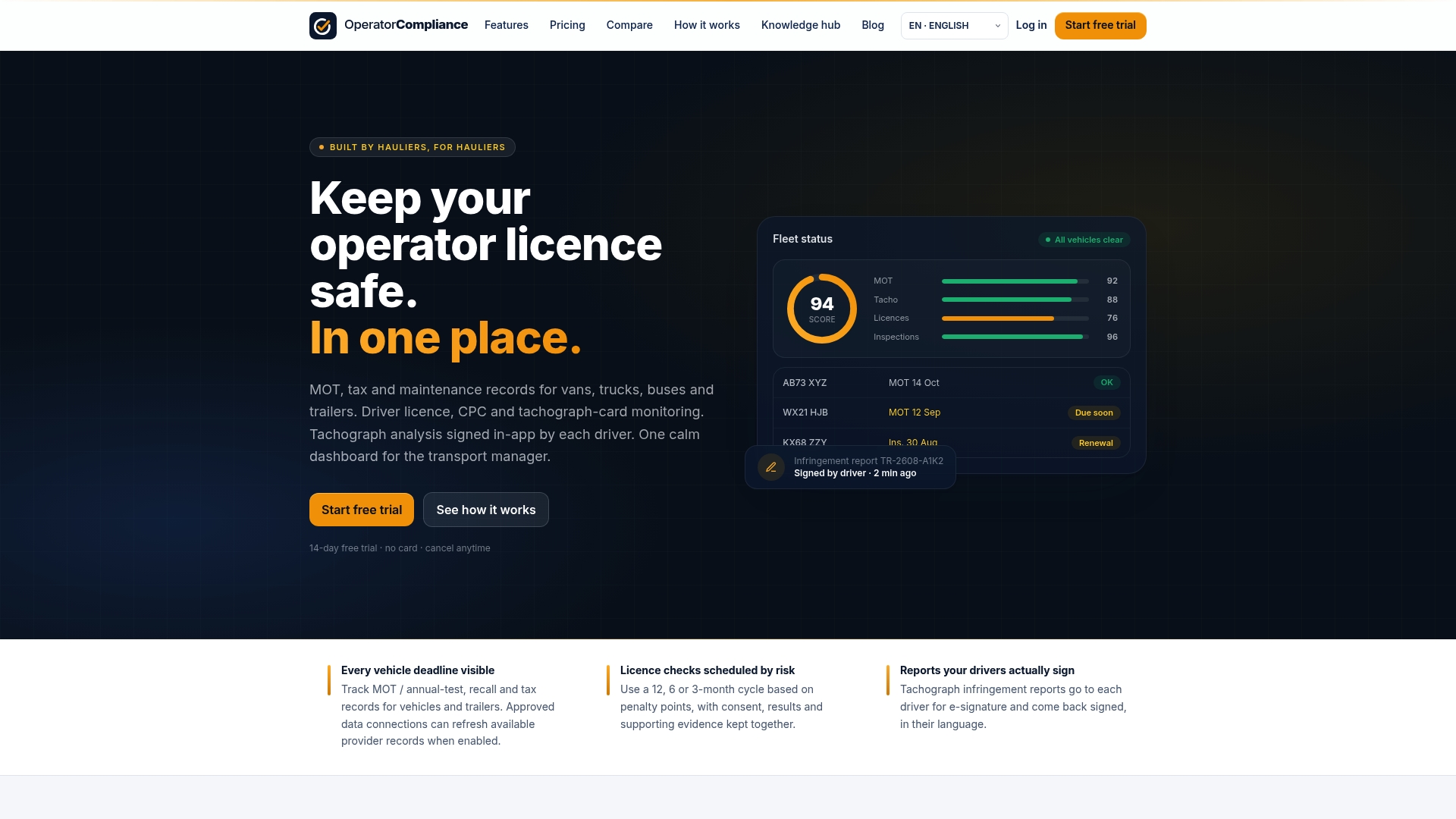
If you manage a mixed HGV or van fleet, the compliance software built for hauliers shows exactly how the driver and vehicle sides fit together, and there’s a free trial if you want to see your own fleet’s data in it before committing. Keep paper originals on file where the regulations require it, and always check that any external Driver CPC provider is JAUPT-approved before the hours go anywhere near your log. Start with the hauliers landing page and book a demo when you’re ready.
Sources
Recommended
- Taxi and private hire fleet compliance
- Tacho Analysis Software for UK Fleets: A Practical Guide
- PSV operator compliance software
This article is general guidance for UK operators and transport managers, not legal or professional advice. Regulations change, so always confirm the current requirements with GOV.UK, DVSA and your traffic commissioner before acting.
driver compliance training