· 10 min read
Audit Ready Evidence for UK Operators: Traffic Commissioner Inquiry
Evidence first checklist for UK operators facing a Traffic Commissioner public inquiry. Build an audit ready pack of maintenance, tachograph and TM...
Audit Ready Evidence for UK Operators: Traffic Commissioner Inquiry
A Traffic Commissioner public inquiry is a formal regulatory hearing that can suspend or revoke an operator’s O-licence. If you’ve been called in, read the calling-in letter now, note the notice period, and start gathering indexed, time-stamped maintenance and drivers’ hours records. Take legal advice early if the allegations touch repute or safety.
TL;DR:
- Operators should begin collecting and indexing all relevant maintenance, driver, and tachograph records as soon as they receive the calling-in letter to ensure quick access during the hearing.
- Notices typically give 14 to 28 days for preparation, with longer periods for transport managers facing repute questions, and adjournments require strong supporting evidence.
- Attendance depends on the operator’s structure: sole traders in person, companies with authorized representatives, and transport managers attending separately if repute is challenged.
- Evidence should be organized logically, including signed defect reports, timestamped checks, and comprehensive digital downloads, ideally prepared well before receiving the call notice.
- Using specialized fleet compliance software helps generate audit-ready evidence packs quickly, reducing last-minute scrambling and increasing chances of a favorable outcome.
Table of Contents
- What is a Traffic Commissioner public inquiry?
- Why would you be called to a traffic commissioner hearing?
- The calling-in letter, notice periods and logistics
- Who should attend, and how do you arrange representation?
- What happens during the hearing?
- What sanctions and outcomes can follow?
- How to prepare: an operator’s checklist and evidence-pack template
- Preliminary hearings: what they are and why they matter
- How do you present audit-ready evidence?
- What small changes actually prevent the worst outcomes?
- How OperatorCompliance keeps you audit-ready for a hearing
- Sources
What is a Traffic Commissioner public inquiry?
A public inquiry is a tribunal hearing where a Traffic Commissioner decides whether to grant, refuse, curtail or revoke an operator’s licence, or whether a transport manager retains their repute. Gov sets out the process, and it applies whether you run three vans or 300 artics.
Commissioners sit in a judicial capacity but the process is disciplinary, not criminal, which shapes how evidence gets weighed. Decisions rest on the balance of probabilities, the same civil standard used in most tribunal work, so the Commissioner asks what’s more likely than not, not whether guilt is proven beyond doubt.
Three broad types of inquiry turn up in practice:
- Licence application inquiries, where a new or varied application raises concerns before it’s granted.
- Operating centre reviews, common with goods vehicle licences, where neighbours or planning issues challenge a site’s suitability.
- Regulatory inquiries, triggered by compliance failures, incidents, or concerns about a transport manager’s fitness.
Hearings are usually held at the relevant Traffic Area office, though remote attendance by video link is increasingly offered for witnesses or representatives who can show good reason not to travel.
Why would you be called to a traffic commissioner hearing?
Most inquiries trace back to one of a handful of triggers, and recognising which one applies to you shapes how you prepare. Commissioners act in a judicial capacity here, and treating the process as disciplinary rather than criminal still means early legal advice pays off.
- DVSA compliance visits or roadside checks that uncover systemic failures in maintenance, drivers’ hours or tachograph management, rather than one-off slips.
- Objections raised against a new licence application or a proposed operating centre, often from residents or local authorities.
- Serious incidents, including bridge strikes, wheel loss, or fatal or serious collisions, which almost always trigger scrutiny of the wider fleet.
- Financial standing concerns, where an operator can’t evidence the required funds to run the fleet safely.
- Transport manager repute or competence queries, where the Traffic Commissioner public inquiries overview explains the nominated TM’s fitness comes under the same lens as the operator’s.
A single missed MOT rarely gets you called in on its own. It’s the pattern DVSA or the Commissioner’s office sees across a fleet that matters.
The calling-in letter, notice periods and logistics
The calling-in letter names the allegations, lists the evidence DVSA or the Office of the Traffic Commissioner intends to rely on, and sets case management directions, including deadlines for written representations.
Statutory notice periods give you a fixed runway, though the clock starts the day the letter lands, not the day you open it:
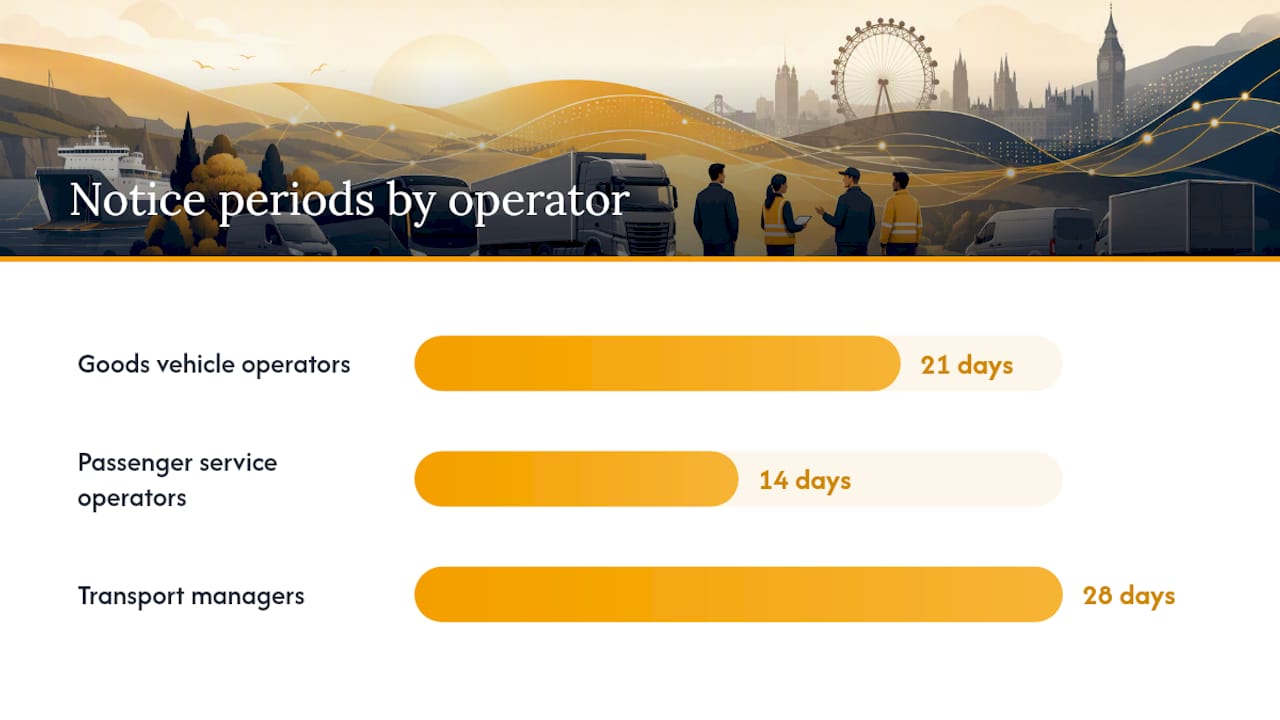
- Goods vehicle operators typically get 21 days’ notice before the hearing.
- Passenger service operators typically get 14 days’ notice.
- Transport managers facing repute or competence questions get 28 days, reflecting the personal and career stakes involved.
These figures come from GOV.UK’s guide to Traffic Commissioner hearings, and exceptions apply where urgent safety risks justify shorter notice.
Adjournment requests need a genuine reason, evidenced clearly. Medical certificates, proof a key witness is unavailable, or confirmation that newly instructed solicitors need reasonable time to review a large evidence bundle all carry weight. A bare request with no supporting paperwork rarely succeeds.
Who should attend, and how do you arrange representation?
Attendance expectations differ by business structure, and getting this wrong before the hearing date creates unnecessary risk. Sole traders must attend in person unless the Commissioner accepts a written excuse. Partnerships generally need at least one partner present, and limited companies must send a director or a properly authorised representative.
- Board authorisation matters. If a company sends someone other than a director, that person usually needs written authority to speak on the company’s behalf, and the Commissioner can ask to see it.
- Transport managers attend separately from the operator when their own repute is in question, even if they also work for the operator being examined.
- Legal representation is common but not compulsory. JMW Solicitors’ guidance on public inquiries stresses reviewing the evidence early, ideally as soon as the calling-in letter arrives, rather than a fortnight before the hearing.
- There’s no legal aid for these hearings. Solicitors and counsel who specialise in transport regulatory work are worth the cost when licence survival, or a transport manager’s livelihood, is on the line.
- Book representation early. Specialist transport solicitors get booked up, and a rushed instruction close to the hearing limits how much preparation time your representative actually has.
What happens during the hearing?
The structure follows a predictable order, and knowing it in advance takes some of the sting out of the day. The Commissioner opens by outlining the issues to be decided, then DVSA or the presenting officer sets out the case against the operator, usually referencing traffic examiner reports, maintenance investigation findings, or roadside evidence.
- Evidence presentation comes next, with the operator or their representative given the chance to respond point by point.
- Witness questioning follows, and the Commissioner can question witnesses directly, not just listen to submissions from the two sides.
- Closing submissions wrap up each side’s position before the Commissioner either delivers an oral decision or reserves judgment.
Commissioners keep tight control over relevance. Irrelevant financial history or unrelated compliance issues from years earlier tend to get shut down quickly unless they bear directly on repute or competence. In some cases, particularly complex financial standing disputes, the Commissioner brings in a financial assessor to review accounts and cashflow evidence independently.
Most evidence is heard in public, though sensitive personal or commercial material can be heard in private on request. Remote witness attendance by video link is increasingly accepted, especially for expert witnesses or those with genuine travel difficulties. Whoever gives evidence is expected to answer truthfully. Commissioners take a dim view of evasive or contradictory testimony, and it colours their assessment of everything else the witness says.
What sanctions and outcomes can follow?
Outcomes range from a formal warning at the lenient end to full revocation and disqualification at the other, and the Commissioner tailors the sanction to the severity and pattern of the failings rather than applying a fixed tariff.
- Formal warning, used where the failings are real but limited, and the operator shows credible commitment to fixing them.
- Curtailment, which reduces the number of vehicles or operating centres permitted under the licence.
- Suspension, a temporary halt, often used where remedial steps are underway but not yet proven.
- Revocation, ending the licence entirely, reserved for serious or repeated failings.
- Disqualification, which can bar an individual or company from holding any operator licence for a set period.
- Licence conditions, attached to an otherwise continuing licence, requiring specific ongoing actions such as regular audits.
Decisions are sometimes given orally on the day, but written decisions on complex cases can take up to 28 days, as GOV.UK’s guide confirms. If you disagree with the outcome, appeals go to the Administrative Appeal Chamber (Transport) of the Upper Tribunal, and strict time limits apply from the date the written decision is issued, so instruct a representative on the appeal question well before that clock runs out.
How to prepare: an operator’s checklist and evidence-pack template
Preparation wins or loses these hearings long before anyone sits down in front of the Commissioner. Contemporaneous, dated records carry far more weight than a tidy explanation written after the fact, and maintenance records need retaining for at least 15 months to satisfy that standard.
Build your bundle around these essentials:
- Maintenance and MOT/annual test records, showing consistent inspection intervals rather than gaps that appeared only after DVSA got involved.
- Safety inspection (PMI) sheets, dated and cross-referenced to defect reports and completed repairs.
- Tax and insurance documentation, current and continuous, with no lapses left unexplained.
- Digital tachograph .DDD downloads, organised chronologically with a short written summary of any infringements found and the action taken.
- Driver CPC and licence records, including DVLA licence check dates and results.
- Completed TM1 forms, since Statutory Document 3 for transport managers makes clear that incomplete transport manager paperwork shifts the evidential burden further onto the operator.
Index and paginate everything. A bundle where the Commissioner can find page 47 in ten seconds looks like an operator who runs a tight ship, regardless of what page 47 actually says. Pair the documents with a short witness statement from the transport manager, in plain language, describing what monitoring actually happens week to week, not just what the systems are capable of.
Pro Tip: Don’t wait for the calling-in letter to start collating records. Operators who can point to remedial action taken before the hearing, an extra PMI cycle added, a new tachograph analysis routine, consistently fare better than those who only respond after the fact. A tool built around operator licence undertakings helps you see exactly which duties DVSA and the Commissioner expect you to evidence.
If a licence curtailment or suspension is a realistic outcome, it’s worth understanding the operational knock-on effects too. Anyone running freight should read a UK freight shipping guide to understand how capacity loss ripples through delivery commitments.
Preliminary hearings: what they are and why they matter
A preliminary hearing is a private, narrower session, and the Commissioner can’t suspend or revoke your licence at that stage. Treat it as a chance to resolve smaller compliance concerns before they harden into a full inquiry, not as a formality to breeze through.
Weightmans’ analysis of preliminary hearings notes that unresolved concerns raised at this early stage commonly escalate into full public inquiries. Use the preliminary session to agree case management directions, narrow the disputed issues, and commit to specific remedial steps with a clear timeline. Turning up with vague reassurances rather than a concrete plan is the single most common reason preliminary matters escalate.
How do you present audit-ready evidence?
Demonstrating “continuous and effective management” of transport operations, the phrase Statutory Document 3 uses for transport managers, means showing ongoing monitoring, not just having policies on file. A Commissioner wants to see audits happening in real time, corrective actions logged, and a clear trail from problem spotted to problem fixed.
- Ordered .DDD downloads with an analysed summary attached, rather than a raw folder of files nobody has reviewed.
- DVLA licence check logs showing issue dates and, critically, what happened next when a check flagged a problem.
- Indexed PMI sheets with timestamps, cross-referenced to defect reports and completed remedial entries.
- Signed defect reports, showing drivers actually engage with walkaround checks rather than rubber-stamping them.
A compliance dashboard that timestamps every check automatically shortens hearings because the Commissioner isn’t left waiting while someone digs through paper files. It also improves credibility, since automated logs are harder to dispute than a hand-written summary p
traffic commissioner public inquiry