· 9 min read
UK Ferry Tachograph Rules: 60 Minute Limit, Checklist and Examples
UK checklist for ferry tachograph compliance. Learn the 60 minute interruption rule, how to set ferry mode, record borders correctly, and keep audit-ready...
UK Ferry Tachograph Rules: 60 Minute Limit, Checklist and Examples
The ferry rule lets a driver interrupt a rest period for a crossing, but only under three conditions: no more than two interruptions totalling 60 minutes, access to a sleeper cabin or bunk, and the tachograph correctly switched to ferry/train mode before the vehicle moves. Miss any one of those and the rest period is void, however good the paperwork looks afterwards.
TL;DR:
- Ferry mode must be activated immediately before boarding and switched back once the vehicle is parked to ensure rest periods remain valid.
- Interruption time during a ferry crossing must not exceed 60 minutes in total, with a booked sleeper cabin or equivalent available throughout the break.
- For weekly rest, the crossing must last at least eight hours with a cabin booked, and all remaining rest hours must be completed within the normal time limits.
- Manual entries or notes are essential if the tachograph lacks automatic ferry mode, and recording the country symbol at the first stop after arrival is mandatory.
- Automated tachograph analysis software helps flag missed ferry mode activations and maintains audit-ready evidence, reducing the risk of enforcement penalties.
Table of Contents
- What to do at the port before boarding
- When the ferry rule applies: daily rest, reduced and regular weekly rest
- How to set ferry mode on a digital tachograph
- Recording borders and manual entries correctly
- Common mistakes, enforcement checks and penalties
- Worked examples: getting the timing right
- How compliance software helps with ferry evidence
- A transport manager’s take on ferry compliance
- Keep ferry evidence audit-ready with Operatorcompliance
- Official guidance and regulations to consult
- Sources
- FAQ
What to do at the port before boarding
Get this sequence wrong and you can undo a full rest period without realising it until an enforcement officer pulls the download.
- Toggle ferry/train mode on the tachograph just before driving onto the ramp, not after you’ve parked on deck.
- Switch back to the rest symbol as soon as the vehicle is stationary and secured.
- Keep interruptions to two movements maximum, and make sure they add up to 60 minutes or less in total.
- Confirm a bunk, couchette or sleeper cabin is booked if the crossing is interrupting daily or weekly rest, and keep the cabin ticket.
- Record the country symbol at the first suitable stop after arrival, and note down any delays or forced vehicle movements while you’re still on deck.
Pro Tip: Photograph your cabin ticket and boarding pass the moment you receive them. If a download is later queried, that timestamp evidence settles the argument faster than trying to reconstruct it from memory weeks later.
When the ferry rule applies: daily rest, reduced and regular weekly rest
The ferry exception doesn’t apply uniformly across every type of rest, and mixing up the conditions is one of the easiest ways to end up with an invalid rest period on record.
- Regular daily rest (11 hours). This can be interrupted twice for a ferry or train crossing, provided the combined interruption time stays at or under 60 minutes and a sleeper cabin, bunk or couchette is available throughout, according to Gov.
- Reduced and regular weekly rest. These can only be interrupted when the ferry or train leg is scheduled for at least eight hours and a sleeper cabin is available, a stricter threshold than the daily rest rule.
- Completion within the window. Once the crossing ends, the remainder of the rest period must still be completed within the normal regulatory time limits. Multi-manning crews need to check each driver’s individual rest record separately, since one driver resting doesn’t automatically satisfy the requirement for the other.
How to set ferry mode on a digital tachograph
Activation timing matters more than the button itself. Select “Ferry/Train” mode immediately before the vehicle moves onto the ramp, not once it’s already rolling, and switch back to “Rest” the moment the vehicle is parked and secured on deck.
Smart 2 tachographs with GNSS positioning can stamp a border crossing automatically, but that doesn’t remove the driver’s own duty to select ferry mode manually. As the Freightlink guide to ferry mode on Smart Tachographs makes clear, automatic location logging and manual mode selection are two separate obligations, and enforcement still expects to see the second one.
If a device genuinely has no ferry/train setting, the fallback is a manual entry on the digital unit, or a note on a printout or temporary sheet if the tachograph can’t accept the entry directly.
- Activate ferry mode before the ramp, not after boarding.
- Switch back to rest once the vehicle is stationary.
- Use manual entries or printouts where no ferry mode exists.
- Retain the cabin ticket, boarding pass, and any port paperwork as evidence.
Pro Tip: If your fleet runs mixed tachograph generations, don’t assume every driver’s device behaves the same way. Older Smart 1 units and Smart 2 units handle border stamping differently, and a driver moving between vehicles needs to know which behaviour they’re dealing with that week.
Recording borders and manual entries correctly
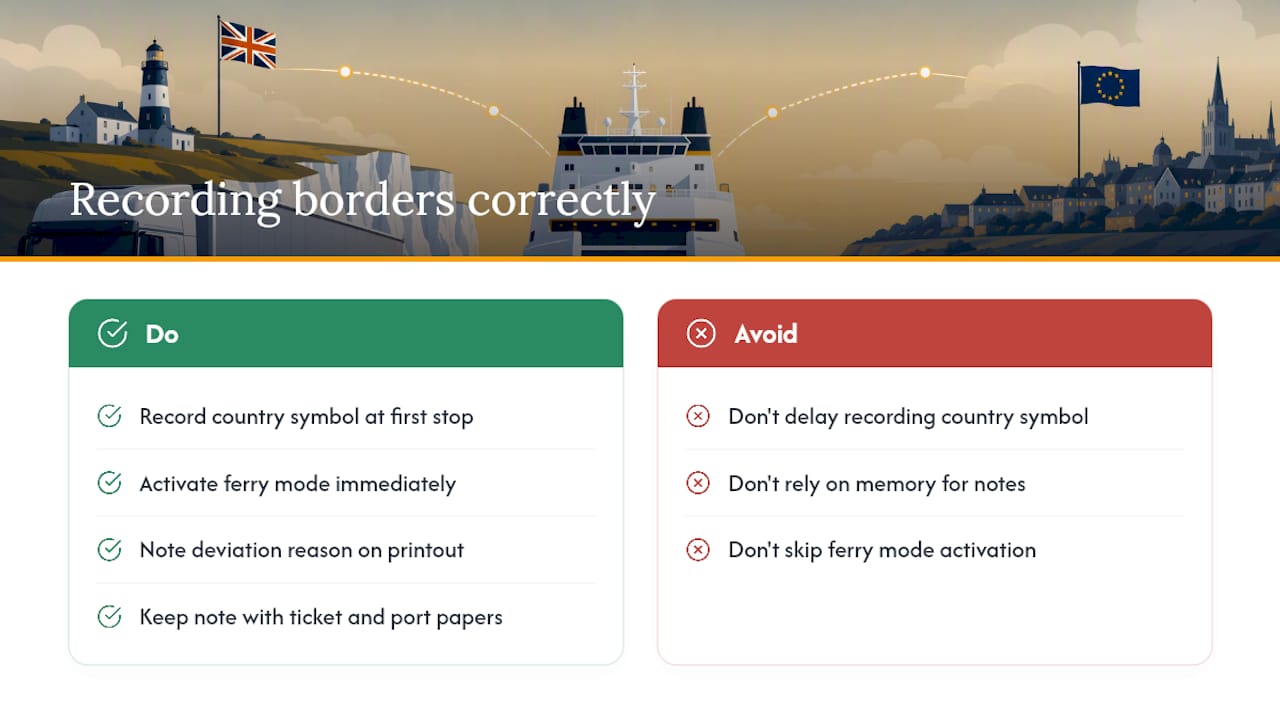
The country symbol must be recorded at the first suitable stopping place at or after the port or station of arrival, not simply logged when it’s convenient later in the shift, according to GOV.UK’s tachograph rules guidance. Smart tachographs that capture GNSS positioning can ease some of this manual burden, but ferry mode activation itself is never optional.
Where a driver deviates from normal recording, Regulation 165/2014 requires the reason to be noted on a printout or temporary sheet at the latest by the time the vehicle reaches a suitable stopping place. Keep that note alongside the ticket and any port paperwork rather than relying on memory.
Common mistakes, enforcement checks and penalties
Most ferry-related infringements come down to timing errors rather than deliberate rule-breaking, but enforcement doesn’t distinguish between the two.
- Forgetting to activate ferry mode, or letting two short interruptions drift past 60 minutes combined.
- Booking a seat-only ticket when the crossing is being used to interrupt weekly rest, which invalidates the interruption because no bunk was available.
- Tachograph data that doesn’t line up with ferry ticket timestamps, which is exactly the kind of mismatch that triggers a closer inspection.
- Falsifying or failing to record data correctly, which Regulation 165/2014 explicitly prohibits, alongside suppressing or destroying recorded information.
If a mistake happens, the remedy is immediate: print a record at the next stop, add a manual entry explaining the deviation, and keep every piece of cabin and ticket evidence rather than discarding it once the crossing is over.
Worked examples: getting the timing right
Numbers make this rule far easier to apply than reading the regulation text alone.
- Example A, compliant. A driver interrupts daily rest twice during a crossing: once for 20 minutes boarding, once for 30 minutes disembarking. Total interruption time is 50 minutes, under the 60-minute ceiling, and a bunk was booked throughout. The daily rest remains valid.
- Example B, non-compliant. The same driver faces a delayed disembarkation, pushing the second interruption to 50 minutes. Combined interruption time reaches 70 minutes. The 11-hour daily rest is now invalid, and the driver needs a fresh rest period before continuing, with the delay noted on a printout.
- Example C, weekly rest. A driver on an 8-hour overnight crossing with a booked cabin interrupts a reduced weekly rest for the sailing. Because the leg meets the 8-hour minimum and a sleeper was available, the interruption is valid, and the remaining rest hours are completed once ashore.
How compliance software helps with ferry evidence
Reconstructing a ferry crossing weeks later from memory is where most disputes go wrong. Tachograph analysis software that ingests .DDD files automatically can flag a missed ferry mode activation before it becomes an infringement on record, rather than after an inspection finds it. Storing tickets and cabin bookings against the matching tachograph event builds an audit pack that stands up under scrutiny, and multilingual, e-signed infringement reports keep the follow-up conversation with each driver straightforward.
A transport manager’s take on ferry compliance
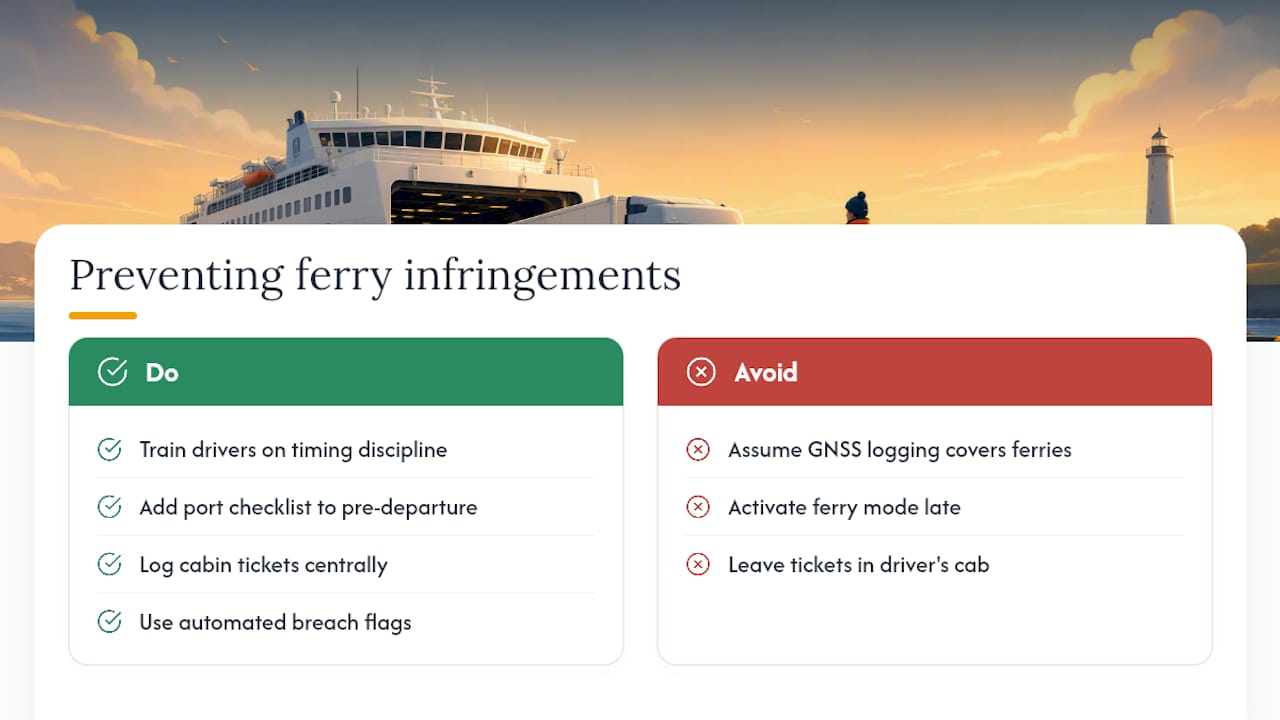
The pattern behind most ferry infringements isn’t ignorance of the 60-minute rule. It’s timing discipline: drivers who know the rule but activate ferry mode a few minutes late, or assume GNSS logging covers them when it doesn’t. Fixing that is training, not paperwork.
Build a port checklist into pre-departure routines, log every cabin ticket centrally rather than leaving it in a driver’s cab, and lean on automated tools to flag a possible breach before an inspection does. The drivers’ hours rules rarely change quickly, but the discipline around applying them consistently is where fleets actually lose or win compliance arguments.
— Vytautas
Keep ferry evidence audit-ready with Operatorcompliance
Manually cross-referencing ferry tickets against tachograph downloads works until your fleet grows past a handful of vehicles, then it becomes the first thing that slips. Compliance software can automate the process of reading digital tachograph downloads, flag drivers’ hours infringements including missed ferry mode activations, and build an audit-ready evidence pack suitable for DVSA examiners or traffic commissioners.
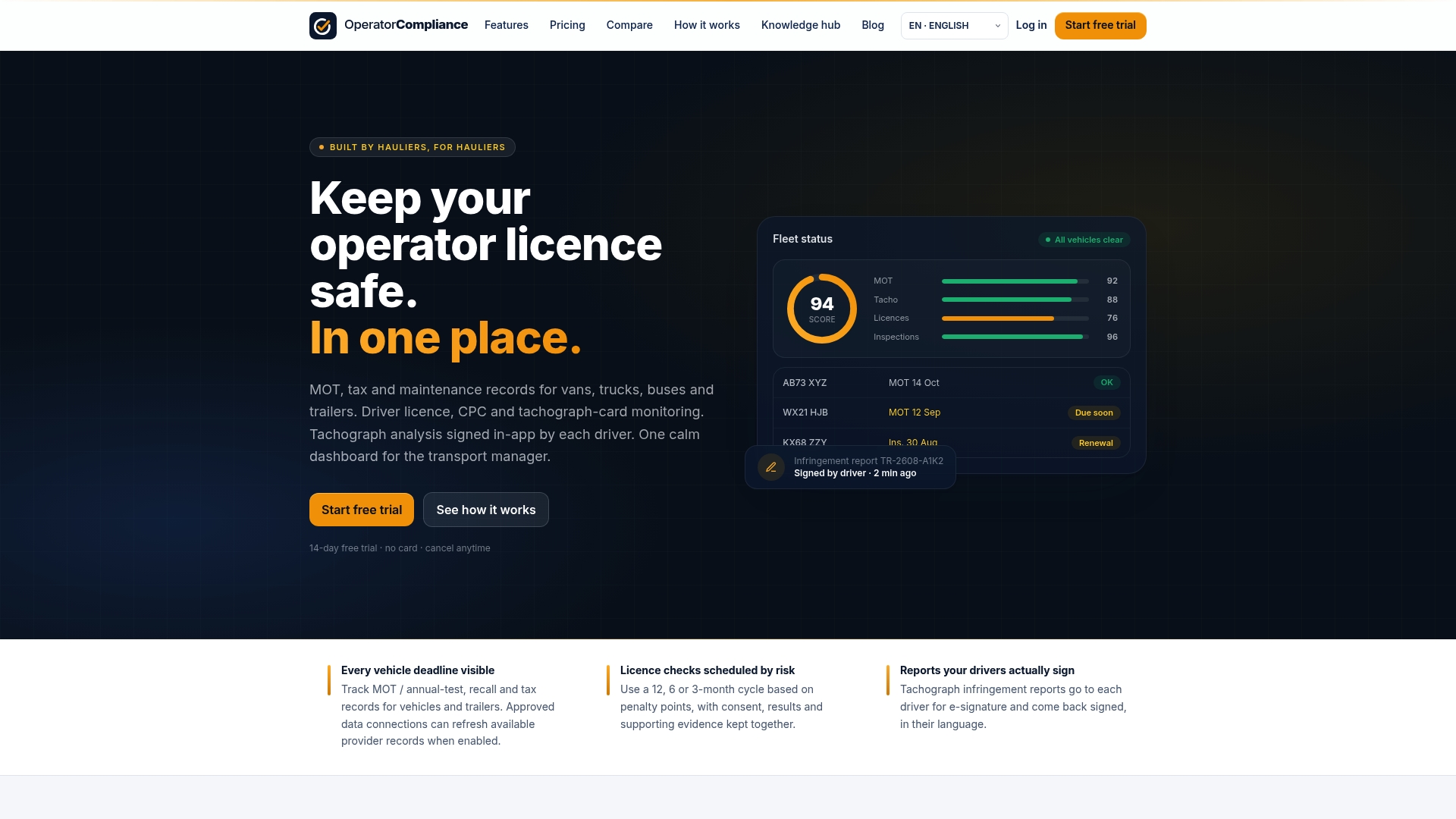
The platform also handles tachograph download rules for the wider 28 and 90-day cycle, so ferry evidence sits alongside every other compliance record rather than in a separate folder somewhere. If you run HGVs, PSVs or vans on an O-licence, see how it works and set your fleet up in an afternoon.
Official guidance and regulations to consult
For the primary legal text, see GOV.UK’s drivers’ hours and tachograph guidance, Regulation (EC) No 561/2006, and Regulation (EU) No 165/2014.
Sources
- Gov
- Regulation (EU) No 165/2014 on tachographs in road transport
- Ferry mode on Smart Tachographs V2 | Freightlink
FAQ
What are the tacho rules for ferry crossings?
A regular daily rest can be interrupted twice, up to 60 minutes combined, with a sleeper cabin available; weekly rest needs at least an 8-hour crossing and a cabin to qualify for interruption.
What are the tachograph rules in the UK for 2026?
The core rules haven’t changed: Regulation 561/2006 on drivers’ hours and Regulation 165/2014 on tachograph technical standards still govern ferry interruptions, GNSS recording, and manual entry obligations.
How do you set ferry mode on a digital tachograph?
Select “Ferry/Train” mode just before the vehicle moves onto the ramp, then switch back to “Rest” once parked and secured on deck, keeping the combined interruption time under 60 minutes.
What are the most common tachograph infringements around ferries?
Failing to activate ferry mode, letting interruptions exceed 60 minutes combined, and using a seat-only ticket when
ferry rules tachograph