· 14 min read
How to Operate a Digital Tachograph the Right Way
Learn how to operate a digital tachograph with confidence. Covers driver cards, downloads, mode settings, troubleshooting, and UK compliance essentials.

At 04:50, the driver's standing beside a tractor unit with the trailer already coupled, card still in the pocket, and the depot manager looking at the clock. That's the moment most tachograph mistakes start, not later on a roadside check. If the card goes in late, the mode's wrong, or the download window slips, you don't just get a paperwork headache. You can end up with a digital record that won't defend the driver or the operator when DVSA asks questions.
Table of Contents
- What a Digital Tachograph Does and Why It Matters in 2026
- Starting a Shift With the Driver Card and Correct Modes
- Running the 28-Day Card and 90-Day Unit Download Cycle
- Calibration, Repairs and the Smart Tachograph 2 Threshold
- Common Operating Mistakes and How to Fix Them Fast
- Building a Defensible Tachograph Workflow for Your Fleet
What a Digital Tachograph Does and Why It Matters in 2026
A digital tachograph is the vehicle's evidence trail, not just a dashboard unit. It records speed, distance, driving time, rest, and activity mode, so it shows what the vehicle and driver did, minute by minute. If the driver sets it badly, or the operator lets the record drift, the box still works, but the evidence becomes weak.
The legal scope is wider than many yards think
The working rule in the UK is straightforward. If the vehicle sits in tachograph scope, the operator has to manage the card, the unit, and the downloads as part of compliance, not as a side task. The tachograph guidance from PDRS makes the 28-day driver card and 90-day vehicle unit download cycle clear, and it explains why timing matters, because older data can be overwritten if you leave it too long. Digital tachograph guidance for UK operators
Vehicle type still decides a lot of the edge cases. The familiar framework remains focused on heavier commercial vehicles, but the awkward question now is the 2.5 to 3.5 tonne international van. For UK operators, the rule change matters most where vans are used for international hire-or-reward work, because those vehicles need the right kit and records from the point the law applies. UK-only vans in that bracket do not automatically fall into the same scope just because they pass 2.5 tonnes. UK operator guidance on the 2026 van threshold
Practical rule: treat the tachograph as evidence first and equipment second. If the record will not stand up under scrutiny, the hardware has not done its job.
Why remote scrutiny changes the job
That matters more in 2026 because enforcement is no longer only a roadside stop and a quick card check. Remote and record-based scrutiny now plays a bigger part, with ANPR data and remote sensing of second-generation smart tachographs feeding the picture before anyone opens the cab door. A sloppy record can be visible long before a driver sees an examiner. Remote and record-based enforcement trends
So the job is not just card-in, card-out. It is about keeping a digital trail that matches the shift, the mileage, and the activity at the unit. That means the driver card, the download routine, calibration, fault handling, and fleet control all have to line up. If the yard treats the tachograph as a live evidence chain, the system holds. If it treats it as a warning light to silence, the gaps show up later.
Starting a Shift With the Driver Card and Correct Modes
The cleanest tachograph shift starts before the engine's turned over. The driver gets in, checks the card, and sets the unit to tell the truth from the first movement. That sounds basic, but most infringements start with a tiny miss, a card left out, a mode left on rest, or a journey that begins before the unit knows who's driving.
The card sequence in the cab
Slot the driver card chip-up into the correct slot, usually slot 1 for the driver. If there's a second crew member, slot 2 gets used for the co-driver. The unit will normally ask for the PIN, then it should display the name, licence number, and country so the driver can confirm the card's been read properly.
If the card prompts manual entries, answer them carefully. The unit may ask for where you were, country start, odometer reading, and any out-of-scope activity before insertion. Don't rush those screens. A tidy manual entry closes the gap that an examiner later sees as missing mileage or unexplained time.
If the card isn't in the slot while the vehicle is moving, the tachograph can't protect the driver's record. Missing mileage is one of the most common avoidable problems on the yard floor.
Set the mode before the work starts
The mode switch, whether it's a rotary knob or soft keys, has to match what the driver is doing. Driving is obvious. Rest is rest. The tricky calls are availability and other work. Yard shunting, loading, unloading, and paperwork usually sit under other work if the driver is actively doing the task. Waiting around for someone else to finish a job can be availability if the driver isn't required to work, but that judgement has to match the facts, not the convenience of the moment.
A few habits save grief later:
- Check the UTC time, it should be within ten minutes. If the clock's wrong, the record starts looking untidy fast.
- Confirm the previous session is closed, especially if the driver used another vehicle yesterday.
- Record ferry, train, and transition symbols before border crossings or mode changes that the unit needs to capture.
- Don't leave the mode on the default setting after a break, because that's how simple yard movements turn into infringements.
The DVSA's own operator guidance puts the driver's duties plainly. The card has to be carried, the mode has to match the activity, and missing card use can create missing mileage. DVSA tachograph operator bulletin on correct mode use
For a driver who wants the job done right, the rule is simple. Insert, confirm, set the mode, and keep it accurate until the shift ends. That's what turns a tachograph from a nuisance into usable evidence.
Running the 28-Day Card and 90-Day Unit Download Cycle
Download discipline works best when it's calendar-based, not memory-based. If the process depends on somebody “getting round to it”, the record will eventually drift beyond the safe window. For UK fleets, the key cadence is still driver cards at least every 28 days and vehicle units at least every 90 days, with the practical aim of downloading before the stored data reaches the overwrite point. UK tachograph download rules and retention workflow
What the download actually looks like
Most fleets use a download key or a remote device. The physical process is straightforward enough, connect to the front panel USB or the approved interface, authenticate with the company or workshop card where required, and export the .ddd file. After that, the software matters. Raw tachograph files have to be read, converted, and checked against the rules the operator is working to, whether that's EU, AETR, GB domestic, or RT(WT)R 2005.
The file is only useful if someone reviews it
The gap I see most often isn't the download itself, it's the analysis. Operators download the card and the unit, file the data away, and assume the job's finished. It isn't. The analyst needs to review the file, flag infringements, and produce something the transport manager can act on. That usually means infringement reports, anomaly flags, and a record that shows the issue wasn't ignored.
A tidy workflow normally does three things:
- Download on schedule, before the card or unit falls behind.
- Store the files securely, with access controlled and the records kept in the right retention period for the fleet's process.
- Close the analyst review, so no file sits in limbo without a decision.
The usefulness of software is not flashy dashboards. It's the quiet parts, reminders, automatic collection, and proof that the file was seen by someone who understands tachograph rules. A simple spreadsheet can help for a tiny fleet, but it won't chase a card that's sitting in a truck overnight or tell you when the review ticket's still open.
If you want a process view of how that file flow works in practice, the operator's guide to tachograph download rules is the right place to start. The point is discipline, not software brand loyalty. The record has to be there, readable, and analysed before it becomes the sort of gap an examiner can use.
Calibration, Repairs and the Smart Tachograph 2 Threshold
A tachograph that has not been calibrated properly is worse than useless, because it looks official while weakening the evidence. Calibration is not just a workshop ritual. It ties the unit to the vehicle it sits in, so the registration number, motion data, and printed output line up with the truck in front of the examiner.
What the calibration cycle has to prove
UK guidance says the tachograph has to be activated and calibrated with the vehicle registration number before first use, then recalibrated at least once every 24 months, and again after repair or a registration change. The workshop visit is not finished when the keys are handed back. The unit needs to show the correct plaque, the paperwork has to match, and the operator has to keep the certificate in the audit trail. Calibration and inspection guidance for UK tachographs
Repairs and mixed fleets are where fleets slip
Repairs that affect measurement accuracy need proper follow-up. Gearbox changes, sensor replacement, and wheel circumference changes can all throw the system out of line, so the unit needs to be revisited rather than assumed to be fine. Mixed fleets make that harder because some vehicles sit on one generation of tachograph and others on another, and the workshop date gets missed while the vehicle is still earning.
Where smart tachograph 2 becomes the issue
The 2026 edge cases sit alongside the calibration job, not instead of it. The scope point for goods vehicles and vans over 2.5 tonnes is covered earlier in the article, so here the practical issue is keeping the calibration record clean for whatever vehicle class you are running. If a vehicle moves from domestic use to international work, the paperwork has to prove the unit was valid at the time it was used.
The smart tachograph 2 generation also gives enforcement more to inspect through GNSS, DSRC, and the ITS interface. That makes the record more than a driver's self-report. It becomes a machine-readable trail that can show location points, remote checks, and data exchange with other systems. That helps enforcement, but it also means the workshop certificate has to be current, readable, and easy to produce when the unit is pulled for scrutiny.
| Event or vehicle class | Action required | Deadline | Evidence to keep |
|---|---|---|---|
| First installation | Activate and calibrate with registration number | Before first use | Workshop certificate, plaque details |
| Routine calibration | Recalibrate the unit | At least every 24 months | Calibration certificate, workshop record |
| Repair affecting accuracy | Recalibrate after the repair | Immediately after repair | Repair note, new calibration record |
| Registration change | Recalibrate to match the new details | After the change | Updated certificate, vehicle record |
| International goods vehicle over 2.5 tonnes from 1 July 2026 | Fit smart tachograph 2 where required | As the rule applies | Fitment record, workshop paperwork |
| UK-only van over 2.5 to 3.5 tonnes | No automatic smart tachograph 2 duty under the international rule | Not applicable unless scope changes | Fleet scope assessment, route records |
The examiner is not guessing here. They are checking whether the fleet can prove the unit was valid when it was used. If the certificate, plaque, and vehicle record do not agree, the argument gets harder fast.
Common Operating Mistakes and How to Fix Them Fast
The same few errors keep turning up because they're easy to make and awkward to explain. A driver forgets to switch modes on a yard move, a ferry crossing isn't marked properly, or a unit goes past the download date because the office assumed someone else had it covered. By the time an examiner or Traffic Commissioner sees the file, the difference between a fixable slip and a real breach is whether the operator acted quickly and documented it properly.

The faults drivers usually create
The first problem is missing mileage. That happens when the card wasn't inserted for a one-man run, or it was left in another truck, so the unit never had a proper driver identity against the movement. The second is a mode switch miss, especially when leaving a yard or moving from waiting time to loading. The third is the unrecorded ferry or train move, where the driver forgets the symbol change and the day's route suddenly looks incomplete.
A sensible fix is always the same sequence. Reconstruct the missing period with the unit menu where possible, add the manual entry while the facts are still fresh, and attach supporting paperwork such as a delivery note, crossing record, or depot sign-out. The analyst's job is to decide whether the gap is explained, not to pretend the gap never existed.
What to do when the download cycle slips
Download offences are easier to avoid than to defend. If the card file is older than 28 days or the unit file is older than 90 days, the operator needs to act immediately and record why the deadline was missed. The best defence is a prompt download, a written explanation, and a note showing the corrective control, whether that's a calendar reminder, a remote download device, or a revised handover process.
Unanalysed downloads cause a different problem. The files exist, but nobody closed the ticket. That's weak because the operator can't show that infringements were identified and dealt with. The right fix is to run the analyst review, issue any driver report, and get the signed copy back into the file. For a practical reading of what examiners look for in the file, see how to read a tachograph printout.
If you can't explain the gap with a record, assume the enforcement officer will treat it as a gap.
The correction pack that actually helps
- Manual reconstruction: Enter the missing activity, add the location and time, and keep the supporting job paperwork.
- Driver briefing: Tell the driver what went wrong, because repeated “simple slips” look like poor control.
- Signed declaration: Keep a note signed by the driver or manager where a genuine exception has been accepted.
- Analyst closure: Don't leave the issue open in the system, because an open ticket looks like an ignored breach.
I've seen fleets defend small errors successfully when they could show the correction, the explanation, and the follow-up. I've also seen the same fleets trip over the same mistake again because nobody changed the habit that caused it. The fix only counts if it changes tomorrow's shift.
Building a Defensible Tachograph Workflow for Your Fleet
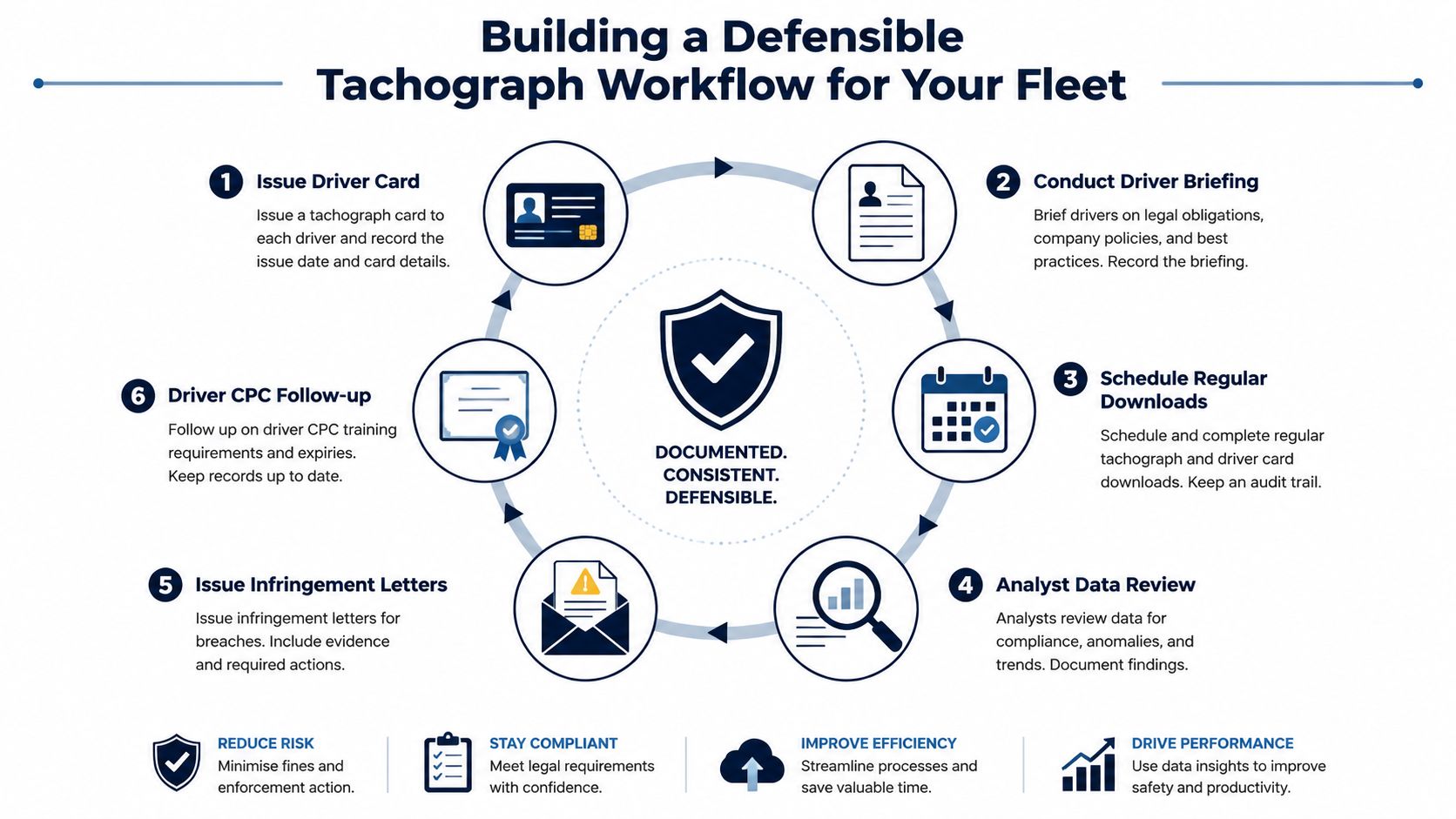
A driver can do everything right at the roadside and still leave you exposed if the office side is messy. A defensible tachograph workflow starts with the card, but it survives on the paperwork, the downloads, the analyst review, and the follow-up when something is missing or wrong. That is what stands up when an examiner asks who checked it, when it was checked, and what the operator did next.
The office process that holds up under scrutiny
The transport manager has to keep the evidence trail complete enough for inspection. Download dates need tracking, cards need replacing before they go stale, and the analyst needs to close the loop, not just open the file and move on. Driver training sits in the same trail, because many tachograph breaches start with poor understanding rather than intent, and the training record helps show due diligence.
The file structure matters too. Tachograph records should sit inside the operator's evidence process, with staff records showing who was briefed, when they were briefed, and how the business reacted after a breach. That is the difference between “we think it was handled” and “we can show it was handled”.
Where software earns its keep
A spreadsheet can list dates, but it won't chase a card that never came back after a vehicle change, and it won't reliably show that analyst review happened on time. Software with reminders and remote download support makes the workflow visible and easier to prove. For details on remote download setups, see our guide to remote tachograph downloads. One option in that space is OperatorCompliance, which handles tachograph file upload and analysis, download reminders, and signed infringement reports alongside wider operator-licence records.
Questions fleets keep asking
- Can one driver use two cards? No, not as a shortcut. The card has to match the driver and the journey, otherwise the record gets hard to defend.
- What if a new vehicle has missing data? Treat it as a handover issue, check the activation and calibration trail, and confirm the first valid download.
- What counts as other work? Loading, unloading, and admin tasks usually do, but the facts of the task matter more than the label.
- How do I handle a defective unit notice? Keep the vehicle's evidence intact, document the fault, and move quickly to a repair and recalibration path so the day's record is not lost.
The point is simple. Anyone should be able to open the file and see what happened, who checked it, and what the operator did next. That is what makes the tachograph record defensible, whether the scrutiny comes from an audit, a roadside check, or a remote review of the file set.
digital tachographdriver cardstachograph downloadsUK haulage complianceDVSA tachograph rules