· 11 min read
Audit Ready in 4 Steps: Telematics for Compliance for UK Managers
UK transport managers: four steps to keep O licence records audit ready with telematics, including 28 and 90 day downloads and tamper proof exports.

Audit Ready in 4 Steps: Telematics for Compliance for UK Managers
In this article, telematics for compliance means operator-licence compliance software that keeps vehicle and driver records audit-ready: tachograph downloads, MOT, tax, insurance, PMIs and licence and CPC checks. It is not GPS tracking or driver-behaviour telematics. The outcome that matters is evidence a DVSA examiner or traffic commissioner can check quickly, and OperatorCompliance is one product built specifically for that job.
TL;DR:
- Compliance telematics consolidates vehicle and driver records into an audit-ready format, excluding GPS tracking and driver behavior systems.
- Download schedules are strict: driver cards every 28 days and vehicle units every 90 days, with gaps risking permanent data loss.
- The core value lies in producing tamper-proof, signed, and exportable evidence packages, not just in real-time dashboards.
- Establishing weekly routines for reviewing exports, closing defects, and signing infringement reports prevents common audit failures.
- Digital records must demonstrate clear management review and active oversight, not just data storage.
Table of Contents
- What counts as telematics for compliance and what does not
- The legal basics transport managers have to meet
- How compliance telematics turns daily tasks into audit evidence
- A step-by-step routine to stay audit-ready
- How OperatorCompliance meets these requirements
- Fitting telematics data into your existing compliance systems
- Common challenges when introducing compliance telematics
- Regulatory updates that affect how you use compliance telematics
- Why the paperwork isn’t the problem, the management is
- Getting ready to trial OperatorCompliance
- Sources
- FAQ
What counts as telematics for compliance and what does not
Under this definition, compliance telematics covers vehicle records (MOT and annual test, road tax, insurance, safety inspections, tachograph calibration), driver records (driving licence checks, Driver CPC, tachograph cards, right to work) and the tachograph analysis that flags drivers’ hours infringements. It also covers digital walkaround checks and the audit packs a transport manager assembles before an inspection.
It does not cover GPS vehicle tracking, route optimisation or driver-behaviour scoring systems. Those tools monitor where a vehicle goes and how it is driven; they were not built to prove licence compliance and rarely produce the paperwork an auditor asks for.
Mapped against a transport manager’s duties, the features line up neatly: fitness and continuity duties need licence and CPC tracking, roadworthiness duties need PMI and tachograph calibration records, and drivers’ hours duties need tachograph download and infringement management. Each duty needs its own evidence trail, and that is what this software produces.

The legal basics transport managers have to meet
A few statutory clocks run regardless of fleet size, and missing them is one of the fastest ways to fail an audit.
- Vehicle units must be downloaded at least every 90 days, and driver cards at least every 28 days, because units hold roughly a year of data while cards hold around 28 days of activity before older entries are overwritten.
- Safety inspection records must be kept for at least 15 months, covering every vehicle that has been on the licence, even one since removed or disposed of.
- A forward maintenance planner should show inspection dates at least six months ahead, and DVSA notes that electronic planners can be more effective than a static wall chart because they update dynamically.
Missing a download window does not just risk a fine. It destroys evidence that cannot be recreated, and auditors treat gaps as a sign that hours are not being managed rather than an administrative slip.
How compliance telematics turns daily tasks into audit evidence
The value of this software is not the dashboard itself, it is what the dashboard produces when an auditor asks to see it.
A central view with automated alerts covers the recurring deadlines: MOT and annual test dates, road tax, insurance renewal, tachograph calibration, Driver CPC expiry and licence checks. Instead of a transport manager tracking these across spreadsheets, the system flags what is due and when.
- Automated ingestion of digital tachograph .DDD files replaces manual downloads with a scheduled process that catches infringements as they happen.
- Driver e-signature workflows let each driver acknowledge and sign their own infringement report, creating a documented response rather than a silent record.
- A driver app supports daily walkaround checks and defect reporting in multiple languages, useful where a workforce includes non-native English speakers.
- Records carry tamper-proof audit trails with date and time stamps, and the whole set can be exported as an audit-ready pack rather than pulled together at the last minute.
DVSA guidance is explicit that digital systems must show who checked a record and when, with the ability to produce hard copies on request. A system that cannot show that chain of custody does not meet the standard, however good its dashboard looks.
Pro Tip: Set your tachograph download reminders a week earlier than the legal deadline, so a missed alert still leaves room to fix it before the record is lost.
A step-by-step routine to stay audit-ready
Audit readiness is a routine, not a one-off exercise before an inspection letter arrives. The following sequence works as a weekly habit and as a pre-audit sprint.
- Confirm your downloads schedule: who pulls driver card and vehicle unit data, where files are archived, and what filename convention is used, so nothing depends on memory.
- Check PMI and brake test evidence for the last few scheduled inspections, and confirm any defects found were closed out with a recorded corrective action.
- Export a sample of driver infringement reports and check each has a countersigned management response, not just a system-generated flag.
- Assemble a full compliance pack: MOT and vehicle history, insurance documents, tachograph analyses, signed walkaround checks and management sign-off notes.
A practical version of this routine, drawn from DVSA’s own operator licensing guidance, is to export six months of tacho analyses and signed infringements, produce a forward planner showing the next four inspections, collate MOT and insurance evidence, and countersign the lot in a short management review note.
Most audit failures come down to one gap: operators can show the data exists, but not that a manager actively reviewed it and acted. DVSA’s operator compliance audit guidance states auditors look for tamper-proof, auditable records and clear evidence of active management, not passive storage.
How OperatorCompliance meets these requirements
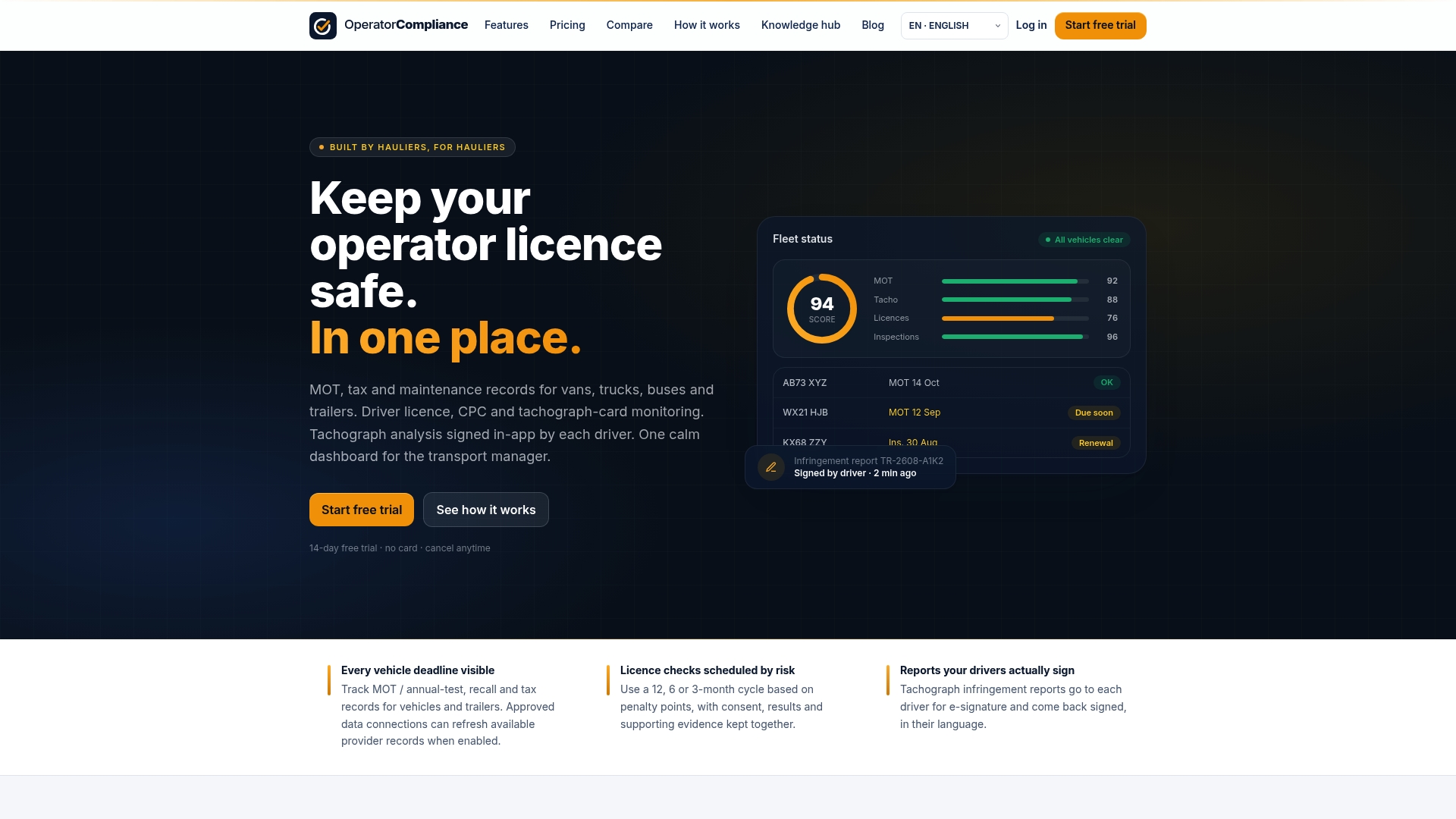
OperatorCompliance imports digital tachograph .DDD files and produces infringement analysis, with each driver signing their own report inside the app rather than a manager chasing paperwork. The driver app supports English, Polish, Romanian, Lithuanian and Bulgarian, useful for mixed-nationality driving teams doing daily walkaround checks.
A typical flow runs from a driver logging a defect on the app, through a workshop fixing it, to the record landing in an exportable pack alongside tachograph analyses and licence checks, aligned to the structure DVSA and traffic commissioners expect to see at audit. The transport manager landing page sets out how the dashboard, alerts and exports fit together for a single-person compliance role.
Fitting telematics data into your existing compliance systems
Most operators already run something: a spreadsheet for MOT dates, a filing cabinet for safety inspection sheets, a separate tachograph analysis tool. Compliance telematics is not meant to replace every process overnight, it is meant to consolidate the records that currently live in different places into one exportable set.
The practical integration point is the audit pack itself. Whatever system holds MOT and insurance data, tachograph analysis and PMI records, the end product an auditor wants is a single, legible file set covering the licence period in question. DVSA’s remote audit framework confirms that remote audits are accepted when operators can supply complete, easy-to-read electronic evidence, which makes a consolidated export more useful than several disconnected systems each holding part of the picture.
Where a fleet already uses a transport management system for job scheduling or invoicing, the practical fix is usually procedural rather than technical: decide which system is the source of truth for each record type (tachograph data, PMI, licence checks) and keep that discipline consistent, rather than letting the same fact live in two places with two different values. A digital tachograph download and a paper safety inspection sheet, for instance, should not need reconciling by hand every audit.

Common challenges when introducing compliance telematics
The most frequent obstacle is not the software, it is historic data. Operators often start a new system with gaps in their tachograph archive or missing PMI records from previous months, and those gaps do not disappear on day one.
DVSA’s Earned Recognition guidance suggests self-auditing and fixing historic gaps before relying on a new system’s records, which is sound advice even for operators not applying to that scheme. A second common issue is driver adoption: a digital walkaround check or e-signature workflow only produces evidence if drivers actually use it, so a short driver-facing explanation of why the check matters tends to work better than a policy memo nobody reads.
A third challenge is treating the software as the finished job. A dashboard full of green ticks means nothing to an auditor if nobody can show a manager reviewed the amber and red items and did something about them. The fix is procedural: a fixed weekly slot to review flagged items, with a short note recording what was checked and what was decided.
Regulatory updates that affect how you use compliance telematics
The rules a transport manager works to are not static, and the Operator Compliance Risk Score is the clearest example of where internal monitoring now matters more than it used to. OCRS is calculated from roadside encounters, MOT history and combined risk scores, and operators can use their own internal compliance data to spot issues before they show up in that score.
DVSA’s Earned Recognition scheme also continues to shape what “good” evidence looks like, with audit standards built around documented forward planning, tachograph calibration processes and robust infringement reporting. Operators who are not in the scheme still benefit from matching that standard, because it is broadly what a standard audit checks for too.
The direction of travel is towards accepting digital evidence more readily, provided it is legible, complete and verifiable, as the acceptance of remote audits shows. That makes tamper-proof, date-stamped digital records a more durable choice than paper files that need scanning or copying before an audit.
Why the paperwork isn’t the problem, the management is
The software rarely fails an audit. What fails is the absence of proof that anyone reviewed what it produced. A system full of unread alerts and uncountersigned infringement reports looks identical to no system at all, from an auditor’s chair.
The fix is small and behavioural: a fixed weekly review, a countersigned note on every corrective action, a short debrief with drivers who trigger repeat infringements. None of that needs new software, it needs a habit.
— Vytautas
Getting ready to trial OperatorCompliance
If you want to see whether this approach fits your operation, the practical test is to run your own records through it rather than read another feature list. Try importing a batch of .DDD files to see the infringement analysis, generate an exportable pack, run a walkaround check through the driver app, and check the multilingual interface if you run a mixed-nationality team.
A few actions worth doing this week regardless of what software you choose:
- Run a pre-audit export of your last six months of tachograph analyses and infringement reports.
- Confirm your download schedule matches the legal 28 and 90-day limits and assign it to a named person.
- Invite a small pilot group of drivers to trial the app before rolling it out fleet-wide.
Plans start at £9 a month for the Starter tier, with Standard and Professional tiers scaling up for larger fleets, and full details are on the pricing page.
FAQ
What does telematics for compliance mean for an O-licence?
It means software that tracks the records an operator licence depends on: MOT and tax, insurance, safety inspections, tachograph downloads and driver licence or CPC checks. It is distinct from GPS or driver-behaviour telematics, which do not produce the evidence a DVSA audit checks.
How often must I download tachograph data?
Driver cards must be downloaded at least every 28 days and vehicle units at least every 90 days, because data held on the card and unit is eventually overwritten. Missing either deadline risks losing records permanently rather than just facing a late download.
How long must I keep safety inspection records?
Safety inspection records must be retained for at least 15 months, covering every vehicle that has held an entry on the licence. This applies even to vehicles later removed from the licence or disposed of.
What does OperatorCompliance cost?
OperatorCompliance offers Starter, Standard and Professional plans from £9 a month on the monthly billing option, with annual pricing also available, plus an Enterprise tier priced on request. Full details and feature breakdowns are on the pricing page.
What should an audit-ready compliance pack contain?
It should include MOT and vehicle history, current insurance, tachograph analyses with infringement reports, signed walkaround checks and countersigned management review notes. DVSA’s operator compliance audit guidance states auditors expect tamper-proof records with clear evidence that a manager reviewed and acted on them.
Recommended
- Tacho Analysis Software for UK Fleets: A Practical Guide
- Tacho Remote Download Guide for UK Fleets
- Compliance software for hauliers
- Owner-driver compliance from £9/month
This article is general guidance for UK operators and transport managers, not legal or professional advice. Regulations change, so always confirm the current requirements with GOV.UK, DVSA and your traffic commissioner before acting.
telematics for compliance