· 10 min read
UK transport manager responsibilities: continuous, effective control
Regulator focused guide to Statutory Document 3 for UK transport managers: audit ready checklist, timelines, 28/90 downloads and records.
UK transport manager responsibilities: continuous, effective control
A transport manager must exercise continuous and effective control over an operator’s transport activities, covering drivers’ licences and hours, vehicle roadworthiness, tachograph compliance and record keeping. This is a statutory standard set by the Traffic Commissioner, not a job description you can interpret loosely. Get it wrong and the consequences run from a warning letter to public inquiry and disqualification.
TL;DR:
- Continuous and effective control requires active oversight and documented supervision of drivers, vehicles, and recordkeeping, not just periodic checks.
- Transport managers must hold a valid CPC, establish a genuine link to the operation, and obtain Traffic Commissioner approval before formal appointment.
- Regular and timely downloads of tachograph data, vehicle inspections, and driver licence checks are essential for maintaining compliance and catching infringements early.
- Accurate record retention of 12 to 24 months and organized audit packs are critical for proving compliance during inspections or inquiries.
- Delegation must be documented, and managers should proactively audit their systems regularly, not just react to enforcement visits or violations.
Table of Contents
- What are a transport manager’s core legal responsibilities?
- Qualification and nomination: CPC, genuine link and Traffic Commissioner approval
- Driver management: licences, Driver CPC and ongoing competence
- Drivers’ hours and tachograph rules: downloads, analysis and infringement handling
- Vehicle maintenance and roadworthiness: PMIs, MOT and defect handling
- Records and documentation: retention periods and audit readiness
- Building proof of active management, not reactive fixes
- Delegation, capacity and what to do when your authority is overridden
- A practical timeline: daily, weekly, monthly and annual tasks
- Practitioner perspective: what separates a clean audit from a public inquiry
- How OperatorCompliance supports your statutory duties
- Sources
What are a transport manager’s core legal responsibilities?
“Continuous and effective control” is the phrase that anchors every transport manager’s legal position in Great Britain, and it comes directly from the Senior Traffic Commissioner’s guidance. It means you cannot simply hold the Transport Manager CPC and check in once a month. You must actively direct and monitor the transport operation, and be able to prove it when a DVSA examiner or the Traffic Commissioner asks.
That proof matters more than most operators realise. A transport manager who signs off on paperwork without genuinely knowing what is happening on the yard is, in the Commissioner’s eyes, not exercising control at all. Gov frames the role around outcomes: are vehicles taxed, MOT’d and insured, are drivers legally entitled to drive, are hours and tachograph rules followed, and are records kept for the periods the law demands.
Delegation is allowed and, in larger fleets, unavoidable. A transport manager overseeing 80 vehicles cannot personally check every tachograph file or walkaround report. What the Commissioner expects is a documented chain: who does what, how often, and how the transport manager reviews and signs off that work. Delegating a task without auditing it later is treated as abandoning control, not sharing it.
Traffic Commissioners assess whether continuous and effective control genuinely exists using several practical indicators:
- Hours committed to the operation against the size and complexity of the fleet, checked against other jobs the transport manager holds.
- Physical or documented presence, including site visits, management meetings, and evidence of direct instruction to staff.
- Systems in place for licence checks, maintenance planning, tachograph analysis and infringement handling.
- Financial and operational authority, meaning the transport manager can actually stop an unroadworthy vehicle running, not just recommend it.
- A track record of corrective action, showing that when something goes wrong, it gets fixed and documented, not just noted and forgotten.
Where these indicators are weak, the Traffic Commissioner may conclude that the named transport manager exists on paper only. That finding alone has triggered public inquiries even where no vehicle defect or driver offence had yet occurred.
Qualification and nomination: CPC, genuine link and Traffic Commissioner approval
Before anyone can be named as transport manager on an operator’s licence, they need the Transport Manager Certificate of Professional Competence. There are separate CPC qualifications for goods vehicle operations and for passenger service vehicles, and holding one does not qualify you to act as transport manager for the other. Under GOV.UK’s guidance on becoming a transport manager, the Traffic Commissioner must formally approve the nomination before it takes legal effect, and approval is not a rubber stamp.
The process generally runs through these stages:
- Obtain the relevant CPC. The qualification is tested through the relevant awarding bodies and covers operator licensing law, vehicle standards, drivers’ hours and business management.
- Establish a genuine link to the operation. The Traffic Commissioner wants evidence that the transport manager is realistically able to exercise control, not just named for convenience. This might include an employment contract, a consultancy agreement with defined hours, or proof of regular attendance at the operating centre.
- Submit the nomination with the operator licence application or as a variation. The operator must notify the Traffic Commissioner formally, and the transport manager’s declaration forms part of that submission.
- Respond to any request for further evidence. Commissioners can ask for detail on hours worked, other roles held, and how oversight will be maintained across multiple sites if relevant.
- Maintain repute throughout the appointment. Repute is not assessed once and forgotten. Convictions, previous disqualifications, or evidence of poor management elsewhere in a transport manager’s career can all be brought into question at any point.
Refusals and repute challenges tend to cluster around a small number of recurring issues. A transport manager nominated across too many operating centres without a credible explanation of how they will cover all of them is a common flag. So is a transport manager who has previously been disqualified or who was named as transport manager during a period when an operator was found to have serious compliance failures. Weak or non-existent evidence of a genuine link, such as a nomination with no employment paperwork and no record of site visits, is another frequent cause of refusal.
There is also an ongoing notification duty that many operators overlook. If a transport manager’s working hours or role change materially, for example moving from full time to a part time consultancy arrangement, the Traffic Commissioner must be told. Failing to notify a reduction in hours that undermines the original “genuine link” evidence can itself trigger a review of repute, independent of any other compliance issue on the fleet.
Driver management: licences, Driver CPC and ongoing competence
Every driver on the fleet needs a valid licence for the vehicle category they are driving, and it is the transport manager’s job to know that at all times, not just at the point of hire. That means running a DVLA licence check before a driver starts, then repeating checks at a frequency that reflects risk. A driver with penalty points close to a threshold, or one flagged during a previous check, generally needs checking more often than a clean licence holder.
Driver CPC compliance sits alongside this. Professional drivers of most goods vehicles over 3.5 tonnes and buses or coaches carrying passengers need periodic training hours completed within a rolling five year cycle. A transport manager who cannot produce evidence of current Driver CPC status for every relevant driver has a live compliance gap the moment a DVSA officer asks.
Good practice on driver records typically includes:
- A licence check log recording the date, method (DVLA online check or the Driver and Vehicle Licensing Agency share code service) and result for every driver, refreshed on a documented schedule.
- Driver CPC certificates or training records held centrally, with renewal dates flagged well before the five year deadline.
- Induction records showing new drivers were briefed on walkaround checks, drivers’ hours rules and company reporting procedures.
- A disciplinary log capturing any drivers’ hours infringement, defect reporting failure or licence issue, with the action taken.
- Evidence of ongoing competence checks, such as periodic ride-alongs, tachograph behaviour reviews or toolbox talks tied to recurring issues.
Pro Tip: Set licence check frequency by risk band rather than a single blanket rule. Drivers on 3 to 6 points get checked more often than those with a clean licence; it is a small administrative step that carries real weight if a Traffic Commissioner ever asks how you manage licence risk.
Recruitment vetting matters here too, particularly for operators bringing in agency or newly qualified drivers. Guidance on selecting professional drivers can help sharpen the questions asked at interview stage, before a driver ever gets near a vehicle. Getting vetting right at the front door reduces the volume of problems a transport manager has to manage reactively later.
Drivers’ hours and tachograph rules: downloads, analysis and infringement handling
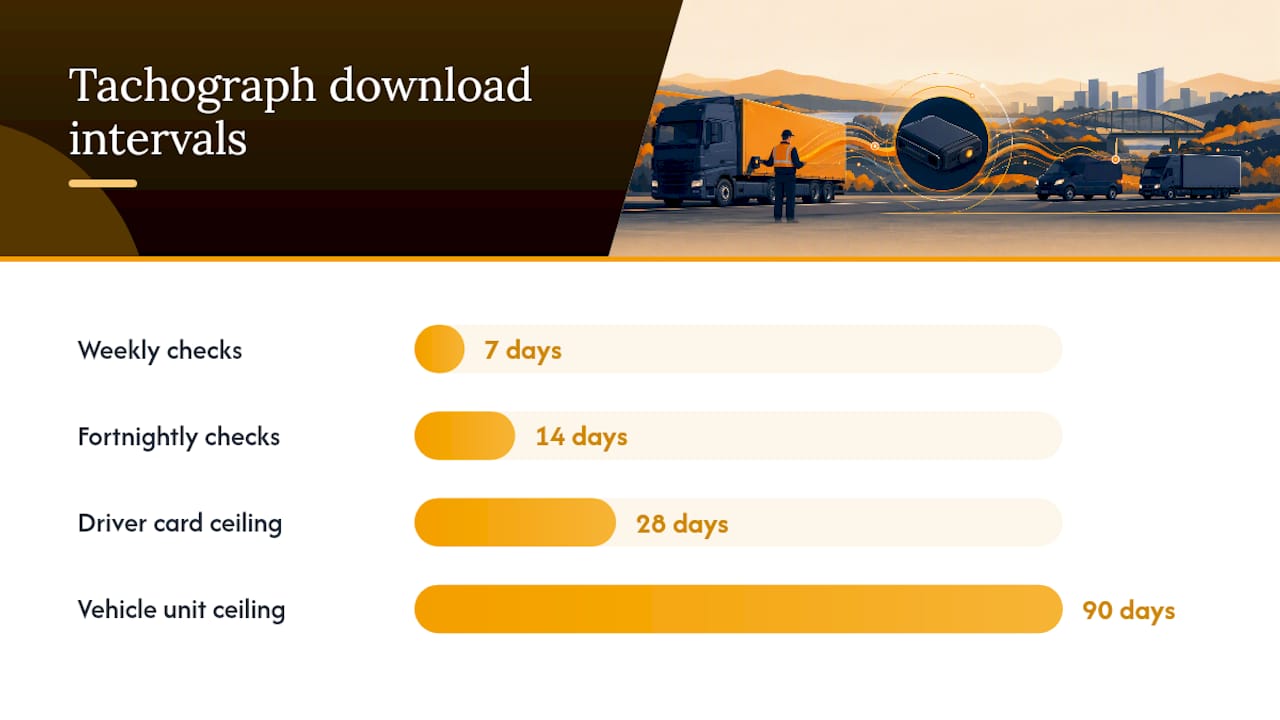
Tachograph data has to be downloaded on a fixed schedule, and missing that schedule is itself a compliance failure regardless of what the data eventually shows. Driver cards must be downloaded at least every 28 days, and vehicle units at least every 90 days, a rhythm summarised clearly in OperatorCompliance’s guidance on the 28/90 rule. Miss those windows and you lose visibility of drivers’ hours in real time, which is precisely when infringements go unnoticed.
A workable tachograph process has four steps that repeat on a cycle:
- Download: driver cards and vehicle units pulled in line with the 28/90 rule, not left to accumulate.
- Analyse: data checked against drivers’ hours rules for daily and weekly driving limits, breaks and rest periods.
- Document: every infringement recorded with the driver’s explanation, even where it turns out to be a legitimate exception.
- Action: repeat offences addressed through training, disciplinary process, or in serious cases, referral for further scrutiny.
The 28 day and 90 day download windows are not arbitrary. They are the maximum intervals that still allow a transport manager to catch a pattern of poor driving behaviour before it becomes a serious, sustained breach picked up only at MOT or roadside check. A driver quietly running short on daily rest for six weeks straight is a very different regulatory conversation if you catch it at week two versus discovering it only at a DVSA stop.
Statistic Callout: The 28/90 rule in practice Driver card downloads: every 28 days maximum. Vehicle unit downloads: every 90 days maximum. These are the statutory ceilings, not the recommended frequency; many well-run fleets download weekly or fortnightly to catch problems faster, as outlined in OperatorCompliance’s tachograph analysis guidance.
Retention matters just as much as the download itself. Tachograph records need to be kept and made available for inspection, and infringement records specifically should show not just that a breach happened but what was done about it. At audit, a Traffic Commissioner’s staff or a DVSA examiner will typically want to see the download history, the infringement report, evidence the driver was informed, and any follow-up action. A pile of downloaded files with no analysis attached tells a regulator that data is being collected but not used, which undermines the “continuous and effective control” standard just as much as never downloading at all.
Vehicle maintenance and roadworthiness: PMIs, MOT and defect handling
Keeping vehicles roadworthy is the most visible part of a transport manager’s job, and it is built around a maintenance planner that schedules every safety inspection, MOT or annual test, and calibration date in advance. GOV.UK’s guidance on transport manager responsibilities is explicit that this planning function sits with the transport manager, not with a workshop or contractor acting alone.
Building and running that planner in practice usually means:
- Map the fleet onto a rolling ISO week calendar, so every vehicle’s safety inspection interval, MOT or annual test date, and tachograph calibration (due every two years) sit on one visible timeline rather than scattered across separate files.
- Set safety inspection frequency based on vehicle use and condition, not just a default interval copied from the last operator licence application, and review that frequency if defect rates rise.
- Manage contractors formally, with a written agreement covering what “service to manufacturer specification” means for that fleet, and spot checks on completed work rather than blind trust in a signed job sheet.
- Process driver defect reports on the day they are raised, categorising each as safe to run, requiring repair before next use, or requiring immediate removal from service.
- Keep evidence that unroadworthy vehicles were actually taken off the road, not just flagged. A defect log showing a fault reported and then the same vehicle still running two days later is one of the clearest red flags a DVSA examiner looks for.
A driver’s daily walkaround check is the first line of defence here, and it only works if defects reported get acted on quickly and visibly. An e-signed defect report that timestamps when a fault was raised and when it was closed off gives a transport manager something a paper diary never can: proof of speed of response, which matters enormously if a defect later contributes to a prohibition.
Records and documentation: retention periods and audit readiness
Retention periods are one of the few areas where the rules ar
transport manager responsibilities