· 10 min read
Check Drivers Licence for UK Fleets the Right Way
Learn how to check drivers licence status for UK fleets using GOV.UK, mandates and risk-based rechecks with audit-ready evidence.
Monday morning, the driver is booked for a vehicle you need out of the depot within the hour. The photocard looks genuine, the driver says nothing has changed, and the paperwork appears complete. Then a roadside stop, internal review or audit request exposes the gap: nobody can prove when the entitlement was checked, what categories were held, whether points were live, or whether the record was still current.
For a UK goods or passenger operator, that isn't a minor filing defect. A driver's licence is part of the evidence behind your operator-licence undertakings. The practical question isn't whether someone has a photocard. It's whether the business can demonstrate ongoing entitlement, controlled checking and a clear audit trail.
Table of Contents
- Why Operator Licence Holders Must Check Drivers Licence Status Continuously
- What a Compliant Licence Check Must Cover and Prove
- How to Check Drivers Licence Using GOV.UK With Consent and Check Codes
- Setting a Risk Based Recheck Schedule That Stands Up to Scrutiny
- Keeping Audit Ready Evidence Alongside CPC and Tachograph Dates
- Common Pitfalls to Avoid and Your Next Steps to Stay Compliant
Why Operator Licence Holders Must Check Drivers Licence Status Continuously
A photocard is useful identification, but it isn't conclusive proof of current entitlement. It won't, by itself, show whether a driver has acquired penalty points, been disqualified, lost a category or changed status since the card was issued. The official GOV.UK driving-information service lets an employer or operator check what vehicles someone can drive, together with penalty points and disqualifications.
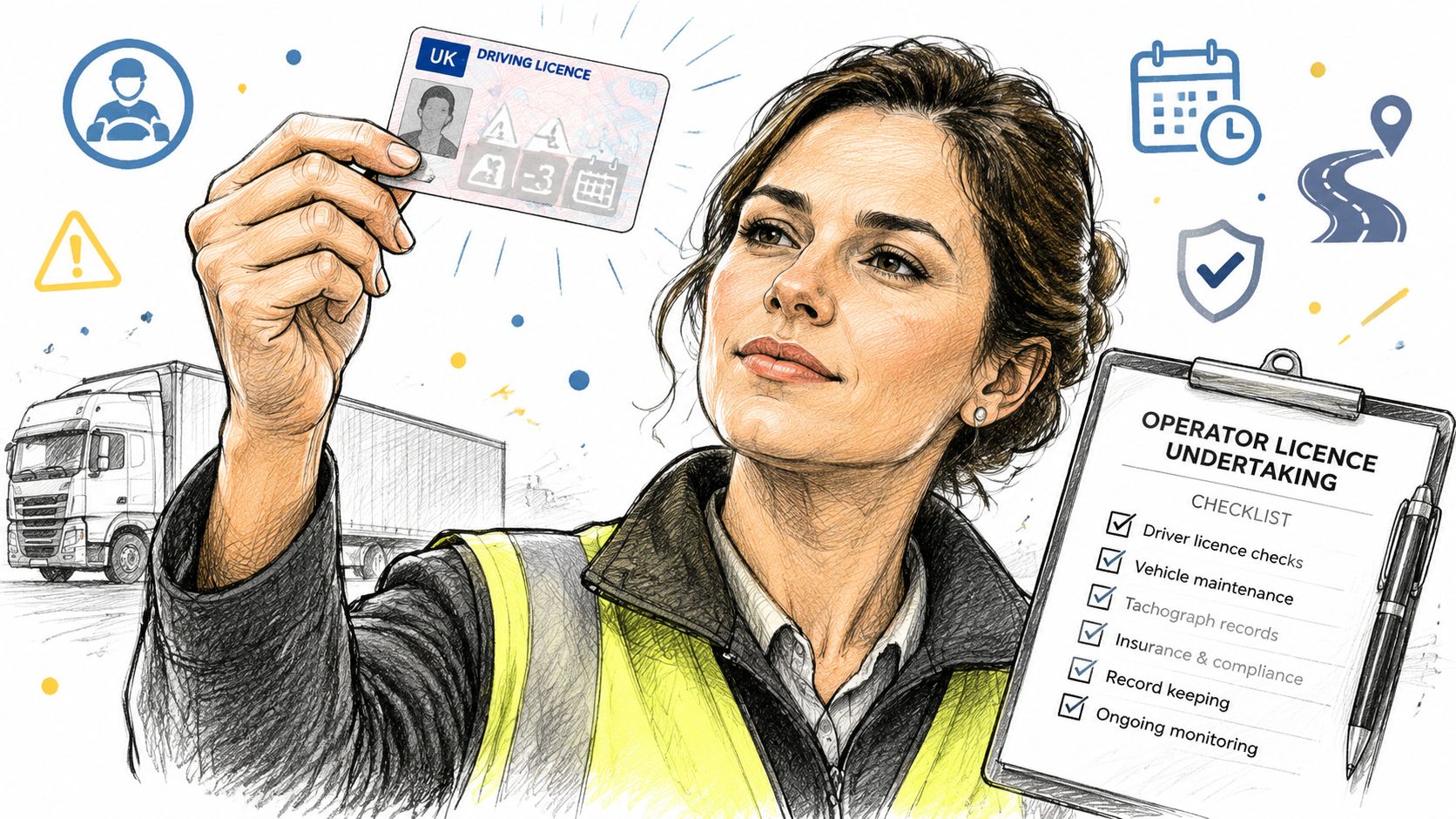
The Monday-morning scenario becomes more serious when the driver is allocated to an HGV, bus or coach without a current evidence trail. If a roadside officer asks about entitlement, or a Traffic Commissioner requests your driver file, the operational consequence of missing records is immediate. You may have to stop the allocation, retrieve information under pressure and explain why your monitoring system didn't identify the issue earlier.
The record carries a longer risk history
Penalty points don't disappear as soon as a driver receives a replacement photocard. Under GOV.UK information on driving licences, endorsements remain on the driving record for 4 years for most offences and 11 years for the most serious drink or drug-driving and fatal-careless-driving offences. The points are treated as live for the first 3 years of a 4-year endorsement or the first 10 years of an 11-year endorsement.
That distinction matters to a fleet manager. A check isn't just confirming today's entitlement. It can reveal a longer-term risk history that affects how often you should review the driver and how carefully you record the decision to keep them in a safety-critical role.
New drivers need particular attention. GOV.UK states that a driver can lose their licence after receiving 6 or more penalty points within 2 years of passing the test. The operator's response shouldn't be an informal conversation followed by a note in a spreadsheet. It should be a documented decision, with a defined recheck date and evidence of any action taken.
Practical rule: Treat licence status like an inspection or tachograph deadline. It belongs on the compliance calendar, with an owner, a due date and evidence attached.
Evidence matters as much as the result
A transport manager should be able to show the driver's consent or mandate, the check result, the date it was completed and the next review date. That record should sit alongside CPC, tachograph and vehicle compliance information, rather than in an individual's email inbox.
This becomes more important where a fleet uses agency drivers, subcontractors or several operating centres. Good managing subcontractor compliance depends on being able to establish who checked what, when the check was valid and whether the business followed its own control process.
The operator licence driver-licence checks guidance is useful for turning that undertaking into a repeatable file process. The principle is straightforward: a one-off hiring check can confirm the starting position, but only continuous evidence supports an ongoing operator-licence control.
What a Compliant Licence Check Must Cover and Prove
A defensible check has two parts. First, it must establish what the driver is entitled to do. Second, it must prove that the operator carried out the check properly and can reproduce the evidence later.
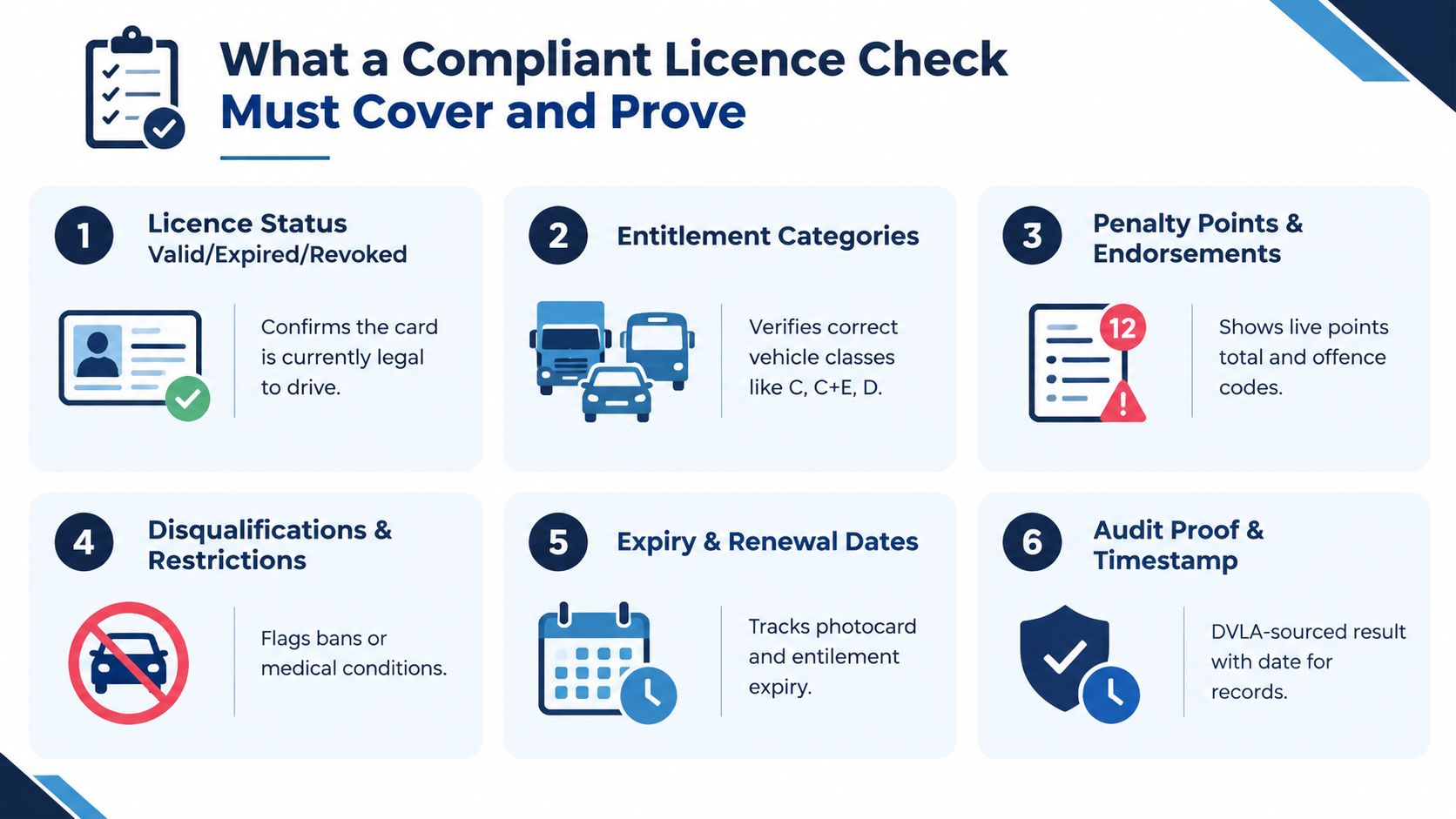
The official result should be reviewed for the relevant vehicle categories, current status, penalty points and disqualifications. For an HGV operator, that means checking the categories needed for the planned work, such as C or C+E. For a PSV operator, the equivalent question concerns the passenger-vehicle entitlement required for the vehicle and duty.
Define the information before choosing the method
A proper licence file should address:
- Current status: Record whether the entitlement is valid, expired, revoked or otherwise restricted according to the returned record.
- Vehicle categories: Confirm that the driver holds the category required for the actual fleet vehicle, not merely a broad assumption based on job title.
- Points and endorsements: Capture the relevant points and offence information, then apply your documented risk policy.
- Disqualifications and restrictions: Identify any ban or restriction that affects allocation. Don't rely on a driver saying that an old issue has been resolved.
- Expiry dates: Track photocard and relevant entitlement dates separately where the source record distinguishes them.
- Audit evidence: Keep the dated result, the check date, the next due date and the person responsible for the review.
Identity validation is a separate control. The returned record should be compared with the driver's name, photograph, date of birth and address. A mismatch doesn't automatically establish misconduct, but it does create an exception that needs resolving before the driver is treated as cleared.
Consent and mandate records matter for more than privacy administration. They show that the operator obtained authority to access and retain the information through the chosen process. Store the signed document or recorded consent with the result, and limit access to people who need it for allocation, compliance, payroll or audit work.
Collect enough evidence, not every available detail
Personal-data collection should be proportionate. Keep what demonstrates the check and supports the operational decision, but don't copy unrelated identity documents or retain information because it happens to be available. Set access permissions, retention rules and deletion procedures that reflect the purpose of the check.
The legal requirement, official guidance and best practice should remain distinct. The operator-licence undertaking requires proper control of driver entitlement. GOV.UK provides the verification route and the information it can reveal. Best practice is the disciplined record around that result, including consent, identity matching, review notes and a scheduled next check.
A screenshot with no date, no driver identifier and no explanation of who reviewed it is weak evidence. A structured record that links the result to the driver, vehicle allocation and next due date tells an auditor how the control operated.
How to Check Drivers Licence Using GOV.UK With Consent and Check Codes
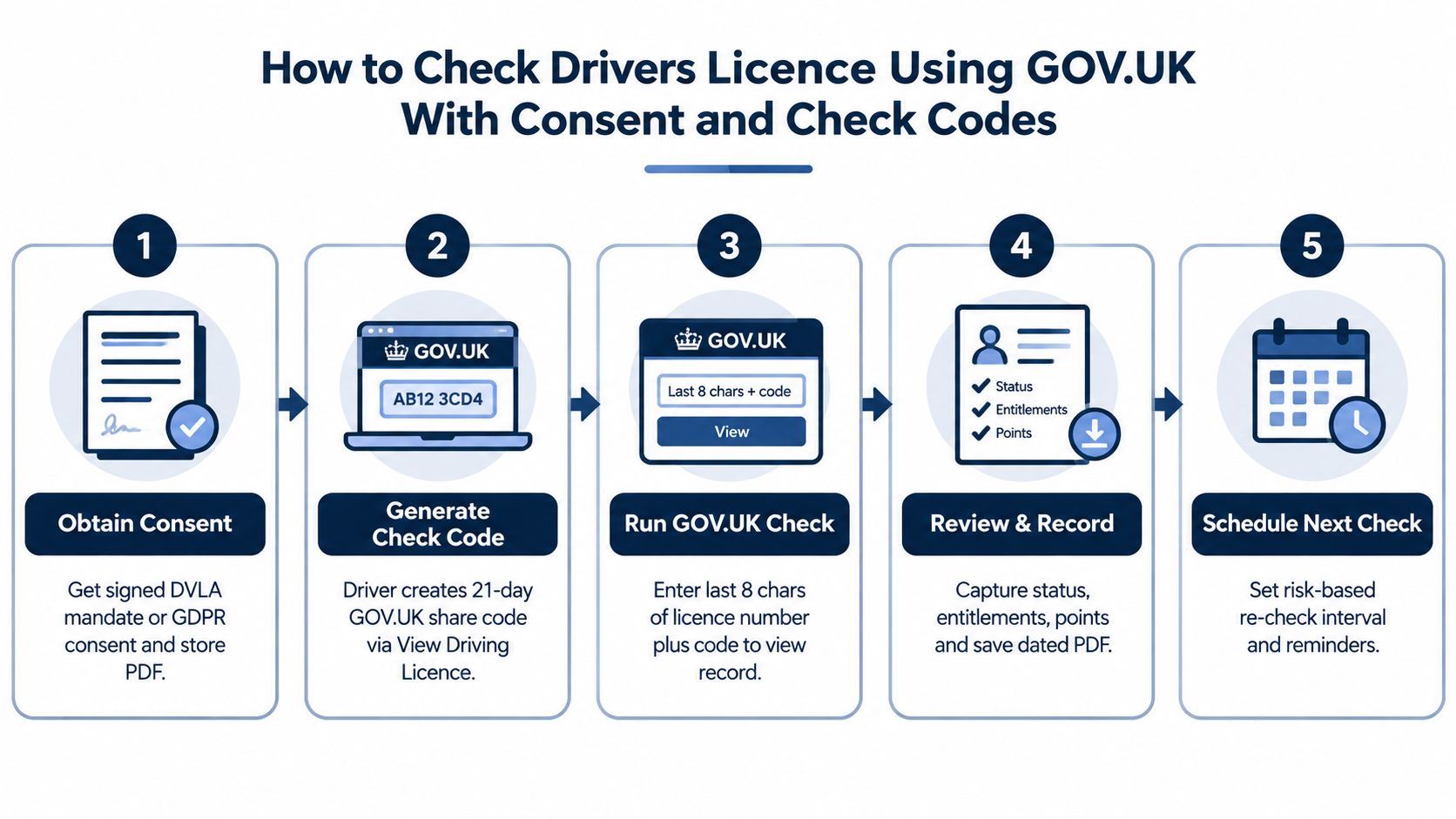
The GOV.UK route is practical for routine employer checks, but only when the workflow is controlled. The online service is free and available 24 hours a day, and an employer can use the driver's licence number, National Insurance number and postcode. A driver can also provide a check code for the employer to use.
The code has a limited operating window. It must be used within 21 days and can be used once only, so generating codes in batches and leaving them in an inbox is a poor process. The GOV.UK employer driving guidance identifies the fastest verified method as the online service using the last 8 characters of the licence number and the check code.
Start with consent and clear driver communication
Obtain consent before requesting or using the information. If your process uses a DVLA mandate, explain what the driver is authorising, how the result will be used and where the evidence will be stored. Keep the signed mandate or consent record in the driver file rather than treating it as a disposable email attachment.
Mixed-language fleets need a communication method that drivers understand. Written instructions can be provided in the languages used by your workforce, while the compliance team should retain the English record of the decision and any exception notes. A driver who can't follow the check-code process is a communication problem to solve, not a reason to skip the check.
The UK driving licence issue number explanation can help staff distinguish the licence details needed for administration from the information required to obtain a check result. Keep the workflow focused on the data the official service requests.
Use the returned record, not the card image
Once the code has been supplied, enter the required licence details and review the returned record. Compare the name, photograph, date of birth and address with the driver and photocard. Then confirm the relevant categories, points, disqualifications and expiry information before deciding whether the driver can be allocated.
Save the result with the check date, reviewer and next due date. If the code has expired or has already been used, obtain a fresh one rather than relying on an old screenshot. If identity fields are incomplete or inconsistent, place the driver into an exception workflow and resolve the issue before assigning safety-critical work.
A valid-looking image is not the same thing as a current entitlement record.
For high-volume work, operators can consider Access to Driver Data. The GOV.UK service states that this route carries a 60 pence enquiry fee per driver record, while a post-based check costs £5. The free online process remains suitable for many routine checks, but volume, consent administration and evidence capture may make a structured digital workflow more practical.
Don't imply that a software platform automatically performs DVLA checks unless the required approval, setup and driver authority are in place. The operator remains responsible for selecting the lawful method, reviewing the output and acting on exceptions.
The following video can help staff understand the official check-code journey before you build it into induction or refresher communication.
Setting a Risk Based Recheck Schedule That Stands Up to Scrutiny
A fixed annual check is easy to explain, but it can be too blunt for a mixed fleet. A new driver, a driver with current endorsements and a long-serving driver with a clean record don't present the same monitoring question. Risk banding gives the operator a reasoned basis for different review intervals, provided the rationale is recorded and applied consistently.
The schedule below is an operational model, not a universal legal interval. Your transport manager should set the policy against the fleet's work, driver profile, information available and operator-licence undertakings.
| Risk Band | Typical Profile | Recheck Interval | Evidence to Retain |
|---|---|---|---|
| Lower | Established driver with no identified licence concerns and stable entitlement | 12 months | Consent or mandate, dated result, reviewer and next due date |
| Medium | Driver with points, a changed entitlement, previous administrative issue or a role requiring closer oversight | 6 months | Dated result, risk rationale, action notes and scheduled reminder |
| Higher | New or recently qualified driver, unresolved identity issue, material endorsement concern or previous failed control | 3 months | Consent or mandate, result, management review, allocation decision and follow-up date |
Record the judgement behind the band
The interval matters less than the reasoning. A Traffic Commissioner or DVSA examiner needs to see that the operator identified risk, selected a control and followed it. Write a short rationale such as “newly qualified driver, closer review during initial operating period” or “points recorded, six-month monitoring selected”.
A new driver who receives 6 or more points within 2 years of passing the test can lose their licence, as set out in GOV.UK licence information. That makes early monitoring a sensible management control, but the file should show the decision rather than displaying a red label in software.
Plan for fraud and missed checks
Fraud adds another reason not to treat the photocard as the whole control. A 2025 UK Parliament answer on driving-test impersonation records that DVSA works with DVLA to verify identity at tests, can refuse a test where identity isn't satisfied and can revoke a fraudulently obtained licence when impersonation is detected.
The same source also refers to concerns about fake documentation and identity fraud. For an operator, the practical lesson is narrow but important: verify through an official route, don't accept a shared image as proof of current entitlement, and investigate offers of licences that aren't present on the DVLA database.
Calendar alerts should go to a named owner, with escalation when a check becomes overdue. A missed recheck should create an allocation decision, not disappear into a dashboard. Record whether the driver was stood down, whether work was restricted or whether the check was completed late, together with the reason.
Keeping Audit Ready Evidence Alongside CPC and Tachograph Dates
Licence
check drivers licencedriver licence checksDVLA licence checkfleet compliance UKoperator licence