· 11 min read
Digi Tacho Cards a Guide to UK Rules and Compliance
Your complete guide to digi tacho cards for UK operators. Understand download rules, retention periods, and operator duties to ensure DVSA compliance.
A transport manager can do everything else right and still get pulled apart on one missing tachograph record. The phone rings, a DVSA visit is on the way, or a Traffic Commissioner wants evidence, and suddenly the question is not whether the fleet has been busy, it's whether the digi tacho cards system can prove it. In practice, that means the card, the downloads, the analysis, and the sign-off trail all have to line up.
That pressure is why these cards matter far more than a simple admin task. Under the UK framework, they sit at the centre of compliant recording, access control, and enforcement evidence, and the operator's job is to keep the records complete, current, and inspectable. If the system is weak, the problem rarely stays hidden for long.
Table of Contents
- Introduction Why Digi Tacho Cards Matter More Than Ever
- Understanding the Digital Tachograph Card System
- UK Download and Data Retention Rules
- Your Obligations Beyond the Download Button
- Common Tacho Card Risks and How to Prevent Them
- Building a Dependable Tacho Card Management Workflow
- Conclusion Take Control of Your Tacho Compliance
Introduction Why Digi Tacho Cards Matter More Than Ever
A roadside check rarely starts with a long discussion. An officer asks for the records, the driver hands over what they have, and gaps show up fast. This situation critically assesses fleets that treat tachograph cards as routine admin instead of an active compliance control.
The card system matters because it ties the driver, the vehicle, and the operator to the work record. UK regulations introduced digital tachograph cards through the Passenger and Goods Vehicles (Recording Equipment) (Tachograph Card) Regulations 2005, and the legal framework covers driver, company, workshop, and control cards. The move to digital tachographs for new relevant vehicles from 1 May 2006 made card-based recording the standard for the newest vehicles in scope Passenger and Goods Vehicles (Recording Equipment) (Tachograph Card) Regulations 2005.
For operators, the card sits inside the evidence chain. If downloads are late, a card expires, or analysis is left unsigned, the business ends up explaining gaps instead of showing control. Strong fleets treat card management as a repeatable process with named ownership, deadlines, and a clear audit trail. That is what stands up to DVSA scrutiny.
Understanding the Digital Tachograph Card System
A driver pulls the wrong card, a workshop uses the wrong access level, or nobody can show who handled the data. That is how a tachograph process becomes weak. digital tachograph cards only work properly when each card is assigned, used, and tracked against a clear role.
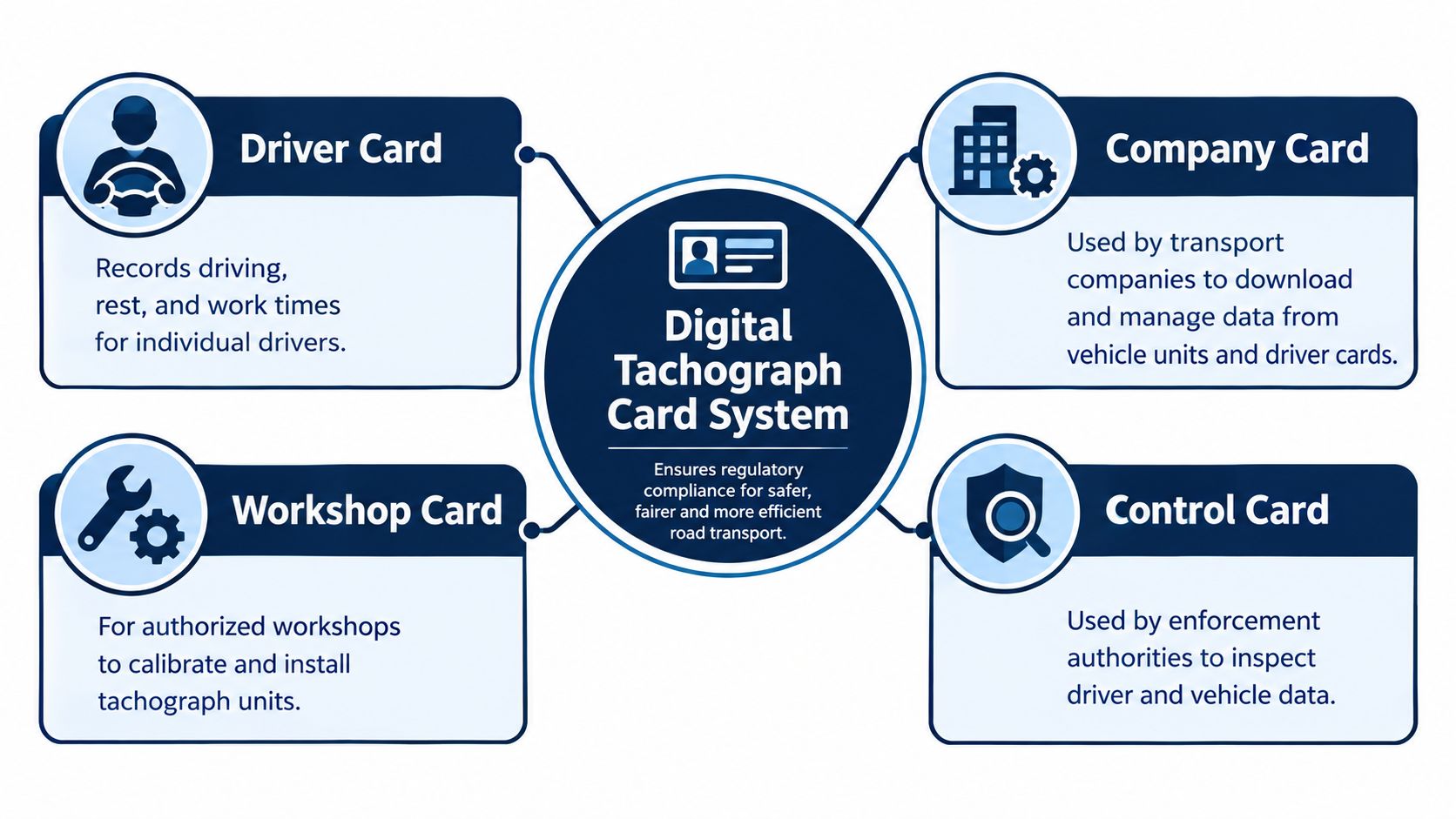
The four card types and what each one does
The driver card is the one fleets use most. It records the driver's work information, and official UK guidance says it is valid for five years from issue driver digital tachograph card guidance. In practice, that means renewal control needs to sit in the same system as driver allocation, not in someone's memory or inbox.
The company card identifies the operator in the vehicle unit. It is used to lock and open access to tachograph data, which matters because it protects the business record and lets the operator retrieve its own information.
The workshop card is for authorised installation and calibration work. The control card is used by enforcement authorities during checks to inspect driver and vehicle data.
Practical rule: if a card cannot be tied to a role, it cannot be tied to a compliant process.
Why the legal structure matters on the ground
The UK framework sets out these four card types and makes the driver card required for vehicles that need digital tachographs Passenger and Goods Vehicles (Recording Equipment) (Tachograph Card) Regulations 2005. That matters because the card system is the control layer for accurate recording. If the wrong card is used, the record can still look complete while the access trail is wrong.
For operators, the issue is operational. Staff need to know which card is used for which task, and the business needs evidence that the right person used the right card at the right time. If that evidence is missing, DVSA scrutiny becomes harder to answer.
A practical workflow starts with written instructions for drivers and admins, then adds checks for issue, use, return, and renewal. A useful reference point is how to operate a digital tachograph. Use that as part of the process, not as a substitute for one.
UK Download and Data Retention Rules
A tachograph system only works if the business treats downloads as a control, not a chore. Driver-card data does not stay available forever, so the operator has to pull it before the card overwrites older activity. The legal expectation is to download driver-card data at least every 28 calendar days, and the practical risk is simple, once the oldest records are gone, they cannot be recovered DVSA operator responsibilities.
Busy operations make that risk sharper. DVSA notes that an average day contains 93 activity changes, so intensive work can shorten the usable window even further. If downloads slip, the business can lose the very evidence it needs to explain hours, breaks, rest, and exceptions.
The intervals are ceilings, not targets
UK tachograph law sets a maximum interval of 90 days for vehicle-unit data and 28 days for driver-card data tachograph download interval legislation. Those are legal limits, not planning points. A fleet that waits until the deadline is running a weak control, because any delay, staff absence, or vehicle off-road issue can push the business into default.
The record also has to be retained securely and made available for inspection. In practice, that means a system that still works when the transport manager is away, the office is busy, or a DVSA officer asks for records without notice. Random file saves and email chains do not give you that. A controlled record set does.
A missed download is not just admin noise. It can become a missing evidence problem the first time someone asks what happened on a specific day.
What the data retention cycle means for operators
The right approach is to build the 28-day driver-card cycle and the 90-day vehicle-unit cycle into the normal management routine. If the process depends on someone remembering, it will fail eventually. The safe position is a written workflow that assigns responsibility, triggers reminders, checks completion, and records any exception.
That workflow also needs review, not just storage. The value of insights on compliance monitoring is in showing how continuous checking differs from periodic checks, especially where evidence must be ready before an audit rather than rebuilt after one. In day-to-day terms, the point is that tachograph compliance only stays defensible if the records are downloaded before they stale out and the process leaves a clear audit trail.
A practical reference for schedulers is tachograph download rules for 28 and 90 days. Use it as a control reminder, then make sure the actual download and review process is happening in the business.
Your Obligations Beyond the Download Button
Downloading the files is only the starting point. The primary obligation is to use the data, identify infringements, and show that someone reviewed the issue and acted on it. If the business cannot demonstrate that, the download is just a technical task with no compliance value.
Analysis and driver debriefs are part of the evidence trail
A competent operator does more than store tachograph files. The records should be checked against drivers' hours rules, then any infringements need to be understood, explained, and signed off. That means a manager or analyst looks at the pattern, speaks to the driver, and records what was discussed.
Practical rule: if an infringement is not signed off, it still looks live in an audit.
Weak sign-off creates a clear operational problem. If a DVSA visit or Traffic Commissioner inquiry asks how the business dealt with infringements, a vague memory is not evidence. A dated note, showing the issue and the response, is evidence. That difference protects the operator and shows the business is managing risk rather than leaving it to chance.
Card expiry, loss, and replacement need a live process
Driver cards expire, and the renewal cycle has to be managed in-house rather than left to memory. The driver digital tachograph card guidance sets out the card lifecycle, and operators need a process that tracks expiry, replacement, and the handling of lost, stolen, or faulty cards.
That process should stop a driver from being sidelined because nobody noticed a card was due to run out. It matters even more in mixed fleets, where the tachograph record is only one part of the evidence being checked.
The same applies to driver communication. If a driver does not know what to do when a card fails, the operator ends up with delay and a poor record. If the steps are written down, the business can respond quickly and keep the audit trail intact.
A practical reading tool is tachograph card readers, especially where managers need to connect readout with review. The device matters less than the discipline around it.
A live process also needs a named owner, a check against the expiry list, and a record of every exception. That is what stands up when someone asks how the business knows the card system is under control.
Common Tacho Card Risks and How to Prevent Them
The biggest tachograph failures are usually boring, not dramatic. They come from routines slipping, one step being missed, or nobody checking the control list before the problem grows. That is why prevention has to be procedural, not improvised.
The faults that cause avoidable trouble
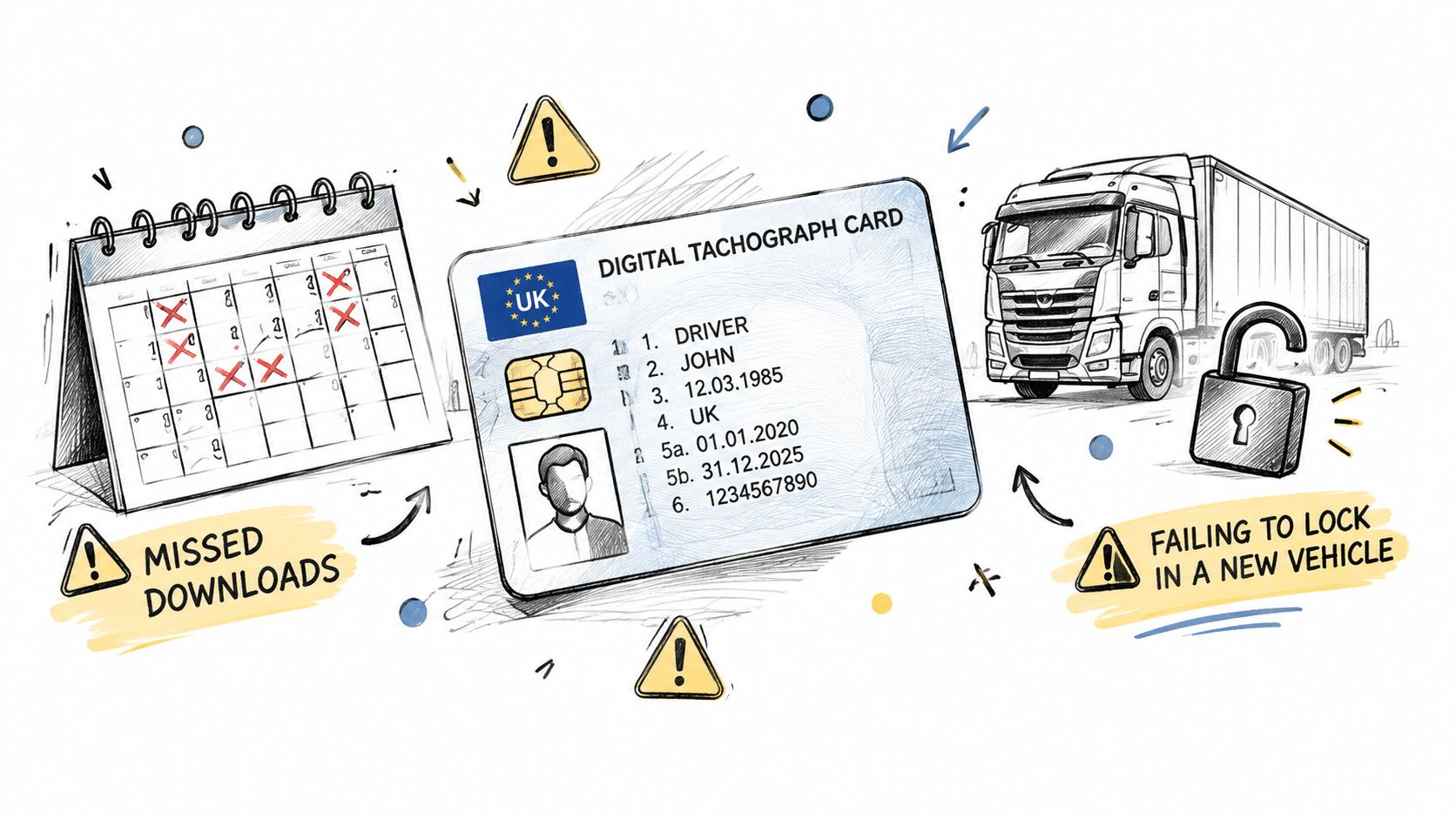
Missed downloads are the obvious one. If a driver card isn't downloaded on time, the oldest records can be overwritten, and the business loses evidence it may need later. If a company card isn't used correctly when a vehicle joins the fleet, the operator can end up with data that's hard to reconcile.
Expired cards are another common weakness. A driver working with an expired or untracked card creates an immediate compliance concern, even if the driving itself was otherwise tidy. The issue isn't just the vehicle being on the road, it's whether the records can support it.
Missing audit trails are just as damaging. If infringements are identified but never signed off, the file looks unfinished. If the manager says the issue was discussed but there's no record, the explanation carries far less weight.
The prevention habits that actually work
A reliable fleet usually does the same few things well:
- Sets calendar controls: downloads, expiries, and review dates are tracked before they become urgent.
- Assigns one owner: each card task has a named person responsible for follow-up.
- Checks exceptions quickly: if a driver misses a download or loses a card, the response starts the same day.
- Keeps proof together: analysis, debrief notes, and signatures sit in one record set, not across three systems.
The consequence of not doing this can be serious. A roadside issue can lead to immediate enforcement attention, while a wider pattern of weak control can raise questions at a Public Inquiry. Operators don't need perfect systems, but they do need dependable ones.
A simple rule helps here. If the process depends on someone remembering it from memory, it will fail at the worst time. If it is calendar-driven, documented, and reviewed, the business has a far better chance of staying ahead of the problem.
Building a Dependable Tacho Card Management Workflow
Manual control can work for a very small fleet, but only up to a point. A spreadsheet, a wall planner, and a set of reminders may look adequate when the operation is quiet. They begin to fail when vehicles are added, drivers change roles, holiday cover starts, or someone forgets to update the sheet after a replacement card arrives.
Manual control versus a managed system
In a manual setup, the transport manager is the system. That sounds tidy until one person is off sick, another is out on the road, and the deadline still stands. The weakness is fragility. Human processes are easy to understand, but they are also easy to miss.
A managed system uses date-driven controls to reduce the chance of a missed task. For tachograph work, that means reminders for the 28-day driver-card cycle and the 90-day vehicle-unit cycle, plus visible tracking of expiries and overdue downloads. The value is not flashy automation, it is consistency.
A platform such as OperatorCompliance is one way to keep this in one place. It is designed to track tachograph file intake, driver-card and vehicle-unit deadlines, infringement reports, and related compliance dates, alongside the wider operator-licence record. It does not replace the transport manager, the analyst, or the driver, but it can cut down the manual chasing that usually creates gaps.
What a good workflow should produce
A strong workflow should give the business the same outcome every time, whether the issue is a download, a card expiry, or an infringement review. The record set should show who did what, when they did it, and what follow-up happened next.
That record set matters far more during an audit than during an ordinary week. A DVSA inspector or Traffic Commissioner does not want a story about intent. They want evidence of control, clean dates, clean actions, and a clear trail from file to review to sign-off.
The working pattern also has to fit live fleet
digi tacho cardstachograph rules ukoperator licence compliancetransport managerhgv compliance