· 9 min read
Audit Ready Driver Fatigue Policy: 3 Essentials for UK Fleets
Audit ready driver fatigue policy for UK fleets. Follow three essentials: risk assessment, non punitive reporting, and tachograph evidence.
Audit Ready Driver Fatigue Policy: 3 Essentials for UK Fleets
Employers must treat driver fatigue as a foreseeable workplace hazard, not an unfortunate side effect of the job. A compliant driver fatigue policy needs three things to hold up: a documented risk assessment, a reporting route drivers will actually use, and records robust enough to survive a Traffic Commissioner review. Everything else in this guide is about how to build those three things properly.
TL;DR:
- Operators must conduct regular risk assessments, review tachograph data proactively, and implement rest and scheduling rules beyond legal minimums to manage fatigue effectively.
- A fatigue policy must include clear responsibilities, specific risk identification, non-punitive reporting, and retention procedures, with reporting procedures prioritized over disciplinary rules.
- Regular review of tachograph, telematics, and dashcam data is essential for early signs of fatigue, with data retention rules extending to 56 days for certain journeys from April 2025.
- Evidence of policy adherence, through automated monitoring and records, is crucial for audits, with centralised compliance software significantly reducing administrative workload.
- Following official guidance and incorporating compliance software enhances both policy writing and evidence gathering, helping operators avoid enforcement penalties.
Table of Contents
- What does the law actually require of a driver fatigue policy?
- What should a driver fatigue policy actually contain?
- How do you draft and roll out a fatigue policy step by step?
- What should you look for in tachograph and telematics data?
- How do you keep a fatigue policy audit-ready?
- Why most fatigue policies fail before they’re tested
- Where compliance software fits into your fatigue policy
- Where to go for official guidance
- Sources
What does the law actually require of a driver fatigue policy?
The Health and Safety at Work etc. Act 1974 and the Management of Health and Safety at Work Regulations 1999 place a direct duty on employers to assess and reduce risks from staff fatigue. Skip that assessment and a fatigue-related incident happens, and prosecution becomes a real possibility rather than a theoretical one. Fatigue is not a marginal contributor either: HSE research indicates it plays a part in up to one fifth of accidents on motorways and other monotonous roads.
Traffic Commissioners go further than the statute. Their published guidance is explicit that drivers’ hours rules are a baseline, not a fatigue management system, and operators are expected to review tachograph data and tailor controls to their own operation. A driver can be fully compliant with drivers’ hours and still be dangerously tired, which is exactly the gap a proper policy has to close.
A few things regulators and legislation specifically expect:
- Risk assessment and reduction measures under HSE’s fatigue guidance, reviewed periodically rather than written once and filed.
- Tachograph data reviewed proactively, not just pulled out after something goes wrong.
- Statutory rest respected under the Working Time Regulations 1998, including the 11-hour daily rest entitlement.
- Enforcement action has followed operators who repeatedly failed to record mandatory breaks or explain tachograph anomalies when questioned.
What should a driver fatigue policy actually contain?
A policy that only states good intentions will not survive contact with an audit. It needs specific, checkable clauses that map to how the operation actually runs.
- Policy statement and scope. Name who is responsible for fatigue management (usually the transport manager), how decisions escalate, and which vehicle and driver categories the policy covers.
- Fatigue risk assessment. Identify high-risk tasks, routes and times of day. INF159 flags midnight to 06:00 and 14:00 to 16:00 as the natural high-risk windows for driver drowsiness, so any driver regularly working those hours needs specific attention.
- Rest, breaks and scheduling rules. Set out minimum rest beyond the legal floor where the job demands it, and address door-to-door time, not just driving time.
- Non-punitive reporting procedure. Drivers need to be able to say “I’m too tired to drive” without fear of disciplinary consequences, and managers need a defined response when they do.
- Medical screening pathway. Middle-aged male HGV drivers carry a higher risk of undiagnosed obstructive sleep apnoea, so a referral route for suspected cases belongs in the policy, alongside routine wellbeing check-ins.
- Record keeping. Tachograph downloads, incident logs and training records all need a defined retention period and a named owner.
Pro Tip: Write the reporting procedure before you write the disciplinary policy. If drivers see the fatigue clause sitting next to a warnings-and-sanctions section, they will not use it, and you lose the one signal that would have flagged the problem before it became an incident.
How do you draft and roll out a fatigue policy step by step?
Building the document is the easy part. Getting drivers and managers to actually use it is where most policies quietly fail.
Start with the risk assessment. Pull tachograph data, existing incident and near-miss logs, and rota patterns before writing a single policy line. A simple template scoring each route or shift by night-time hours, average journey length and historical incident rate gives you a defensible starting point rather than a guess.
Consult drivers and their representatives. They know which routes genuinely run tight and which depots have poor rest facilities. Skipping this step produces a policy that reads well but does not match reality on the ground.
Pilot before you roll out fleet-wide. Trial the reporting procedure and any schedule changes on one depot or route first. You will find friction points, unrealistic assumptions and gaps you missed on paper, and fixing those before full rollout saves you a second version six months later.
Deliver proper training, not a memo. Toolbox talks work better than a policy document nobody reads. Cover the warning signs of fatigue, the medical risks around sleep apnoea, and exactly how to raise a concern. Build a short wellbeing check into daily briefings rather than treating it as an annual box-tick.
Practical measures worth embedding directly into operations:
- Set journey plans against realistic average speeds, not best-case timings that quietly pressure drivers to push through tiredness.
- Build relief driver options into longer routes rather than assuming one person can cover the whole leg.
- If you pay accommodation allowances, check receipts. Drivers sleeping in the cab to pocket the allowance get worse-quality rest, which raises fatigue risk even though the hours look compliant on paper.
- Feed risk assessment findings directly into rostering and route planning KPIs, so fatigue data actually changes future schedules rather than sitting in a file.
What should you look for in tachograph and telematics data?
Tachograph records are where fatigue risk becomes visible, if you know what to look for. Reviewing them is not a compliance formality, it is the main early warning system most operators have.
Watch for split rest being used repeatedly rather than occasionally, clusters of late-night or early-morning driving on the same driver, and near-miss events clustering around specific times or routes. None of these breach drivers’ hours rules on their own, but together they show a driver running close to the edge.
Retention matters as much as review. Since April 2025, certain in-scope journeys require tachograph records to be kept for 56 days rather than 28, which extends how far back an inspector can ask you to go. Operators unfamiliar with the change should check the updated tachograph download rules against their current retention practice.
Other data sources worth folding into the same review:
- Telematics data on harsh braking or lane drift, which can flag drowsiness before a driver reports anything.
- Dashcam footage, useful as supporting evidence, though operators need to understand the legal position on recording and storing that footage before relying on it.
- Near-miss logs and driver self-reports, which catch what tachograph data alone cannot.
Routine, scheduled data checks (weekly, not just after an incident) let you spot a developing pattern and adjust a roster before it produces a genuine event rather than after.
How do you keep a fatigue policy audit-ready?
A policy that looks good on paper needs evidence behind it, and that evidence has to be current, not reconstructed after a Traffic Commissioner asks for it.
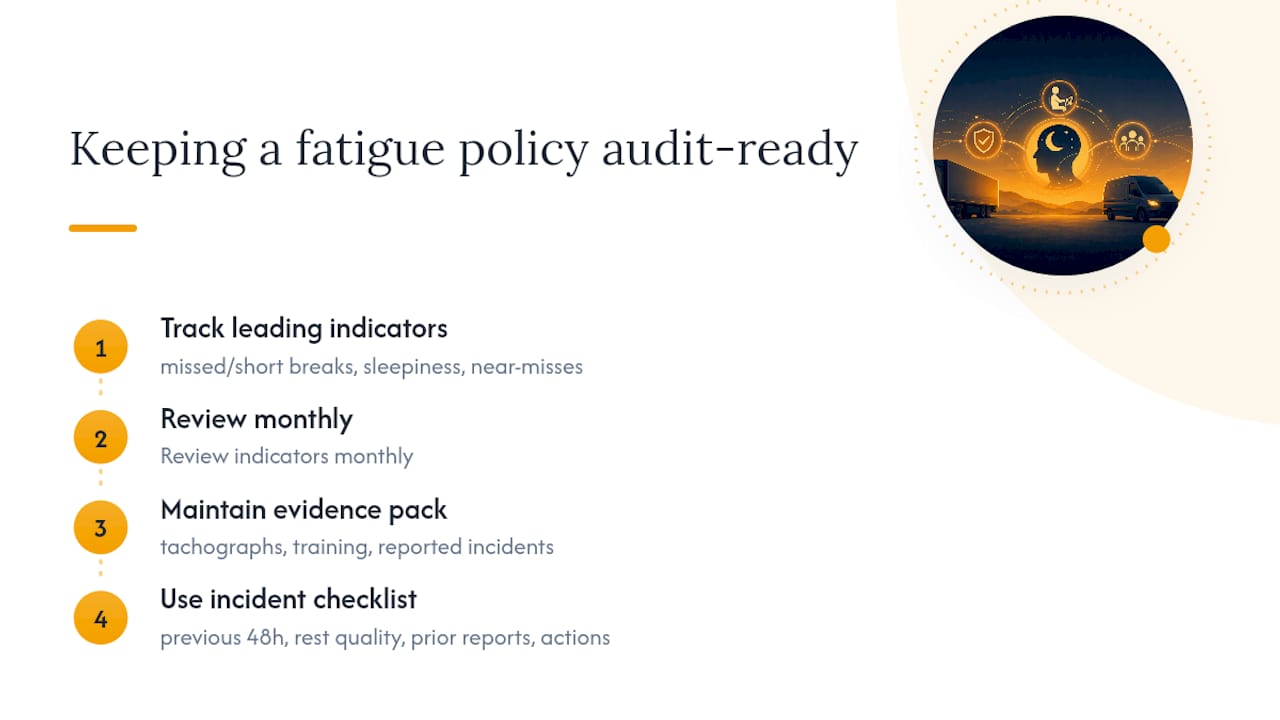
Track a small set of leading indicators rather than waiting for lagging ones: missed or shortened breaks, driver-reported sleepiness incidents, and near misses linked to fatigue. Review these monthly, not annually. Build a standing evidence pack covering tachograph reviews, training records and reported incidents, so you are never assembling it from scratch under time pressure.
When fatigue is suspected in an incident, work through a fixed checklist: hours worked in the preceding 48 hours, rest quality, any prior reports from that driver, and what corrective action followed. Document every step. Traffic Commissioners have taken enforcement action against operators unable to show they reviewed and acted on tachograph anomalies, so the paper trail matters as much as the action itself. Update the policy whenever trend analysis or an enforcement finding shows a gap.
Why most fatigue policies fail before they’re tested
The policies that fall apart under scrutiny are almost never the ones missing a clause. They are the ones where the paperwork says one thing and the roster says another, or where the reporting procedure exists on page four of a handbook nobody has opened since induction. A driver fatigue policy is only as good as the evidence that it was followed, and that evidence has to exist before the Traffic Commissioner asks for it, not after.
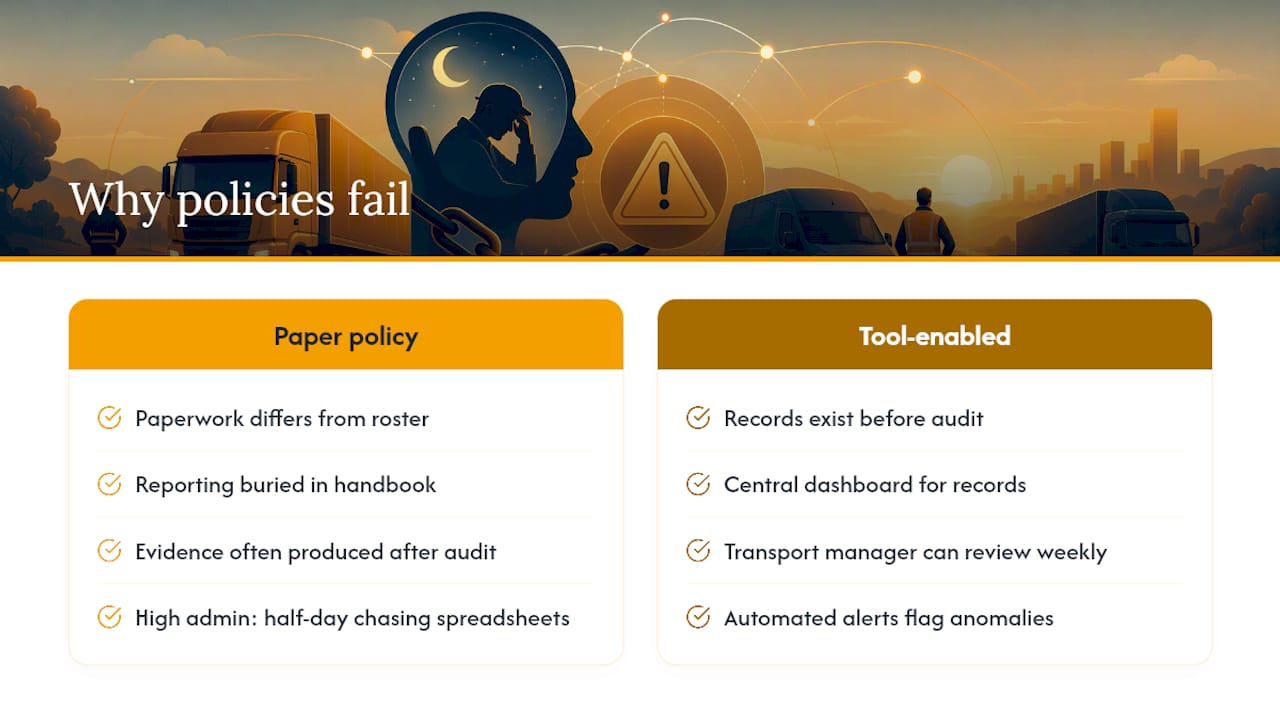
What compliance tooling changes is the admin load behind that evidence. A single dashboard that pulls tachograph downloads, licence checks and inspection records into one place turns a fatigue review from a half-day of chasing spreadsheets into something a transport manager can genuinely do weekly. Automated alerts flag anomalies as they happen rather than at the next audit, and multilingual driver apps mean a non-native English speaker is just as likely to file a fatigue report as anyone else on the fleet. Operators using centralised systems typically spend far less time assembling audit packs than those piecing records together manually.
The gap between having a policy and having a defensible one is entirely about whether the records exist and whether anyone reviewed them. Software does not close that gap on its own, but it removes most of the excuses for not closing it.
— Vytautas
Where compliance software fits into your fatigue policy
Writing the policy is one job; proving you followed it is another, and that second job is where most operators actually struggle. OperatorCompliance was built around exactly that gap: it reads digital tachograph downloads and flags drivers’ hours infringements automatically, runs DVLA licence checks, and lets each driver sign their own infringement report from the mobile app, so the evidence trail builds itself instead of landing on a manager’s desk once a quarter.

For hauliers specifically, the platform pulls vehicle, driver and tachograph data into one live compliance score with automated deadline alerts, and produces an audit-ready compliance pack whenever DVSA or a traffic commissioner comes calling. It is a tool to support your fatigue policy, not a replacement for the risk assessment and training work above. If your current process still means chasing spreadsheets before every audit, it is worth booking a look at the platform to see what a live dashboard actually removes from that workload.
Where to go for official guidanc
driver fatigue policy