· 9 min read
DVSA Earned Recognition: A Practical Guide for UK Operators
DVSA Earned Recognition explained for UK operators: eligibility, KPIs, audits and how a compliance platform supports the journey.
Most advice about DVSA Earned Recognition starts with the benefit, fewer roadside inspections, a stronger compliance reputation, and less disruption. That's the wrong starting point. The scheme doesn't remove scrutiny. It changes its location and frequency, replacing some reactive intervention with a continuing obligation to produce reliable evidence, report performance and demonstrate control.
For a UK HGV or PSV operator, the important question isn't whether the scheme sounds attractive. It's whether your operator licence systems would withstand detailed sampling today, without a hurried document chase, unexplained gaps or a transport manager trying to reconstruct decisions from memory. This guide takes the practical view: Earned Recognition can suit mature operators, but it won't rescue a weak compliance system.
Table of Contents
- Earned Recognition Is Not the Easy Win Operators Expect
- What DVSA Earned Recognition Actually Is
- Eligibility Criteria and KPI Thresholds You Must Clear
- Evidence and Audit Expectations Inside the Scheme
- Steps to Apply Without Wasting Your Audit Window
- How a Compliance Platform Supports Earned Recognition
- Is Earned Recognition Worth It for Your Fleet
Earned Recognition Is Not the Easy Win Operators Expect
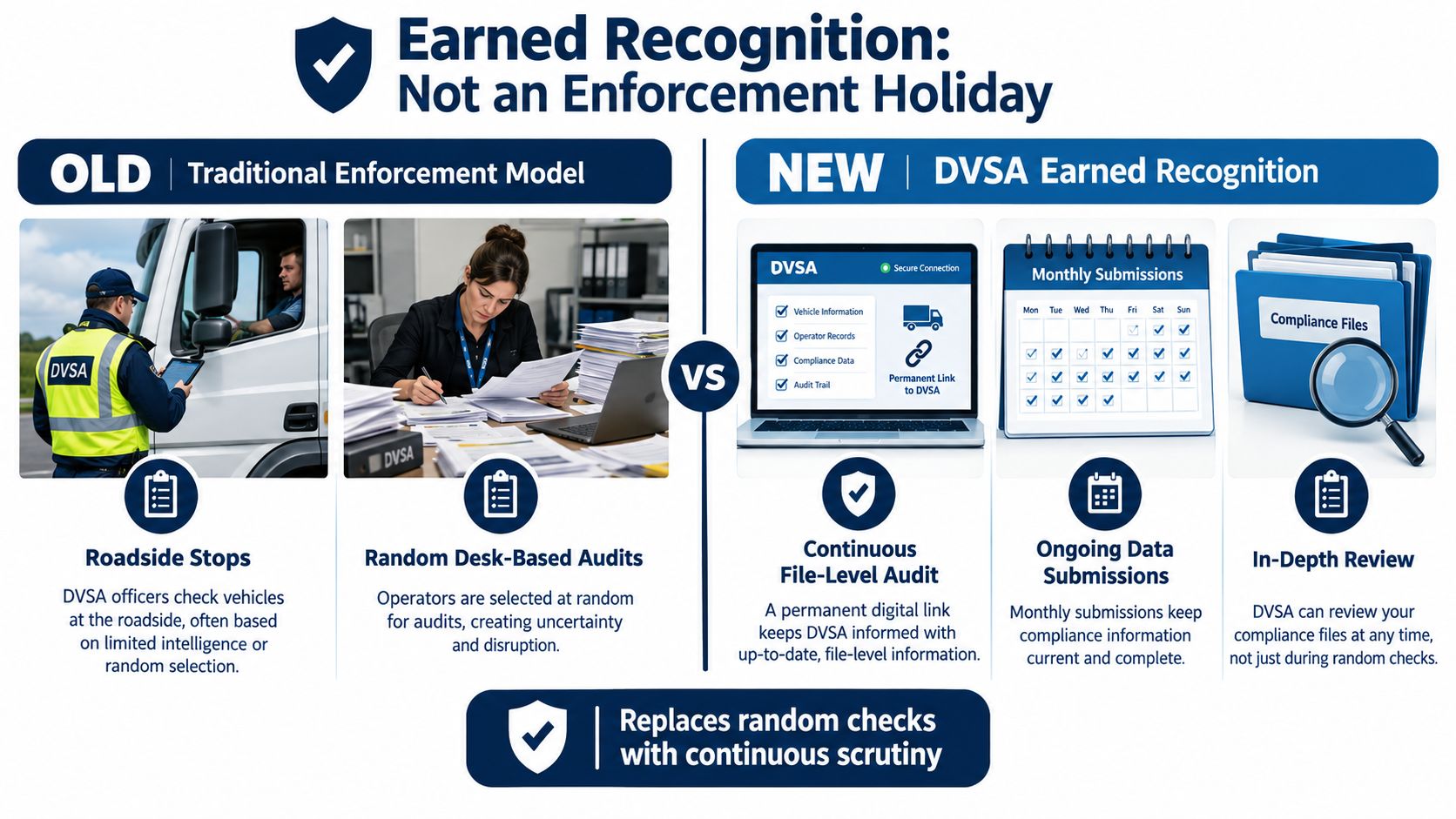
The phrase “enforcement holiday” should be removed from every Earned Recognition presentation. DVSA says members share performance information and their vehicles are less likely to be stopped for inspection, but the official material doesn't quantify the reduction or promise immunity. The benefit is therefore operational, not absolute. A vehicle can still be inspected, and the operator licence undertakings remain in force.
The trade is straightforward. Traditional enforcement may arrive as a roadside encounter, a desk-based intervention or a Traffic Commissioner concern. Earned Recognition places greater emphasis on continuous KPI reporting, evidence quality, remote review and audit access. You may experience fewer roadside interruptions, but DVSA expects the systems behind your application to keep working between audits.
What operators hope to receive
Operators commonly expect a trusted-operator status, reduced intervention and a smoother relationship with customers or insurers. Some of those outcomes may follow from a demonstrable compliance record, but Earned Recognition itself isn't a guarantee of lower insurance friction, commercial preference or uninterrupted operations.
What members do receive is a defined relationship with DVSA, access to the scheme's reporting process and the opportunity to demonstrate sustained control through validated information. The scheme was officially launched on 24 April 2018, following a year-long pilot involving more than 60 commercial vehicle operators representing more than 43,000 vehicles in DVSA's organisational information.
The burden operators accept
At launch, DVSA described the scheme as voluntary, free to join and open to organisations of any size that had held an operator licence for at least 2 years. The published record listed 143 accredited operators, while 41 operators had already been removed since the scheme began in DVSA's annual report and accounts. Those figures don't prove that removal is common, but they do prove that membership isn't permanent.
Practical rule: Join only when your normal monthly compliance pack already looks like an audit file.
The right test is uncomfortable but useful. If DVSA selected several vehicles, trailers, drivers, maintenance dates, defect closures and tachograph records tomorrow, could your team prove who acted, when they acted and why the decision was reasonable? If not, fix the control system first.
What DVSA Earned Recognition Actually Is
DVSA Earned Recognition is a voluntary compliance scheme for eligible HGV and PSV operators. It sits alongside the operator licence. It doesn't replace the licence, its undertakings, its conditions, the Traffic Commissioner's jurisdiction or the operator's duty to maintain vehicles and manage drivers properly.
The scheme's design is best understood as a continuous-control model. An operator must have held the relevant licence for at least 2 years, must not have had Traffic Commissioner regulatory action in the previous 2 years, apart from a formal warning, and must operate management systems for vehicle maintenance and drivers' hours that can identify KPI misses and support ongoing reporting under DVSA's joining guidance.
Three forms of scrutiny
Membership doesn't mean a single approval audit followed by silence. The operator accepts continuing verification through:
- Remote desk audits, where the assessor tests submitted information and supporting records.
- On-site audits, where the compliance function, people, systems and operating practices are examined.
- Fleet inspections, which test whether the vehicles represented by the records meet the expected standard in practice.
The precise audit arrangements depend on the scheme's current requirements and the operator's circumstances. Don't build your internal plan around an assumption that one successful visit ends the relationship.
What the scheme isn't
Earned Recognition isn't the same as OCRS. OCRS is DVSA's risk-scoring approach for prioritising enforcement activity, while Earned Recognition is a voluntary arrangement with defined entry standards, reporting obligations and audits. It also isn't FORS, which is an industry accreditation programme, or a DVSA workshop. A workshop can help improve knowledge, but it doesn't create Earned Recognition membership.
The operator still owns the outcome. The transport manager must retain effective control, maintenance providers must complete competent work, drivers must carry out meaningful checks and tachograph analysts must identify and address infringements. Software, consultants and audit providers can support those activities, but none of them transfers the operator's legal responsibility.
What DVSA receives
DVSA receives structured performance information, anomaly reporting and evidence that the operator is monitoring its own controls. That allows the agency to focus intervention according to risk across the wider operator population. In exchange, the operator receives a more formal route to demonstrate that its compliance management is active, measurable and sustained.
Membership is voluntary, but it's revocable. Treat the scheme as a live operating discipline, not a badge for the website footer.
Eligibility Criteria and KPI Thresholds You Must Clear
Eligibility starts with the operator licence, not the software you intend to buy. The application guidance requires a minimum licence history, a clean recent regulatory position and management systems capable of tracking performance. DVSA also requires applicants to use an IT system provider and an audit provider registered with DVSA through its Earned Recognition guidance and forms.
Your self-assessment should cover the working controls behind the application:
- Licence governance: Confirm the correct legal entity, authorised vehicles, operating centres, undertakings and conditions.
- Transport management: Check that the named transport manager has the competence, authority and practical involvement to demonstrate continuous control.
- Maintenance: Test inspection planning, safety inspection completion, defect reporting, rectification, annual test preparation and trailer records.
- Driver management: Review licence, CPC and tachograph-card monitoring, driver induction, walkaround checks and infringement follow-up.
- Hours control: Confirm that downloads, analysis, sign-off and corrective action operate as a closed loop. A platform such as tachograph analysis software can organise the evidence, but the transport manager still decides what action is appropriate.
The PSV threshold that catches people out
For PSV fleets, the published assessment criteria contain a size-sensitive test-history KPI. If the fleet has more than 20 vehicles, the initial pass rate for the previous 2 years must be 95% or above. If the fleet has 20 or fewer vehicles, that percentage test doesn't apply, but the operator must have no more than one initial fail in a rolling 12 months under DVSA's PSV operator standards.
That distinction matters. A smaller operator doesn't escape scrutiny because a percentage can look stable across a small sample. The control becomes an absolute cap on initial failures.
KPI thresholds at a glance
The table below separates what can be stated from the supplied verified material from areas that require checking against the current applicable standard. Don't insert an invented goods-vehicle benchmark into your readiness pack.
| KPI area | Goods vehicle benchmark | PSV benchmark | Reporting cadence |
|---|---|---|---|
| Test history | Confirm the current applicable DVSA standard before applying | More than 20 vehicles, initial pass rate of 95% or above for the previous 2 years | Ongoing reporting and audit review |
| Smaller-fleet test history | Confirm the current applicable DVSA standard before applying | 20 or fewer vehicles, no more than one initial fail in a rolling 12 months | Rolling monitoring |
| Maintenance control | Demonstrable maintenance planning, records and KPI reporting | Demonstrable maintenance planning, records and KPI reporting | Ongoing |
| Drivers' hours | Demonstrable analysis, KPI monitoring and action on misses | Demonstrable analysis, KPI monitoring and action on misses | Ongoing |
| Anomalies and incidents | Record, investigate and report through the required process | Record, investigate and report through the required process | As they arise, with periodic review |
An operator that can't produce reliable data for its current operation isn't ready because it intends to improve. Readiness means the existing records already show control.
Evidence and Audit Expectations Inside the Scheme
Audit readiness is the ability to answer a targeted question quickly and completely. It isn't the volume of paperwork in a shared drive.
DVSA's roadworthiness guidance says safety inspection and repair records must be retained for at least 15 months, including records for vehicles sold or removed from the operator licence in the Guide to Maintaining Roadworthiness. The Goods Vehicle Operator Licensing Guide also requires maintenance records to be kept for at least 15 months and explains that, where appropriate, digital tachograph data should be downloaded from the vehicle unit at least every 90 days and from each driver's smart card at least every 28 days in the operator licensing guide.
Build evidence around decisions
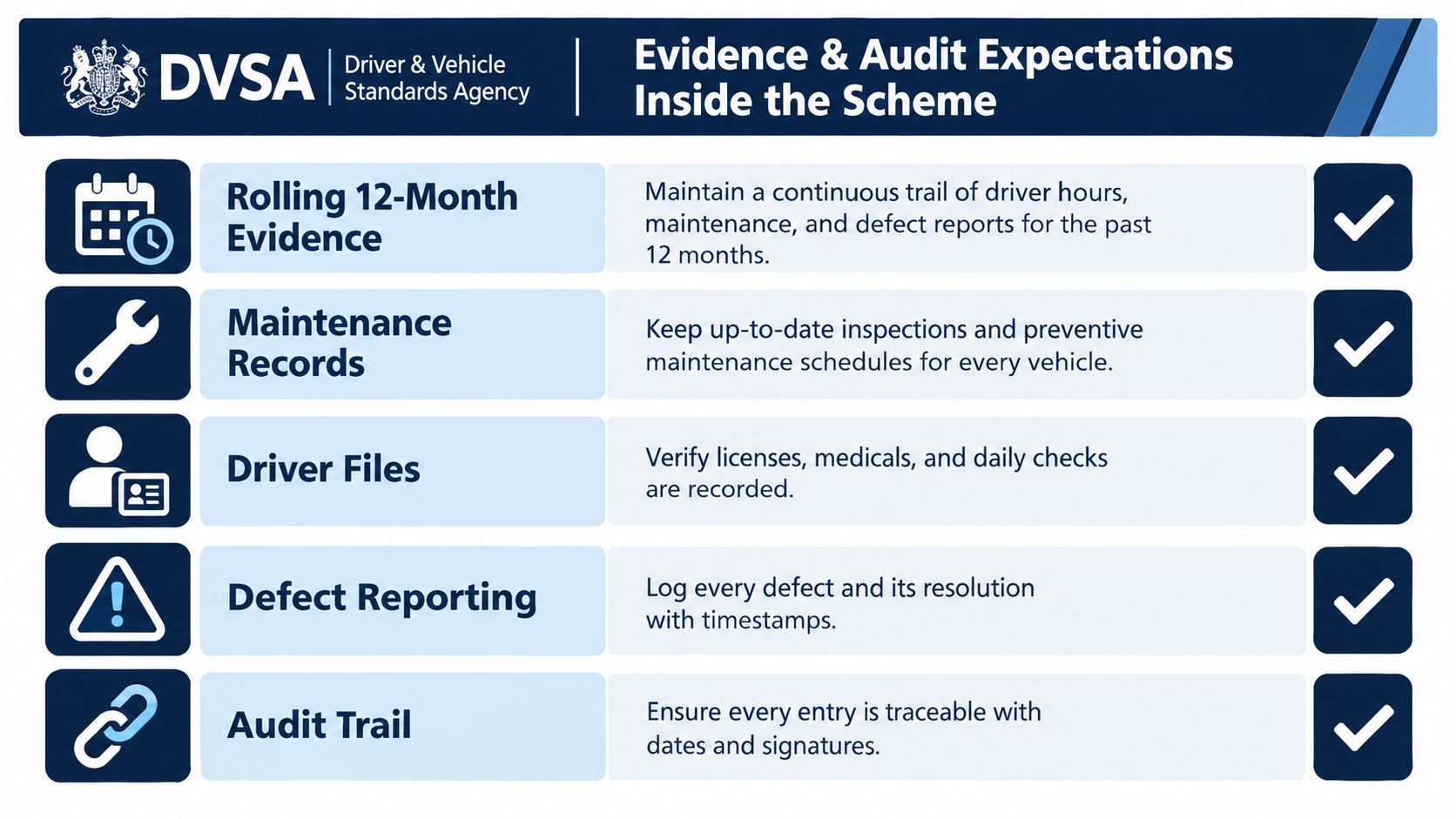
A useful audit file should let an assessor follow the chain from requirement to outcome:
- The maintenance planner shows the due date and planned inspection.
- The inspection record shows what the technician found.
- The defect log identifies the issue and its severity.
- The rectification record shows the work completed.
- The return-to-service decision identifies who authorised use.
- The KPI or compliance pack shows whether the event affected performance.
The same logic applies to tachographs. Keep the downloaded file, analysis result, infringement communication, driver response, signed debrief and corrective action together. A report without evidence of action is only a warning that someone may have noticed a problem.
What a remote request looks like
During a remote desk audit, an assessor may select particular vehicles, trailers, drivers and dates. Your team should be able to export records using stable naming conventions, clear timestamps and an intelligible folder structure, for example:
- Vehicle ID, inspection date, inspection type
- Vehicle ID, defect reference, rectification date
- Driver ID, card period, analysis date
- Driver ID, infringement reference, debrief date
- KPI period, submission status, corrective action
The sample tests whether your controls produced the right outcome. It doesn't matter that a policy exists if the selected vehicle has missed inspections, the selected driver has unsigned debriefs or the selected defect has no closure evidence.
Use operator licence maintenance records as an operational reference for organising the records your team needs to retrieve.
On site, expect a walkthrough of the compliance function, challenge questions for the transport manager and workshop controller, and verification that the systems described in the application are being used. Having data is not the same as proving control.
Steps to Apply Without Wasting Your Audit Window
Start with a readiness review, not an application form. Take a representative sample of vehicles, trailers, drivers and operating centres, then test whether your normal processes produce complete evidence without manual reconstruction.
Establish the operating baseline
Document who owns each control. The transport manager should know how maintenance dates are set, how late inspections are escalated, how driver licence and CPC status is monitored, how tachograph infringemen
dvsa earned recognitionoperator licence complianceearned recognition kpistachograph analysiscompliance audit evidence