· 8 min read
Audit ready fleet risk assessments: 6 steps for UK operators
HSE and DVSA aligned checklist and a 6 step workflow to make fleet risk assessments audit ready. How to capture evidence, set reviews and centralise records.

Audit ready fleet risk assessments: 6 steps for UK operators
A fleet risk assessment must be “suitable and sufficient” under HSE guidance, and it must sit alongside DVSA roadworthiness expectations for vehicles and drivers. In practice that means every significant hazard needs a traceable chain: hazard identified, control chosen, an owner named, and evidence recorded and dated. Anything less collapses under an examiner’s first question.
TL;DR:
- Effective risk assessments require clear documentation of hazards, controls, owners, and evidence, aligned with both HSE and DVSA standards.
- Regular data collection, including defect reports, brake-test records, and driver checks, is essential to maintaining a defensible audit trail.
- Assessments must focus on site-specific hazards and involve drivers and supervisors to identify risks overlooked by desk reviews.
- Short, tailored evaluations of actual yard, routes, and vehicles outperform lengthy templates that get ignored or forgotten.
- Centralized software tools can streamline evidence gathering and reporting but cannot replace human judgment in assessing vehicle safety.
Table of Contents
- What to check: a DVSA and HSE aligned checklist
- How to run an assessment that survives inspection
- Recording evidence for a DVSA or traffic commissioner audit
- Keeping the assessment live: monitoring and review
- Where fleet risk assessments commonly go wrong
- How software fits into evidence gathering
- Why short, specific assessments beat long templates
- Centralise your evidence with OperatorCompliance
- Sources
- FAQ
What to check: a DVSA and HSE aligned checklist
HSE frames workplace transport risk around three connected areas: safe site, safe vehicle and safe driver. A working checklist should cover each one, with a named person responsible for closing gaps.
- Safe site: segregated pedestrian and vehicle routes, banksman controls for reversing, and defined loading and unloading areas.
- Safe vehicle: daily walkaround checks, scheduled PMI safety inspections, tyre management, brake-test evidence from a roller brake test (RBT) or an Electronic Braking Performance Monitoring System (EBPMS), and load-security checks.
- Safe driver: licence and Driver CPC verification, completed daily checks, controls for fatigue and drivers’ hours, and evidence of training and consultation.
- Organisational controls: named owners for each control, fixed inspection intervals, a maintenance planner, and a clear escalation route when a driver reports a defect.
None of this needs to be complicated. HSE is explicit that an assessment does not need to be technical, only proportionate to the real hazards the operation faces.
How to run an assessment that survives inspection
A defensible assessment follows a fixed sequence rather than a one-off form-filling exercise.
- Define the scope. List the vehicles, routes, sites, drivers and any contractors or agency staff covered by the assessment.
- Gather the data. Pull incident logs, DVSA prohibitions, defect reports, brake-test and MOT history, and tachograph exceptions before deciding anything.
- Score the risks. Use a simple likelihood by consequence matrix and prioritise the highest scores first rather than treating every item equally.
- Choose controls. Favour engineering fixes where possible (better yard layout, reversing sensors), then administrative controls (checklists, schedules), then behavioural controls (training, briefings) where the first two are not enough.
- Assign and verify. Name an owner for each control, set a deadline, and collect the evidence that shows it was actually done, not just planned.
- Set review triggers. Reassess immediately after an incident, a new vehicle type entering the fleet, a route change, or a DVSA prohibition, and on a fixed calendar interval otherwise.
Pro Tip: Score risks in a short workshop with a driver and a supervisor in the room; site-specific hazards rarely surface from a desk alone.
The sequence matters more than the paperwork format. An assessment that skips straight from “hazard” to “control” without verification is the most common reason operators cannot answer a follow-up question at a maintenance investigation.
Recording evidence for a DVSA or traffic commissioner audit
DVSA’s Guide to maintaining roadworthiness sets out the roadworthiness controls operators are expected to run and gives example safety-inspection records and brake-test formats to work from. Keeping the right records, in the right order, is what turns a risk assessment from a policy document into evidence.
- Completed walkaround checks and defect reports, with the escalation and repair action recorded against each one.
- Safety inspection (PMI) records at the set frequency, plus RBT or EBPMS brake-performance reports.
- MOT and annual test certificates, alongside driver licence and CPC check results.
- Tachograph download records and any exception reports generated from them.
One audit trail per significant risk is the standard to aim for, so a hazard can be followed through to its control, its named owner and a timestamped record of completion. DVSA’s maintenance investigation guidance lists 14 inspection areas examiners check, including inspection and maintenance records, driver defect reporting and load security. That is the exact chain an examiner will try to follow, and it is the chain your recordkeeping needs to support.
Keeping the assessment live: monitoring and review
A risk assessment that never changes is not being used. Track a small set of indicators and act on movement in any of them.
- Defect close rate: slow closure points to a bottleneck in the repair or escalation process.
- Overdue inspections: even one overdue PMI signals a scheduling gap worth investigating.
- Prohibitions and repeat defects: repeat faults on the same vehicle or route usually mean the control chosen was the wrong one.
- Driver and near-miss reports: feed these into the next review rather than filing them separately.
Fixed calendar reviews (quarterly is common) should sit alongside immediate reassessment after an incident, a prohibition, or a change to vehicles or routes.
Where fleet risk assessments commonly go wrong
Most failures trace back to the same handful of habits.
- Paperwork-only assessments. A template completed at a desk misses real site hazards; get out and watch the yard, and consult drivers directly.
- Treating MOT as sufficient. HSE guidance on maintaining vehicles is clear that the annual test is not a substitute for daily checks and planned preventive maintenance between tests.
- Weak defect-reporting culture. If drivers do not report faults, or reports vanish without action, the traceability an examiner looks for simply does not exist.
How software fits into evidence gathering
Software cannot decide whether a vehicle is safe to drive, but it can stop evidence going missing. OperatorCompliance runs DVLA licence checks, reads digital tachograph downloads, and gives drivers a bilingual app for daily walkaround checks, so defect reports land in one place instead of a cab notebook.

That centralisation is where the operational benefit shows up: fewer overdue inspections slipping through, faster defect closure because escalation is visible, and an exportable audit-ready pack that shows named owners and timestamps against each control. None of this replaces a competent inspection or a decision to take a vehicle off the road. It simply makes sure the record of that decision survives to the audit.
Why short, specific assessments beat long templates
The best fleet risk assessments I have seen run to a few pages and name the actual yard, the actual routes and the actual vehicles. Long generic templates get filed and forgotten. Involve drivers and supervisors before you write anything, because they spot the hazards a desk review never will, and keep enough of a paper trail that an examiner can follow it without you in the room.
— Vytautas
Centralise your evidence with OperatorCompliance
Running the checklist above by hand across a growing fleet means chasing paper defect sheets, checking DVLA licence status manually and hoping tachograph downloads happen on time. OperatorCompliance puts vehicle and driver compliance on one dashboard: MOT and annual test, PMI, insurance, DVLA licence checks and tachograph analysis, with a bilingual driver app for daily walkaround checks.
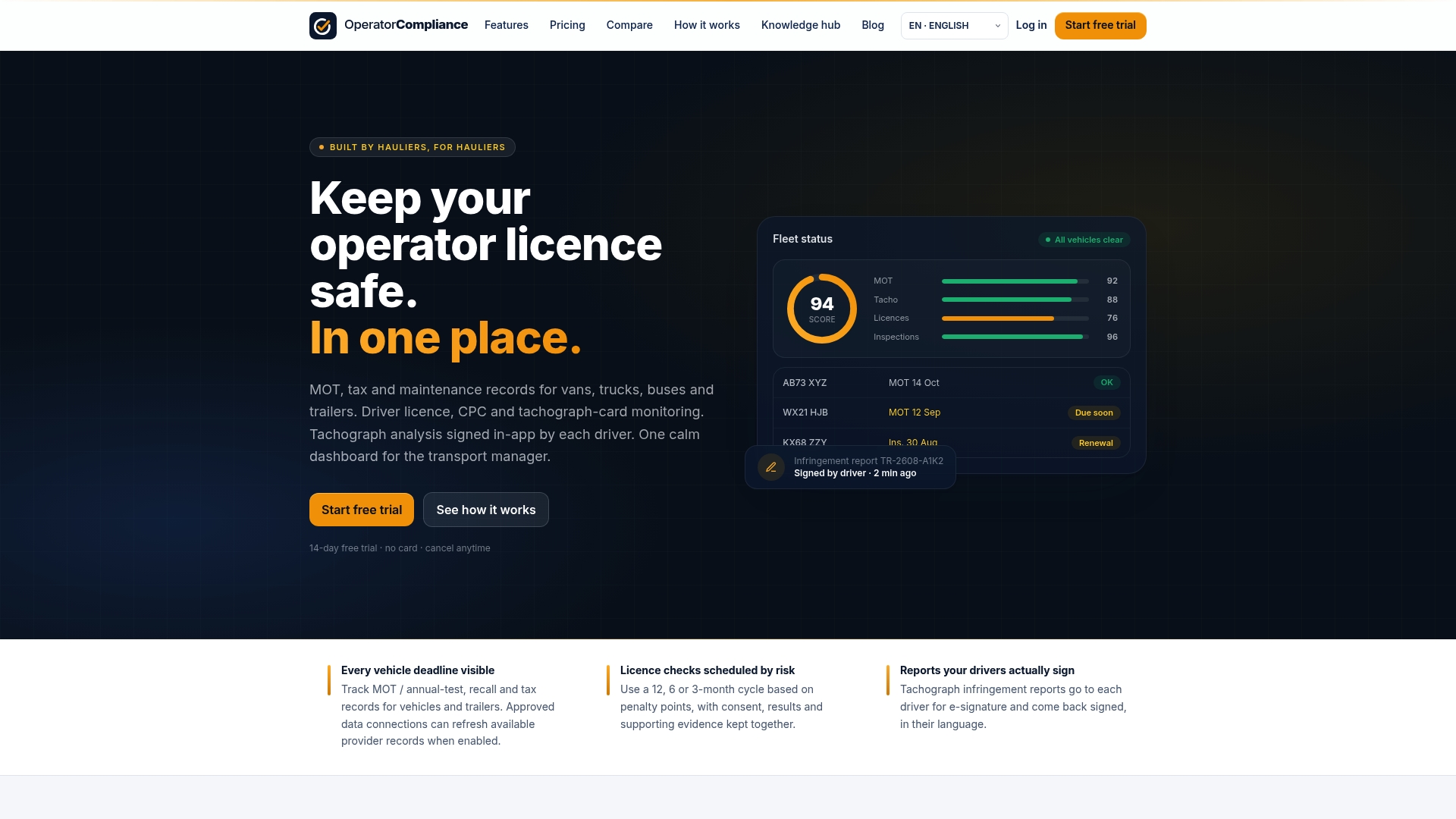
That means the hazard to control to evidence chain your risk assessment demands is captured automatically rather than reconstructed after the fact, with an exportable pack ready for a DVSA or traffic commissioner enquiry. Check pricing plans or read more in the knowledge hub to see how it fits your fleet.
Sources
FAQ
Are risk assessments a legal requirement in the UK?
Yes, employers must carry out a “suitable and sufficient” risk assessment covering foreseeable harm to staff and others, as set out in HSE guidance. For fleet operations, this sits alongside DVSA’s roadworthiness expectations for vehicles and drivers.
Are vehicle checks a legal requirement?
Daily walkaround checks and planned maintenance are expected controls under both HSE and DVSA guidance, and HSE’s vehicle maintenance advice states that the MOT or annual test alone is not sufficient. Operators are expected to keep records showing these checks happened and that defects were acted on.
What records should a fleet keep for a DVSA audit?
Operators should retain completed walkaround checks, PMI safety-inspection records, brake-test evidence from RBT or EBPMS, MOT and annual test certificates, and tachograph download data. DVSA’s maintenance investigation guidance lists 14 areas examiners typically check against these records.
How often should a fleet risk assessment be reviewed?
Reviews should happen on a fixed calendar basis, commonly quarterly, and immediately after an incident, a DVSA prohibition, a new vehicle type, or a route change. HSE’s guidance on reviewing risk assessments regularly applies directly to fleet operations covered under the same framework.
Can software replace a fleet risk assessment?
No. Software such as OperatorCompliance helps centralise evidence, licence checks and tachograph data, but the assessment itself, and any decision about a vehicle’s safety, remains a competent human judgement that the software supports rather than replaces.
Recommended
- Tacho Analysis Software for UK Fleets: A Practical Guide
- Taxi and private hire fleet compliance
- PSV operator compliance software
- How it works - set up your fleet in an afternoon
This article is general guidance for UK operators and transport managers, not legal or professional advice. Regulations change, so always confirm the current requirements with GOV.UK, DVSA and your traffic commissioner before acting.
fleet risk assessments