· 10 min read
15 months' evidence: Make UK operator licence compliance audit ready
Map GOV.UK audit requirements to daily tasks and build an exportable 15 months' audit pack. Practical steps UK operators can use to prove licence...
15 months’ evidence: Make UK operator licence compliance audit ready
Operator licence compliance means meeting the undertakings you signed when granted your O-licence, backed by continuous systems that produce evidence on demand, not just tidy paperwork once a year. The single most urgent step for most operators is building an audit-ready pack now: 15 months of maintenance and driver records, current Driver CPC evidence, and tachograph downloads that have actually been analysed. The Traffic Commissioner and DVSA don’t want promises. They want proof, and software like OperatorCompliance exists precisely to keep that proof current.
TL;DR:
- Building an audit-ready pack covering 15 months of records, including defect reports, tachograph downloads, driver checks, and financial evidence, is crucial for compliance.
- Continuous daily to quarterly routines, such as defect logging, tachograph analysis, and licence verification, help maintain ongoing adherence to operator undertakings.
- A poor Operator Compliance Risk Score or Earned Recognition status can lead to more roadside stops and stricter enforcement, increasing the risk of penalties.
- Responding promptly with a clear corrective action plan to any compliance shortfalls minimizes escalation to license restrictions or revocation.
- OperatorCompliance software automates record management and alerts, making it easier to produce timely, accurate evidence for audits and inspections.
Table of Contents
- What operator licence undertakings require
- What does an operator compliance audit actually check?
- Common compliance failures and the Traffic Commissioner’s responses
- How do you build an audit-ready evidence pack?
- Maintaining continuous compliance day to day
- OCRS and Earned Recognition: why they matter
- Pre-audit checklist: the final seven days
- Procedures for responding to non-compliance findings and appeals process
- Guidance on ongoing training and updates for maintaining compliance
- Standard National vs Standard International: what changes
- Why systems beat paperwork at public inquiries
- How OperatorCompliance keeps you audit-ready
- Sources
What operator licence undertakings require
Every standard O-licence carries a set of legally binding undertakings, and they’re not optional extras. The Goods Vehicles (Licensing of Operators) Act 1995 sets out the statutory basis for holding a licence, and the undertakings you sign against it form the core of what a Traffic Commissioner checks when things go wrong.
The commitments are broadly consistent across operators, though the evidence you need to produce varies by fleet size and vehicle type. In practice, you’re promising to keep vehicles fit and serviceable, keep drivers legally qualified and within their hours, and maintain records that prove both.
- Vehicles and trailers are kept fit and serviceable at all times
- Drivers report defects promptly and those defects get fixed
- Drivers’ hours rules are followed and tachograph records kept
- Driving licences and Driver CPC status are checked regularly
- Financial standing is maintained throughout the licence period
- Changes (address, convictions, new operating centres) are reported to the Traffic Commissioner
Safety inspection and defect records need to be retained for at least 15 months and produced promptly if DVSA or the traffic commissioner asks. The goods vehicle operator licensing guide on GOV.UK spells out exactly what evidence supports each undertaking, and it’s worth reading in full at least once, not skimming for the bits that seem relevant.
What does an operator compliance audit actually check?
GOV.UK’s standard audit framework doesn’t ask you to describe your systems. It asks you to prove they work, with dated evidence covering a defined period rather than a snapshot from last week. An auditor working to that framework will typically examine vehicle maintenance planning, defect reporting and rectification, driver licence and CPC checks, drivers’ hours and tachograph analysis, and your financial standing paperwork.
Auditor independence matters more than most operators realise. The operator compliance audits guidance recommends auditors carry relevant transport manager CPC experience and, ideally, come from an organisation working to recognised quality standards such as ISO 9001. An auditor with no operational background will miss the gaps that actually matter at a public inquiry.
Sample sizes give you a sense of scale. The table below reflects the general approach GOV.UK’s framework describes for evidence periods.
| Evidence type | Typical period examined | What auditors look for |
|---|---|---|
| Safety inspections | 15 months | Consistent intervals, follow-up on defects |
| Tachograph records | Rolling recent period | Downloads on schedule, infringements analysed |
| Driver licence checks | Current status plus history | DVLA checks logged, CPC dates current |
| Financial standing | Current financial year | Evidence matches declared fleet size |
Common compliance failures and the Traffic Commissioner’s responses
Most operators who end up in front of a Traffic Commissioner didn’t set out to break the rules. They let small gaps accumulate until an inspection or a roadside stop exposed them. Driver CPC lapses, missed safety inspections, unanalysed tachograph downloads, and thin record keeping are the most common triggers for enforcement action, alongside financial standing that no longer matches the declared fleet size.
Pro Tip: Don’t wait for an annual review to check Driver CPC expiry dates. A driver working past their CPC deadline invalidates their qualification to drive professionally, and it’s one of the easiest gaps for an auditor to spot.
When undertakings aren’t met, the Traffic Commissioner doesn’t jump straight to revocation. Regulatory action typically escalates through defined stages:
- A warning letter, usually the first formal signal something needs fixing
- A public inquiry, where the operator explains the shortfall in person
- Licence restrictions, cutting vehicle numbers or operating centres
- Suspension, pausing the licence until issues are resolved
- Revocation and, in serious cases, disqualification of the transport manager
Poor compliance also feeds into your Operator Compliance Risk Score, which means roadside enforcement teams are more likely to stop your vehicles. One weak link, an unanalysed tachograph download or a missed inspection, rarely stays isolated. It tends to surface at the worst possible moment, during a routine check that becomes anything but routine.
How do you build an audit-ready evidence pack?
An audit-ready pack isn’t a folder of receipts. It’s proof that your systems, not just your records, actually function. GOV.UK’s audit guidance stresses evidence of the process behind each document: a forward preventative maintenance planner, dated repair follow-ups, and a clear link between every defect report and its fix.
- Gather 15 months of safety inspection and PMI planner records, showing scheduled intervals and completed work
- Attach dated repair invoices to each defect report so the link between fault and fix is obvious
- Export tachograph analysis covering recent download cycles, with infringements flagged and signed off by drivers
- Compile current driving licence and Driver CPC check logs, including DVLA verification dates
- Pull together financial standing evidence matching your declared fleet size
- Package everything into one exportable file rather than scattered folders
On format, GOV.UK guidance notes that scanned or photographed originals are acceptable provided they’re complete and legible, and recommends a secure portal such as SharePoint to preserve image quality rather than emailing compressed attachments.
If you’re bringing in an independent auditor, brief them properly before the visit. An acceptable independent audit paired with a credible corrective action plan can genuinely soften a Traffic Commissioner’s response, so give the auditor full access rather than a curated selection.
Maintaining continuous compliance day to day
Audit readiness isn’t a once-a-year sprint. It’s a set of habits that run daily, weekly and monthly, and it’s where most of the actual failure happens, quietly, between audits.
- Daily: drivers complete walkaround checks and log defects immediately, not at the end of a shift
- Weekly: transport managers review outstanding defects and confirm repairs are logged with dates
- Every 28 days: driver card tachograph data gets downloaded and analysed
- Every 90 days: vehicle unit downloads happen on schedule, with infringements flagged to drivers for sign-off
A Traffic Commissioner will ask a transport manager to demonstrate continuous and effective control, not simply confirm their name is on the licence. Software that automates alerts, signed infringement reports, and exportable records helps turn that expectation into something you can evidence on the day.
OCRS and Earned Recognition: why they matter
The Operator Compliance Risk Score is calculated over a rolling three-year window, weighing your roadworthiness history against traffic enforcement data. A poor score means more roadside stops; a strong one means DVSA officers largely leave you alone.
DVSA Earned Recognition status, awarded to operators who meet defined data-sharing and performance standards, brings similar benefits: fewer roadside interventions and stronger standing with the Traffic Commissioner if issues ever arise. What actually feeds a better score:
- Consistent MOT and annual test passing rates
- Prompt defect rectification with no repeat faults
- Drivers’ hours infringements caught, flagged, and acted on quickly
Pre-audit checklist: the final seven days
The week before an audit is not the time to discover gaps. It’s the time to confirm what you already believe is true.
- Confirm 15 months of safety inspection records are complete and accessible
- Run final tachograph downloads and confirm analysis is up to date
- Check Driver CPC and driving licence status for every driver on the fleet
- Verify MOT, road tax and operating centre declarations are current
- Brief the transport manager and any director likely to be interviewed
- Package the full pack into one secure, exportable file
| Check | Owner | Deadline |
|---|---|---|
| Safety inspection records complete | Transport manager | 5 days before |
| Tachograph analysis current | Compliance lead | 3 days before |
| Driver CPC/licence status verified | Transport manager | 3 days before |
| Audit pack exported and secured | Transport manager | 1 day before |
Procedures for responding to non-compliance findings and appeals process
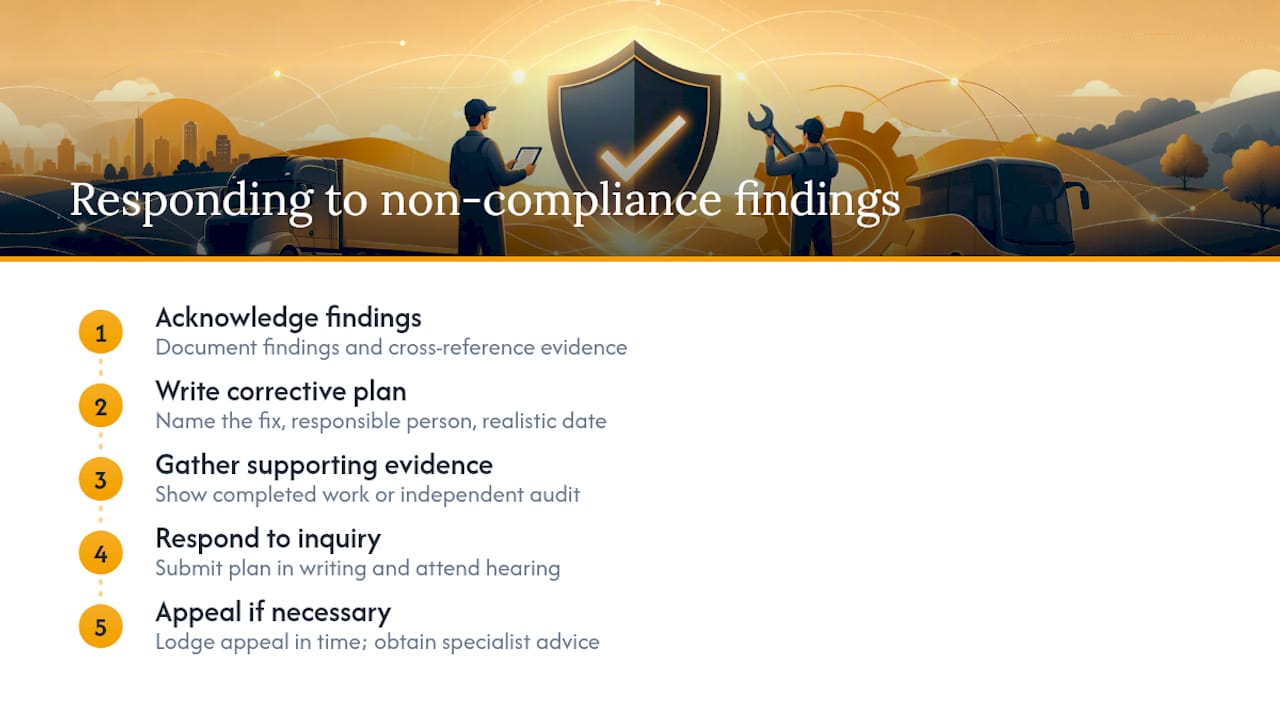
If an audit or DVSA visit turns up a shortfall, the worst response is silence. The Traffic Commissioner responds far better to an operator who acknowledges the gap and produces a corrective action plan than one who disputes every finding.
Start by documenting exactly what was found and cross-referencing it against your own evidence. Sometimes an auditor’s finding reflects a genuine systemic weakness; sometimes it reflects a document that existed but wasn’t presented clearly. Either way, write a corrective action plan that names the specific fix, who’s responsible, and a realistic completion date. Vague promises to “tighten up processes” carry little weight at a public inquiry.
Where you’ve received a formal warning letter or been called to a public inquiry, you’re entitled to respond in writing and attend in person, usually with legal or industry representation if you choose it. Bring your corrective action plan, evidence of work already completed, and, where relevant, an independent audit demonstrating the fix has taken hold, not just been promised.
If a Traffic Commissioner’s decision goes against you, whether that’s a restriction, suspension or revocation, there’s a formal appeals route through the Upper Tribunal. Appeals must be lodged within the specified time limit stated in the decision letter, and they focus on whether the Commissioner applied the law correctly and reasonably, not on relitigating every fact. Given the stakes, most operators bring in specialist transport legal advice at this stage rather than handling an appeal alone.
Guidance on ongoing training and updates for maintaining compliance
Compliance knowledge decays quickly if nobody refreshes it. Drivers need Driver CPC training renewed on a rolling five-year cycle, and and transport managers should treat their own CPC qualification as a floor, not a ceiling, given how often GOV.UK guidance and enforcement priorities shift.
Build a simple training calendar rather than relying on memory. Track each driver’s CPC hours across the five-year period so nobody arrives at year four with a shortfall that forces a scramble. Refresh walkaround check training annually, particularly for new starters who may have learned bad habits at a previous employer.
Transport managers benefit from periodically revisiting GOV.UK’s own guidance rather than relying on second-hand summaries, since undertakings and audit expectations are occasionally updated. Subscribing to DVSA bulletins or checking the goods vehicle operator licensing guide every few months catches changes before they catch you.
Internal training matters just as much as formal qualifications. A driver who understands why a defect report matters, not just that it’s required, is far more likely to file one accurately and promptly. Build short refresher sessions around real incidents from your own fleet rather than generic slideshows; specificity is what makes training stick, and it’s usually free to run if you use your own defect history as the material.
Standard National vs Standard International: what changes
A Standard National operator licence covers goods vehicle operations within Great Britain only. A Standard International licence covers that plus international haulage, and the compliance burden steps up accordingly.
operator licence compliance