· 10 min read
Operator Licence Compliance: A Practical Guide for UK Fleets
Practical UK guide to operator licence compliance: undertakings, inspections, driver checks, tachograph rules and audit-ready evidence for HGV and PSV fleets.
The most popular advice on operator licence compliance is to keep a tidy folder and update it regularly. That advice is incomplete. A folder can contain every expected form while the operator still can't explain which defect was escalated, why an inspection interval was chosen, whether a tachograph infringement was debriefed, or what happened after a driver check identified a problem.
Compliance is evidence discipline. The Traffic Commissioner isn't testing whether paperwork exists in isolation. They're testing whether the operator, transport manager and maintenance providers exercised effective control, and whether the records prove it. The scale of that scrutiny is clear from the Traffic Commissioners' 2024-25 annual reporting data, which records 12,345 operator licence applications and variations, 1,066 public inquiries, 224 preliminary hearings and 15,613 vocational driver cases closed in a single year.
A downloaded tachograph file isn't the same as an analysed file. A safety inspection stamp isn't the same as a defensible inspection history. A driver licence copy isn't evidence that the entitlement remained valid when the driver operated the vehicle.
Table of Contents
- Why a Folder of Documents Is Not the Same as Operator Licence Compliance
- The Operator Licence Undertakings You Actually Signed
- Safety Inspection Planning and 15-Month Evidence Retention
- Driver Licence, CPC and Tachograph Card Monitoring
- Tachograph Downloads Analysis and the 28 and 90 Day Rules
- Walkaround Checks Defect Reporting and Rectification Closure
- Building Monthly Compliance Packs a Traffic Commissioner Will Accept
- What Software Can and Cannot Do and How to Take the Next Step
Why a Folder of Documents Is Not the Same as Operator Licence Compliance
A tidy folder feels reassuring because it gives management something visible to point at. Under questioning, that reassurance can disappear quickly. A Traffic Commissioner may ask who reviewed the records, what exception was found, what action followed, and how the business knows the action worked.
That's the difference between document retention and operator licence compliance. Retention keeps the file. Compliance connects the obligation, the event, the decision and the follow-up. If a tachograph archive contains downloads but no infringement analysis, the operator has preserved data without demonstrating control. If a maintenance folder contains inspection sheets but no evidence of defect closure, it may show activity without proving roadworthiness was managed.
The question isn't “Have you got the document?” It's “What did you do with the information in it?”
The same weakness appears in driver monitoring. A photocopy of a vocational licence may show what the driver held at one point, but it doesn't prove that the transport team performed checks at the expected cadence or acted on an endorsement, expiry or entitlement change. A compliance system must show the last check, the next due date, the evidence returned and the person who reviewed it.
Evidence must tell a connected story
The strongest records allow someone outside the daily operation to follow the sequence without relying on memory:
- Obligation: The undertaking or procedure says what must happen.
- Event: The inspection, download, licence check or walkaround occurred.
- Review: A named person assessed the result.
- Action: The operator repaired, debriefed, suspended or escalated as appropriate.
- Closure: The record shows when the issue was resolved and who confirmed it.
This guide treats each major control in those terms. The practical test is simple: could you retrieve a vehicle's inspection history, a driver's monitoring record or a tachograph remediation trail quickly, then explain every exception without guesswork?
The Operator Licence Undertakings You Actually Signed
An operator licence undertaking isn't background wording. It's the operational promise the licence holder makes to the Traffic Commissioner. For a standard licence, that promise normally covers proper maintenance, roadworthiness, drivers' hours, tachograph control, record keeping, lawful operation and honest notification of material changes.
Translate the wording into actions:
- Maintain vehicles properly. Vehicles and trailers must be kept fit and serviceable. Missed safety inspections, weak brake evidence or repeated unresolved defects suggest the maintenance system isn't working.
- Use suitable drivers. The operator must control driver entitlement, qualification and fitness for the work. A driver operating without current Driver CPC where it's required, or without the appropriate vocational entitlement, creates a direct regulatory concern.
- Control drivers' hours and tachographs. Downloads must happen on time, but the operator must also analyse the information, identify infringements and show follow-up.
- Keep proper records. Maintenance inspections, repairs, defects, brake-test information and driver records must be retrievable and internally consistent.
- Operate only within the licence. Vehicles must not be used without the required operator licence authority, and changes affecting the operation must be managed through the proper process.
- Be honest with the Traffic Commissioner. Relevant convictions, changes to the business, operating arrangements or other material matters must be considered and notified where required. Concealing a problem usually makes the regulatory response worse.
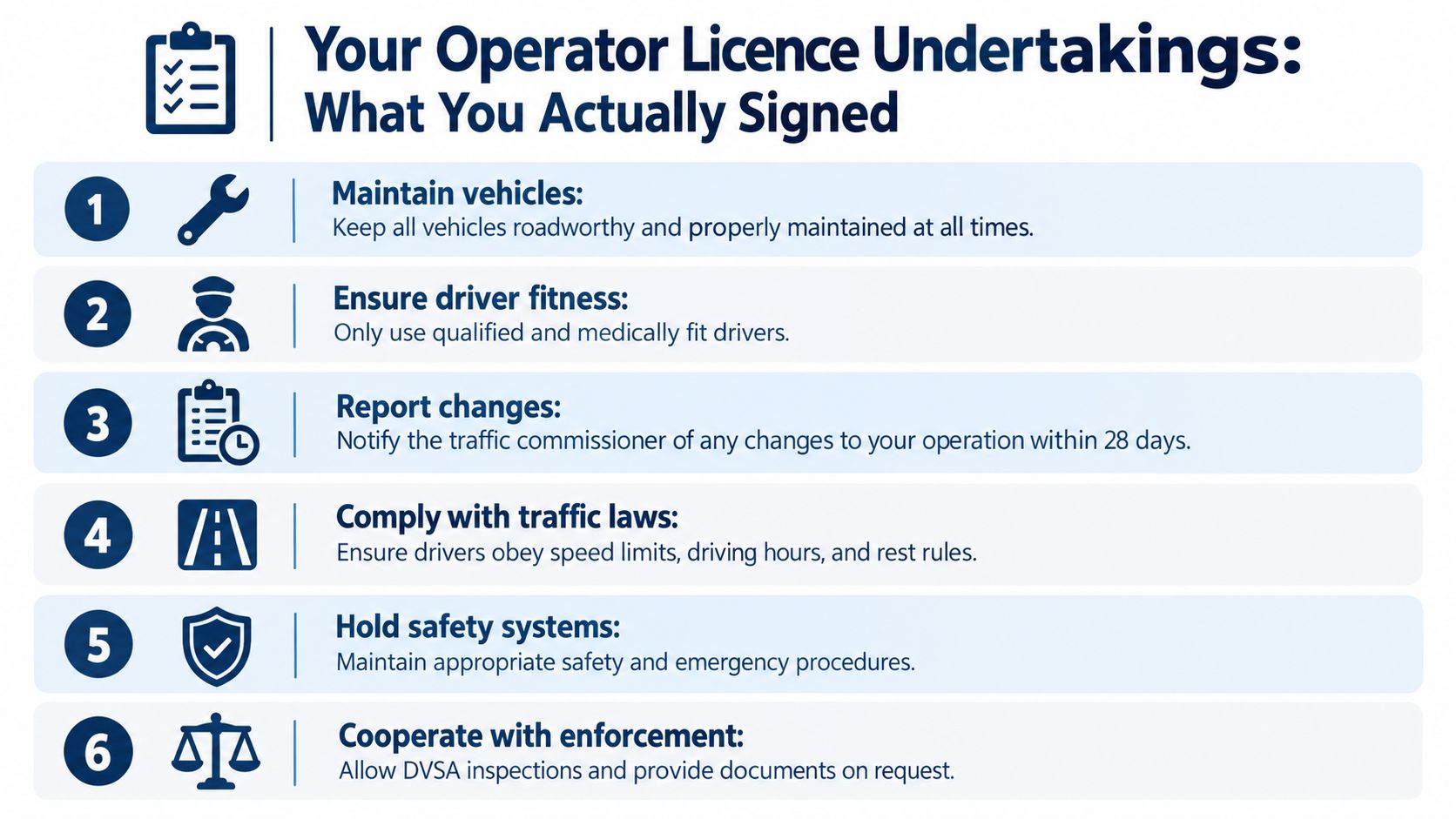
The plain-English guide to operator licence undertakings is useful for translating the promises into day-to-day ownership. Goods vehicle and PSV operators may apply different operational controls, but the central principle is the same: the licence holder remains responsible for the system.
At a public inquiry, a missed inspection isn't treated as an isolated calendar error if the operator can't show how the planning system detected it. A tachograph gap isn't resolved by producing an old download if nobody analysed the relevant period. A conviction or material change that wasn't disclosed raises questions about honesty and management control.
The undertaking is therefore a contract with consequences. It sets the standard against which the Traffic Commissioner will test what the operator did, not what the operator intended to do.
Safety Inspection Planning and 15-Month Evidence Retention
The DVSA maintenance framework is risk-based, not a universal calendar. The GOV.UK goods vehicle operator licensing guidance states that safety inspection intervals are normally set between 4 and 13 weeks, with the chosen interval justified by factors including vehicle age, mileage, operating conditions and historical defect rate.
That range needs practical judgement. A vehicle doing demanding work with a history of defects may need a shorter interval than a lightly used unit. The important point is that the operator should be able to explain the choice, apply it consistently and review it when the operating risk changes.
Build the planner around evidence, not reminders
A useful planner should show every vehicle and trailer, its inspection interval, the next due date, the allocated maintenance provider and the outcome of the latest inspection. It should also flag vehicles that are unavailable, overdue or returned to service after repair.
VOR status needs particular care. If a vehicle is off the road, record the start and end dates, the reason, the location and the decision about whether an inspection or interim examination remains necessary before use. “It was off the road” is an explanation, not a record.
Brake evidence must be attached to the relevant inspection record and be understandable to the person reviewing the file. Keep the brake-test report, the date, the vehicle identity and the inspector's assessment together. Also retain evidence that the person carrying out the inspection and assessment was competent for the task.
| Inspection Element | Frequency or Trigger | Evidence Required | Retention |
|---|---|---|---|
| Safety inspection | Risk-based interval within the applicable 4 to 13 week range | Completed inspection record, defects, inspector details and outcome | At least 15 months |
| Brake assessment | At the relevant safety inspection or when required by the maintenance system | Brake-test data, supporting report and review | With the inspection file |
| Interim inspection | Return from VOR, significant repair or risk-based trigger | Reason, checks completed, release decision and sign-off | With the vehicle history |
| Defect rectification | Whenever a defect is reported | Defect report, repair evidence, verification and closure | At least 15 months |
| Maintenance provider review | Internal control point | Work order, invoice or report matched to the vehicle and defect | With supporting records |
The DVSA Guide to Maintaining Roadworthiness requires safety inspection and repair records to be kept for at least 15 months, and Traffic Commissioners can request them as operator licence evidence.
Outsourcing doesn't change that duty. A workshop can perform the inspection and repair, but the operator must still select a suitable provider, define the required evidence, check the work and challenge gaps. A supplier's invoice rarely proves that the operator controlled the maintenance system. A complete, date-linked inspection and rectification history does.
Driver Licence, CPC and Tachograph Card Monitoring
Driver compliance rests on several live records, and each one can change independently. The transport team needs to monitor vocational entitlement, Driver CPC status and tachograph-card validity rather than treating a single annual document review as sufficient.
The evidence route matters. A GOV.UK licence check code can support an entitlement check, while DVLA Access to Driver Data may provide a different route where the required driver consent and mandate arrangements are in place. Don't imply that one method replaces the other, and don't file a screenshot without recording what was checked, when it was checked and who reviewed it.
Create one controlled record per driver
A practical driver file should contain the driver's identity, entitlement categories, last check date, next due date, CPC evidence, tachograph-card details and any risk flags. Keep consent or mandate evidence alongside the result where the chosen checking route requires it. If a check code expires before the record is filed, retain the available evidence and record what replacement action was taken.
The cadence should reflect risk. Traffic Commissioner guidance says regular driver licence checks are usually carried out every 3 months, as set out in the Traffic Commissioner transport manager guidance. An operator may choose tighter controls for new, higher-risk or post-incident drivers, but it should document the reason for the cadence rather than applying an unexplained pattern.
| Record | Evidence Source | Re-check Cadence |
|---|---|---|
| Vocational entitlement | GOV.UK check code or approved DVLA access route, with consent evidence where required | Usually every 3 months |
| Driver CPC | DQC or other current qualification evidence | Before assignment and on the internal expiry schedule |
| Tachograph card | Card details and validity record | On issue, renewal and before planned use |
| Risk flags | Incident, infringement or management review record | At the cadence justified by the risk |
| Driver file | Signed review or electronic audit trail | Updated after every relevant check |
CPC monitoring needs its own expiry control. A driver who has completed training but doesn't hold the required current evidence can still create an operational problem. The transport office should check qualification status before allocating work, especially when drivers move between goods and passenger operations or return after a long absence.
The objective isn't to collect more documents. It's to make the driver file answer three questions immediately: what was checked, when was it checked, and what happened if the result wasn't satisfactory?
Tachograph Downloads Analysis and the 28 and 90 Day Rules
Tachograph control fails when operators confuse downloading with management. The GOV.UK public service vehicle operator licensing guidance states that, where appropriate, digital tachograph vehicle-unit data must be downloaded at least every 90 days, drivers' smart-card data at least every 28 days, and drivers' hours records retained for at least 12 months. Working-time records have separate retention requirements.
The interval runs from the last download. It isn't reset by a driver changing vehicles, a card being issued or a file being moved between folders. The operator must provide the facilities and process for timely downloads, while the transport team must monitor whether the process happened.
Analysis is the control
A download archive without review notes is an evidence gap. An analyst should examine the relevant period for driving-time breaches, rest problems, missing activity, unauthorised manual entries, unexplained gaps and other infringements under the applicable drivers' hours rules. The review should identify patterns, not just count events.
A useful one-page analysis summary can include:
- Driver and period: Driver identity, card or employee reference and dates covered.
- Findings: Each infringement, missing period or data concern, with the relevant date.
- Debrief: The driver's explanation and the date the discussion took place.
- Corrective action: Training, route planning, scheduling, supervision or escalation.
- Sign-off: Analyst name, date, review status and driver acknowledgement where used.
Downloading data preserves information. Analysing it demonstrates management control.
The tachograph download rules for 28 and 90 days should be used alongside the operator's own procedure, not instead of one. The transport manager needs a calendar that identifies approaching deadlines, overdue files and unresolved infringements.
The practical test is whether a reviewer can select a driver, open the download, read the analysis and follow the remediation trail to closure. If the only answer is “the files are stored in the tachograph folder”, the system has recorded activity but hasn't shown control.
Walkaround Checks Defect Repor
operator licence complianceHGV compliancetachograph downloadsDVSA roadworthinessO-licence undertakings