· 10 min read
Handover Checks That Prevent Invalid Tachograph Calibrations in the UK
Practical UK checklist: follow the 24 month rule, recalibrate after repairs, tyre or VRN changes or UTC drift, and store certificates to pass DVSA checks.
Handover Checks That Prevent Invalid Tachograph Calibrations in the UK
Digital and smart tachographs must be recalibrated at least every two years, and immediately after a repair, a tyre or VRN change, or a UTC time drift of more than 20 minutes. Analogue units follow a different clock: inspected every two years, recalibrated every six. Only an Approved Tachograph Centre using a valid workshop card can do the work, and drivers must check the plaque and note any fault before setting off.
TL;DR:
- Digital tachographs must be recalibrated every 24 months or immediately after events like repairs, tyre changes, VRN updates, or UTC time drifts over 20 minutes.
- Only approved technicians at registered centres with valid workshop cards can perform calibration, which must be properly sealed and recorded.
- Operators must document calibration dates, keep certificates, and photograph plaques to ensure compliance during audits, linking maintenance triggers to calibration validity.
- Mixed fleets require separate checks for analogue units, inspected every two years and recalibrated every six, with paper charts and manual entries still in use.
- Automated compliance tools that track triggers, store certificates, and generate exportable audit packs significantly reduce the risk of failing to meet calibration regulations.
Table of Contents
- What the law requires: calibration intervals and recalibration triggers
- Who can actually calibrate a tachograph?
- Reading the calibration plaque and keeping the paperwork straight
- Analogue vs digital and smart: what actually differs
- Operator and driver responsibilities: the audit-ready checklist
- Where a compliance process (or software) actually earns its keep
- Practical perspective: common pitfalls and immediate fixes
- A simpler way to stay on top of calibration dates
- Where to check the rules yourself
- Sources
- FAQ
What the law requires: calibration intervals and recalibration triggers
The two-year rule is the backbone of digital and smart tachograph compliance. Every unit fitted to a goods vehicle must go through periodic inspection and recalibration on that cycle, full stop, regardless of mileage or how the vehicle is used. But the calendar isn’t the only thing that forces a workshop visit.
Certain events reset the clock immediately, because they can throw off the accuracy of the unit’s recorded data. Gov sets out the full list:
- Any repair affecting the tachograph unit or the vehicle’s speed measurement system
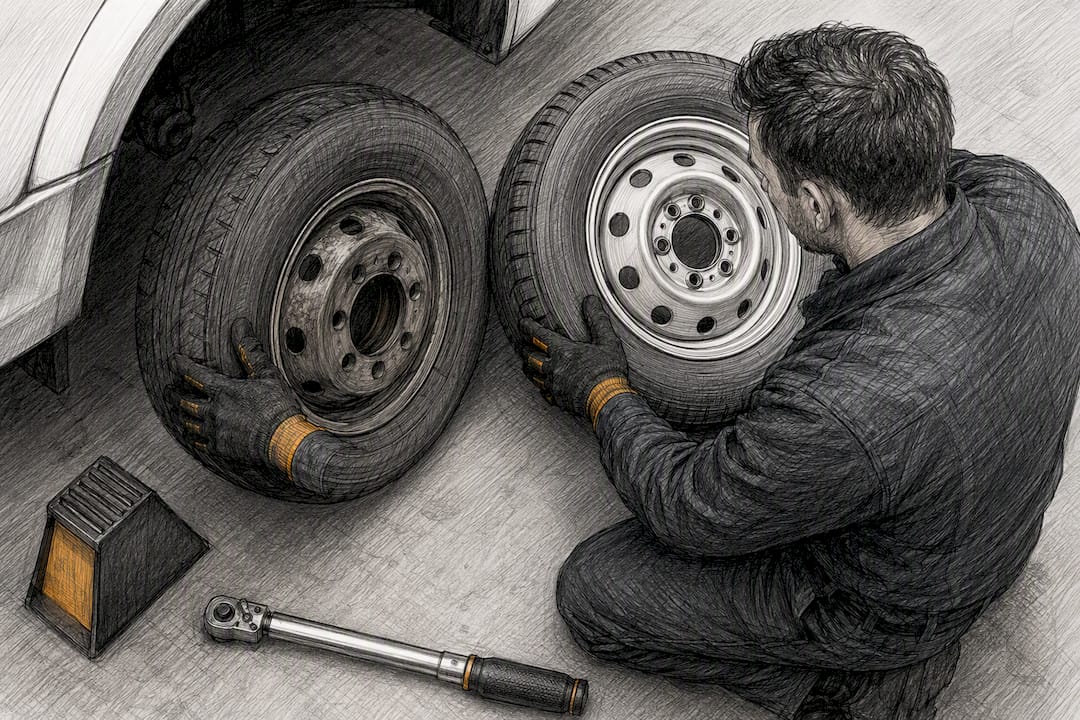
- A change to tyre circumference or the vehicle’s characteristic coefficient (new tyre size, different wheels)
- A change of vehicle registration number (VRN)
- UTC time drifting by more than 20 minutes from the correct time
- Fitting a replacement or new tachograph unit
Miss any one of these and your calibration is legally invalid from that point, even if the 24 month clock hasn’t run out. That’s the trap most operators fall into: they treat calibration as a fixed date in the diary rather than as a status that can be broken overnight by a tyre fitter or a bodyshop repair.
Analogue tachographs run on a longer cycle. They need inspection every two years and full recalibration every six years, under the construction and inspection annexes covering analogue units. Very few new vehicles carry analogue equipment now, but plenty of older vehicles in mixed fleets still do, and the rules for them haven’t changed.
Who can actually calibrate a tachograph?
Calibration isn’t a job for a general mechanic. It has to be done by a nominated technician working at an Approved Tachograph Centre (ATC), using a valid workshop card issued for that purpose. The ATC manual sets the conditions of approval, and it’s detailed: approved equipment lists, sealing procedures, record retention duties, and disciplinary consequences if a centre gets it wrong.
A few things worth knowing before you book a workshop:
- Workshop cards have generations too. Second generation smart tachographs need a second generation workshop card. An older card won’t calibrate a newer unit correctly, so it’s worth asking the workshop directly rather than assuming.
- The technician must be named on the card, not just employed by the garage. If you’re auditing a workshop’s credentials, ask to see the card itself.
- Seals matter. After calibration, the unit is resealed, and a broken or missing seal is a red flag at the roadside as much as an expired date is.
You can find your nearest approved workshop through the ATC finder on GOV.UK, which lists centres by postcode.
Reading the calibration plaque and keeping the paperwork straight
Every calibrated tachograph carries a plaque, usually fixed near the driver’s seat or on the door pillar, showing the calibration date, the VRN it was calibrated against, and the characteristic coefficient of the vehicle. It’s a small sticker that carries a lot of legal weight.
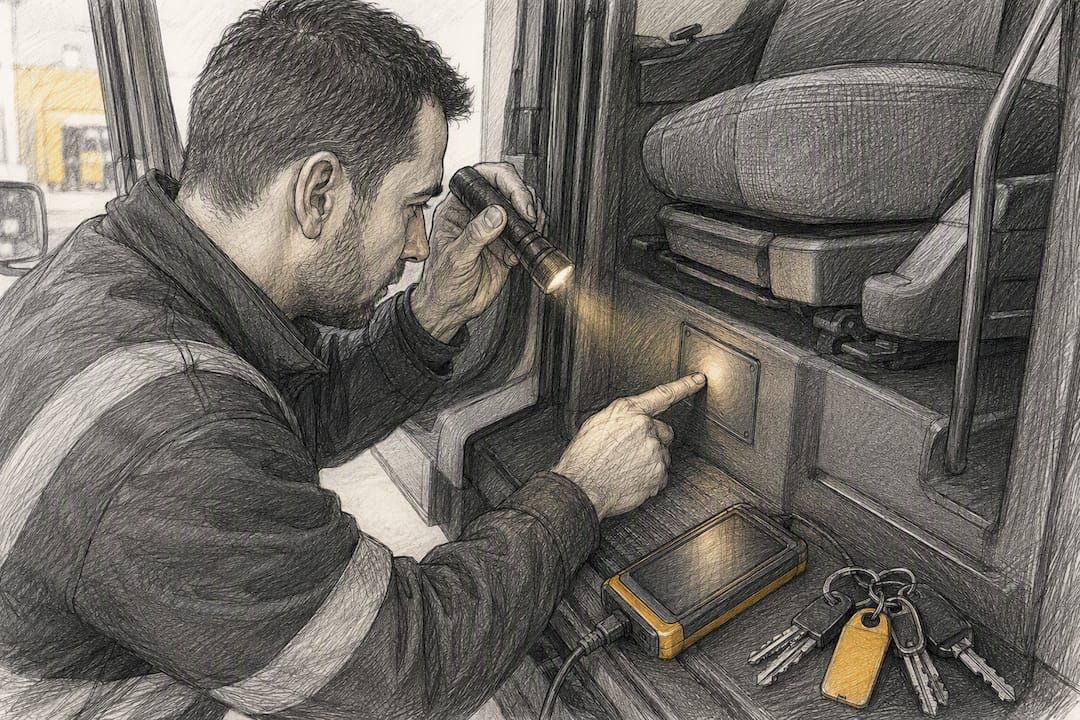
The calibration certificate issued by the ATC goes further, recording the technician’s details, the equipment used, and the parameters set during the process. Keep it on file, not just in the cab; it’s one of the first documents a DVSA examiner or traffic commissioner will ask to see during an audit.
At handover, before the vehicle moves an inch, a driver should run through this:
- Check the plaque date against the vehicle’s service and repair history. Has anything happened since that should have triggered recalibration?
- Confirm the VRN on the plaque matches the vehicle’s actual registration.
- Verify the tachograph’s UTC time is accurate, not drifted.
- If the unit shows a fault or won’t record correctly, make a signed manual record or printout detailing the activity and the error, rather than driving on and hoping nobody notices.
Pro Tip: Photograph the plaque on every vehicle change or repair and file the image with the vehicle record. It takes ten seconds and gives you dated proof of the calibration status if a query ever comes up months later.
Analogue vs digital and smart: what actually differs
Mixed fleets need to run two mental checklists, because the rules genuinely diverge by equipment type.
- Analogue units: inspected every two years, recalibrated every six years, and rely on paper charts. Manual entries cover any period the driver wasn’t using the vehicle.
- Digital and smart units: recalibrated every 24 months as standard, plus immediately after any of the trigger events above. Calibration writes vehicle parameters, VIN, tyre size, and UTC time directly into the unit’s memory, sealed by the technician, as the relevant EU regulation annexes require.
- Smart tachographs (second generation) need a second generation workshop card specifically, which is why generation mismatches trip up workshops that haven’t updated their equipment.
For an auditor, the practical upshot is this: analogue compliance lives in a box of paper charts, while digital compliance lives in a certificate, a plaque, and a memory chip that can be interrogated electronically if DVSA wants to check it.
Operator and driver responsibilities: the audit-ready checklist
The O-licence holder carries the legal duty to ensure every vehicle’s tachograph is calibrated on schedule and that inspection and calibration reports are retained and produced on request. That responsibility doesn’t transfer to the driver just because the driver is the one behind the wheel.
Split sensibly, the duties look like this:
- Operator: schedule recalibration against the 24 month or 6 year cycle, log every repair or tyre change that might trigger an earlier date, and keep certificates filed against each vehicle.
- Driver: check the plaque and time at the start of each shift, use the correct mode switch settings, and produce a signed printout or manual note the moment the unit misbehaves.
- Both: treat a missing or unreadable plaque as a stop-the-vehicle issue, not a note-it-and-move-on issue.
Build an audit pack per vehicle: calibration certificate, plaque photo, calibration dates, and the .DDD download history alongside any signed printouts. Retrieval speed matters as much as retention. A DVSA examiner asking for proof mid-check won’t wait while someone digs through a filing cabinet.
Pro Tip: Tie tyre changes into your maintenance schedule as a recalibration trigger, not just a tyre job. It’s the single most overlooked reason a “valid” calibration turns out not to be valid at all.
Where a compliance process (or software) actually earns its keep
Most calibration failures aren’t caused by ignorance of the rules. They’re caused by nobody noticing a trigger event happened. A tyre gets swapped for a different size on a Tuesday afternoon, and nobody links that job to the tachograph’s calibration status until three months later when an examiner asks for the certificate.
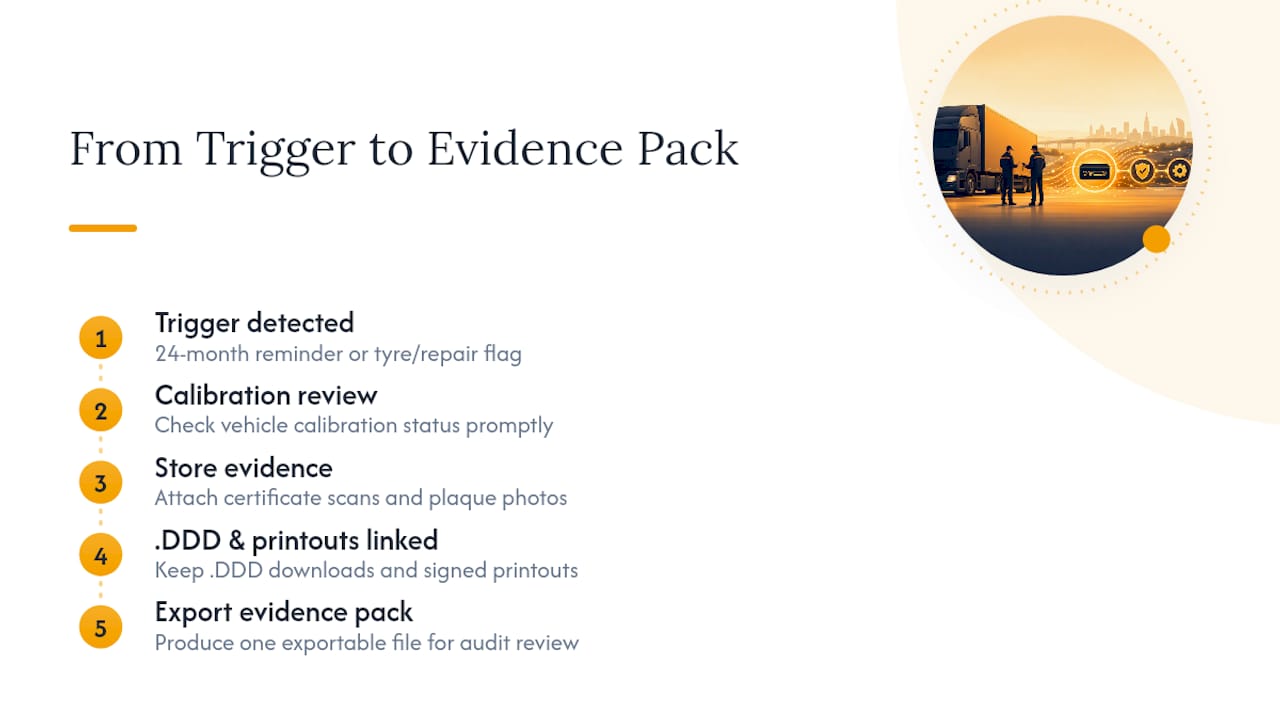
Automated reminders tied to the 24 month cycle, plus flags for repair and tyre events, close that gap. Storing certificate scans and plaque photos against each vehicle’s record means an audit request is a search, not a scramble. Linking .DDD downloads and signed printouts to the same vehicle file turns scattered paperwork into one exportable pack a DVSA officer or traffic commissioner can review in minutes rather than an afternoon.
Practical perspective: common pitfalls and immediate fixes
The recurring mistake isn’t ignorance of the 24 month rule; it’s assuming the plaque date alone proves compliance after a repair or tyre change silently invalidates it. Photograph plaques, add tyre jobs to your calibration trigger list, and require a certificate upload before any vehicle returns to service. If a workshop’s paperwork doesn’t stack up, query it through the ATC finder before you use them again.
— Vytautas
A simpler way to stay on top of calibration dates
Chasing plaque dates across a spreadsheet works until it doesn’t, usually right when a vehicle gets pulled in for a DVSA check. Some compliance software tracks calibration due dates alongside MOT, PMI and other operator licence duties in one dashboard, helping ensure tyre changes or repairs don’t slip past unnoticed.

The platform stores certificate scans against each vehicle record, reads .DDD tachograph downloads directly, and assembles the whole thing into an exportable pack ready for a DVSA or traffic commissioner audit, no digging through folders required. It’s built for UK operator licence holders specifically, with reminders that fire ahead of the 24 month digital cycle and the 6 year analogue one. When you’re checking any compliance tool, ask whether it links calibration to repair and tyre events automatically, whether it exports an audit pack in one click, and whether it supports your drivers’ own languages. Operatorcompliance covers all three, and you can see how it fits your fleet on the features page or get started with your own fleet setup in an afternoon.
Where to check the rules yourself
For the full legal text rather than a summary, go straight to the source. GOV.UK publishes the operator responsibilities guidance for goods vehicles and the tachograph rules drivers must follow, alongside the ATC finder and ATC manual. The technical annexes sit on legislation.gov.uk for anyone who wants the regulation text itself.
FAQ
Is tachograph calibration a legal requirement?
Yes. UK operators must have digital and smart tachographs recalibrated at least every 24 months, and analogue units inspected every 2 years and recalibrated every 6, under rules enforced by DVSA and the traffic commissioners.
What are the current tachograph calibration rules in the UK?
Digital and smart tachographs need recalibration every 24 months and after specific triggers (repair, tyre or VRN change, UTC drift over 20 minutes); analogue units follow a 2 year inspection and 6 year recalibration cycle. Only an Approved Tachograph Centre can carry out the work.
What are the legal requirements for using a tachograph in the UK?
Drivers must check the calibration plaque before use, keep the unit’s time accurate, and produce a signed manual record or printout if it fails to record activity correctly, while operators must ensure calibration stays current and retain the certificates.
What are the calibration rules for an analogue tachograph?
Analogue tachographs must be inspected every two years and fully recalibrated every six years by an Approved Tachograph Centre, with paper charts and manual entries covering any gaps in recorded activity.
Who is allowed to calibrate a tachograph?
Only a nominated technician at an Approved Tachograph Centre, using a valid workshop card for the tachograph’s generation, can legally calibrate or seal a unit.
Recommended
tachograph calibration rules