· 10 min read
Tachograph Download Rules 28 Days Explained for UK Operators
Tachograph download rules 28 days explained for UK operators. Learn legal basis, timing, retention and how to stay audit-ready.
Driver cards must be downloaded at least every 28 calendar days, while vehicle units must be downloaded every 90 days. Downloaded tachograph data must be analysed and retained for 12 months, because the card's limited memory means older activity can be overwritten and lost.
A transport manager usually discovers the problem at the worst possible time. A DVSA visit is under way, the examiner asks for the latest driver-card files and infringement follow-up, and one driver's most recent download is outside the required window. The driver may still have worked lawfully, but the operator can't prove it because the evidence has disappeared or was never reviewed.
That's why tachograph download rules for 28 days aren't just an office reminder. They're part of the operator licence system for HGV, bus and coach fleets. The operator, transport manager, drivers, compliance staff and maintenance team all need a clear record of who downloaded what, when it was checked, what issues were found and how the business responded.
This guide separates the legal requirement from practical controls. It also deals with the distinction that causes many roadside problems: downloading records every 28 days is not the same as carrying the required records at the roadside. The relevant carry period can be 28 or 56 days depending on the journey.
A download calendar can help, but a calendar alone won't demonstrate control. The file must arrive, remain readable, be analysed, and lead to documented action where there's an infringement or missing evidence. A practical overview of remote downloading is available in this guide to tacho remote download workflows.
Table of Contents
- Introduction Why the 28 Day Rule Catches Operators Out
- The Legal Basis Behind the 28 Day Download Requirement
- Download Rules Versus Carry Rules and Retention
- Exact Timing When the 28 Day and 90 Day Clocks Run
- What Happens When You Miss the 28 Day Window
- A Practical Compliance System That Keeps You Inside 28 Days
- Staying Audit Ready and Next Steps for Your Fleet
Introduction Why the 28 Day Rule Catches Operators Out
The core job is proving continuous control of drivers' hours to DVSA and, where necessary, the Traffic Commissioner. That means showing more than a collection of files on a server. You need to demonstrate that driver cards were downloaded on time, vehicle units were downloaded on their own timetable, records were analysed and follow-up was completed.
The basic control is straightforward. Driver cards must be downloaded at least every 28 calendar days, and vehicle unit data must be downloaded every 90 days. The downloaded records must then be analysed to check compliance, and tachograph records must remain available for 12 months. These intervals and the analysis requirement are set out in GOV.UK tachograph guidance.
The reason the driver-card interval is so important is practical rather than administrative. A driver card holds about 28 days of average activity. Once the available space is used, the oldest data is overwritten and lost, so a missed download can create a permanent hole in the operator's evidence. High-activity work can reduce the practical period further, because the card can store less than 28 days where activity changes are particularly frequent.
The evidence problem behind a missed download
Consider a mixed fleet running scheduled deliveries, occasional international work and PSV contracts. The office has a spreadsheet showing expected card downloads, but one agency driver's card wasn't collected before the driver stopped accepting shifts. The vehicle unit was downloaded on schedule, yet the missing card data means the office can't complete a reliable driver-hours review for that period.
That gap affects several controls at once:
- Drivers' hours analysis: The analyst may not have the full activity record needed to investigate possible infringements.
- Working Time records: The operator may lack evidence needed for the applicable working-time review.
- Driver debriefs: A manager can't fairly discuss an infringement if the source data is incomplete.
- Monthly compliance packs: The pack may show a download exception without a satisfactory explanation or corrective action.
Downloading without analysing is also weak evidence. A file sitting in a folder doesn't show that anyone checked the driver's activities, assessed the result or took reasonable steps to prevent recurrence.
What this guide separates
The 28-day download clock applies to driver cards. The 90-day clock applies to vehicle units. The roadside carry window is a separate question, and the answer depends on whether the journey is GB domestic, AETR or UK-EU international work.
For an operator licence holder, the safest approach is to assign each clock to an owner, record the due date, retain the original file and preserve the review trail. That gives the transport manager something more useful than a green tick. It gives them evidence of an operating system.
The Legal Basis Behind the 28 Day Download Requirement
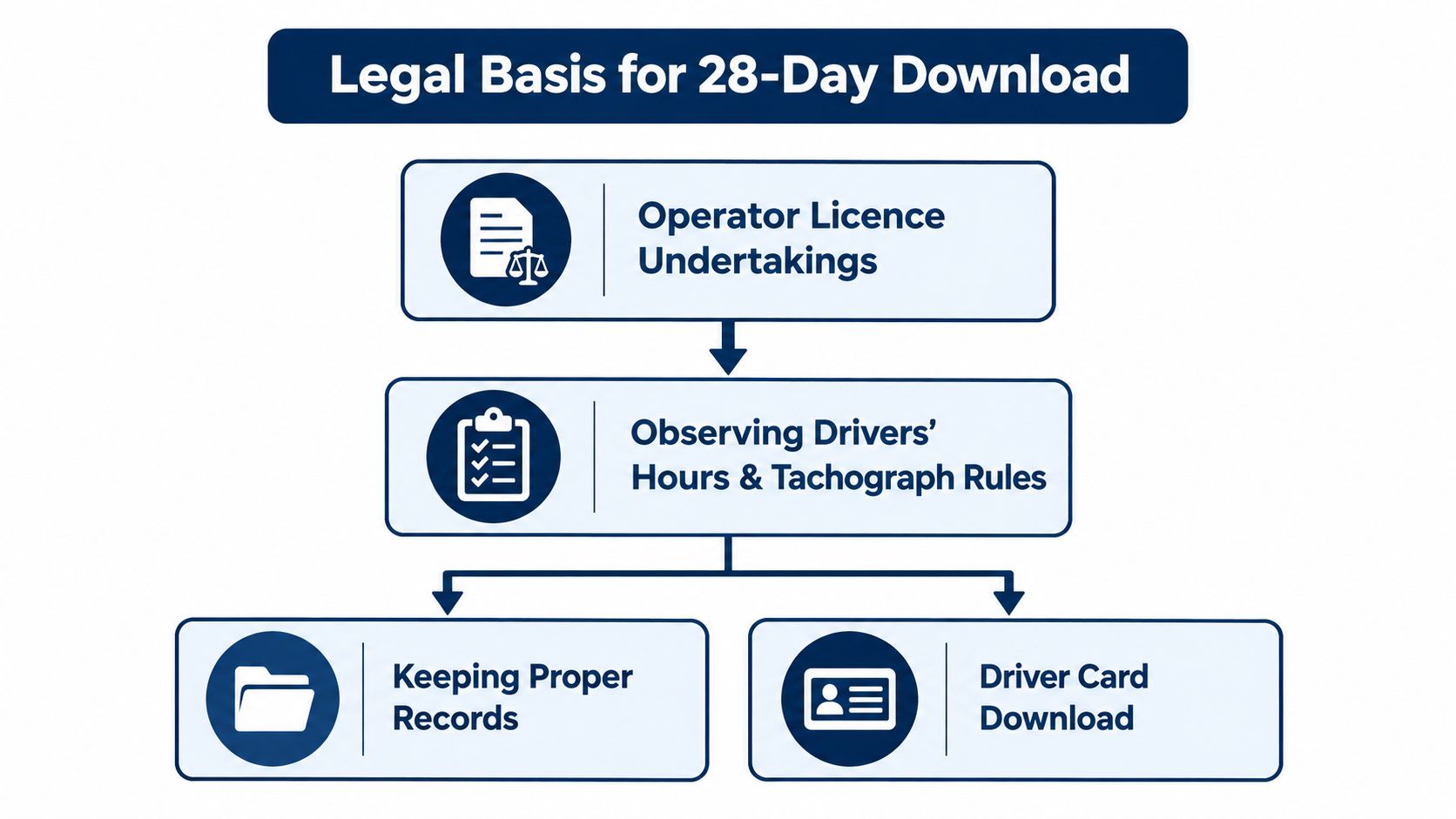
Operator licence undertakings are the starting point. An undertaking to observe drivers' hours and tachograph rules, and to keep proper records, creates an ongoing management responsibility. The 28-day driver-card download interval turns that broad responsibility into a timed control that someone must monitor.
The legal framework connects several duties. The operator must organise work so the applicable drivers' hours rules can be observed, make the required records available, and take reasonable steps to identify and address non-compliance. The Traffic Commissioners' perspective on safety, compliance and responsibility reinforces the practical expectation that operators and transport managers need solid procedures, regular monitoring and documented corrective action.
From licence undertaking to daily control
The responsibility normally sits with the operator licence holder, even where the business uses agency drivers, subcontractors or vehicles supplied under commercial arrangements. Another business may perform a task, but the licence holder still needs to know what control was assigned, what evidence was received and what happened when the process failed.
Transport managers provide professional oversight. Drivers must use their cards correctly and make the operator aware of problems. Compliance teams need to maintain the calendar, chase missing data and protect the audit trail. Fleet engineers and maintenance providers may not own the tachograph process, but vehicle changes, unit faults and vehicle disposal can create events that require an earlier download.
The practical sequence is:
- Set the undertaking into a procedure. State who is responsible for driver cards, vehicle units, analysis, infringement review and record storage.
- Create timed controls. Track each driver card against its last successful download and each vehicle unit against its own last download.
- Check the source data. Confirm that the expected driver and vehicle records are present and readable.
- Analyse the records. Review drivers' hours, Working Time where applicable, tachograph events and missing-data exceptions.
- Act and retain evidence. Debrief the driver, record explanations, obtain sign-off where used and retain the resulting audit trail.
Law, guidance and best practice
The legal duties sit alongside official guidance. GOV.UK explains the download and production framework, while the operator licence undertaking provides the regulatory context for demonstrating control. A business can choose a tighter internal cadence, earlier reminders or additional sign-off controls as best practice, but it shouldn't confuse those internal controls with the statutory minimum.
The useful question during an audit isn't only, “Did we download the card?” It's also, “Can we show the expected file, the analysis, the decision taken and the person responsible?” That is the difference between a technical download process and an operator-licence compliance system.
Download Rules Versus Carry Rules and Retention
The phrase “28-day rule” hides three different controls. One concerns when the operator downloads a driver card. Another concerns what the driver must produce at the roadside. A third concerns how long the operator keeps the downloaded record.
The comparison matters most in mixed fleets. A driver may have had their card downloaded on time, but the business can still struggle at the roadside if the driver can't produce the correct period for the journey. Equally, the business may produce records during a visit but fail to show that it analysed them and retained them properly.
| Control | Interval or Window | Who It Applies To | Evidence Required |
|---|---|---|---|
| Driver-card download | At least every 28 calendar days | Operators responsible for driver cards | Original card file, download date, file integrity and exception record |
| Vehicle-unit download | Every 90 days | Operators responsible for vehicle units | Vehicle-unit file, download date, vehicle identity and event-driven download evidence |
| Roadside production for GB domestic or AETR journeys | Current day plus previous 28 calendar days | Drivers on the relevant journeys | Driver card and available tachograph records |
| Roadside production for UK-EU international journeys | 56 days | Drivers on the relevant UK-EU journeys | Driver card and the longer journey-specific record window |
| Tachograph retention | 12 months | Operators retaining downloaded tachograph records | Searchable files, analysis reports, explanations and follow-up records |
The roadside windows are described in GOV.UK's current tachograph rules, while practical guidance on the difference between the operator download interval and the records a driver must carry is set out in this guide to missing tachograph data.
Which clock applies to which trip
For GB domestic and AETR work, the driver must be able to produce the current day and the previous 28 calendar days when required. UK-EU international journeys use the longer 56-day production period. That does not turn every UK operation into a 56-day operation, so a fleet should classify the journey rather than apply one blanket rule.
A driver who works across both categories needs clear dispatch instructions. The compliance team should know which records the driver may be asked to produce, and the driver should know that a completed office download doesn't replace the roadside production obligation.
Retention is the back-office control
The operator's downloaded files need to remain available for inspection for 12 months. Retention without analysis isn't enough, and analysis without reliable retention leaves the operator unable to prove what was reviewed.
A sensible evidence pack links the original file to the analysis result, infringement decision, driver communication and any corrective action. That approach makes it easier to investigate a late download, a missing mileage period or a no-card event without treating every exception as proof of deliberate misuse. Guidance on organising the underlying digital tachograph card records can help teams maintain that chain.
Exact Timing When the 28 Day and 90 Day Clocks Run
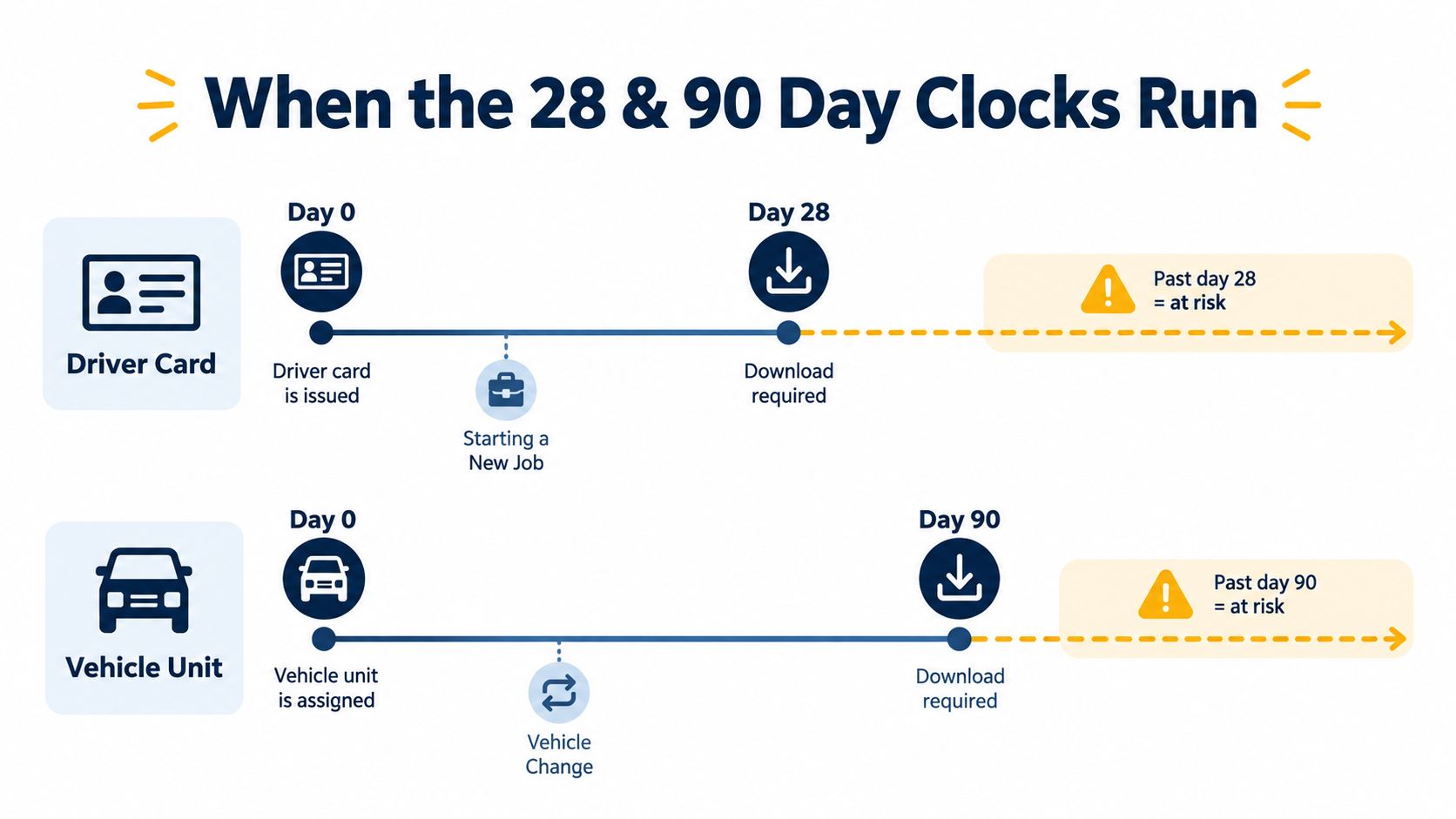
Calendar control is where many otherwise sound procedures fail. The driver-card interval is measured in calendar days, not convenient office weeks, and the vehicle-unit interval runs independently. Each driver and each vehicle needs its own last-successful-download date.
A recurring spreadsheet reminder often looks adequate until a driver changes employer, a vehicle is sold, a unit develops a fault or an office worker assumes that a download key has captured every file. Those events need separate treatment because waiting for the routine date may put data at risk.
Driver-card timing
Download a driver card at least every 28 calendar days. Download it immediately before the driver leaves employment, or as soon as data loss is reasonably foreseeable. The practical reason is that the card's storage is finite. Average activity is treated as 93 activity changes in a day, and high-activity operations can therefore hold less than 28 days of records.
That benchmark matters for operations with frequent loading, unloading, waiting, yard movements and status changes. A calendar that only flags day 28 may be too late for a driver whose card is filling more quickly than average. The business should review the type of work, identify high-activity roles and set an earlier internal reminder where the risk justifies it.
Vehicle-unit timing
Download vehicle-unit data every 90 days, and bring the download forward when the vehicle's control or data integrity is changing. A vehicle should be downloaded before disposal or transfer, and the operator should respond without delay where the unit is being permanently removed, malfunctioning or at risk of losing data.
When a vehicle enters the fleet, use the company card to lock the unit to the operator. When it leaves, complete the appropriate lock-out and preserve the final data. A missed lock-in can create a serious ownership problem because another company may be able to lock the vehicle's data to itself.
Build the triggers into fleet administration
The download process should sit alongside vehicle and trailer maintenance dates, safety inspection planning, walkaround defect reporting and driver credential monitoring. A vehicle transfer that appears in the asset register should create a tachograph action, not depend on someone remembering a separate email.
Use a control record that shows:
- Last successful download: Record the actual receipt date, not just the date someone expected it.
- Next rout
tachograph download rules 28 daystachograph compliance UKDVSA tachograph rulesdriver card download