· 9 min read
56 Day Window: What UK Inspectors Review for Tachograph Infringements
Know what UK inspectors check and the 56 day review window. Weekly audits and auto downloads stop tachograph infringements and protect your operator licence.
56 Day Window: What UK Inspectors Review for Tachograph Infringements
A tachograph infringement in the UK can trigger a fixed penalty, a court summons for serious tampering, or lasting damage to your Operator Compliance Risk Score. The fastest way to limit the damage is to download and review your .DDD files promptly after a notice arrives, not after a traffic commissioner inquiry. Enforcement now runs on a graded scale, from a written warning through to prosecution, with GOV.UK and legislation.gov.uk setting the legal boundaries operators actually get judged against.
TL;DR:
- The most serious tachograph infringements, such as falsification or deliberate manipulation, can lead to prosecution, unlimited fines, and revocation of an operator’s license.
- Common violations like exceeding driving limits or using expired driver cards are usually handled with fixed penalties, but repeated or severe offenses can trigger court action and impact operator risk scores.
- Operators must download and retain tachograph data every 90 days for vehicle units and 28 days for driver cards, keeping records for at least 12 months due to ongoing inspection windows.
- Regular weekly audits of downloads, manual entries, and driving patterns help prevent infringements and catch small issues before they escalate to serious penalties.
- Automated tools like OperatorCompliance’s platform streamline downloads, flag infringements instantly, and generate compliant reports, reducing the risk of missing or delayed responses.
Table of Contents
- What penalties can you face for tachograph infringements?
- What are the most common tachograph infringements?
- How long must records be kept and what do inspectors check?
- How do you check for tachograph infringements yourself?
- Can you appeal or mitigate a tachograph infringement notice?
- Preventing infringements before they happen
- Immediate triage and common operator mistakes
- OperatorCompliance: automate downloads, flag infringements automatically
- Official guidance and legislation to consult
- Sources
- FAQ
What penalties can you face for tachograph infringements?
DVSA examiners and police officers work through a graduated response. A minor, one‑off breach might earn a verbal warning or a fixed penalty notice on the spot. Repeated or more serious offences escalate to court action, and the most serious category, which includes deliberate falsification, can mean prosecution rather than a fine at all.
Fixed penalties for drivers’ hours and tachograph offences typically run into the hundreds of pounds per offence, while Gov confirms that courts can impose Level 5 fines, which have no fixed ceiling, for the most serious breaches. Roadside officers also hold immediate prohibition powers, meaning a vehicle can be grounded there and then.
Statistic callout: GOV.UK’s own enforcement guidance lists prosecution, not just a fine, as the standard outcome for the most serious tachograph offences.
Beyond the individual penalty, every recorded infringement feeds into the Operator Compliance Risk Score. A poor OCRS increases the odds of a follow‑up DVSA visit and can prompt a referral to the traffic commissioner, who has the power to review, curtail or revoke an O‑licence entirely.
- Verbal warning: minor, isolated breach with no pattern of repetition.
- Fixed penalty notice: standard sanction for most driving time and rest break offences.
- Court referral: repeated offences or aggravating circumstances.
- Prosecution: reserved for tampering, falsification and the most serious category.
What are the most common tachograph infringements?
Most enforcement activity clusters around a small number of recurring mistakes, and knowing the categories helps you triage risk before an inspector does it for you.
- Driving time and rest break breaches. Exceeding the daily, weekly or fortnightly driving limits, or cutting a break short, is the single most frequent infringement type recorded during roadside checks.
- Driver card offences. Driving without inserting a card, using an expired card, or using another driver’s card are all treated seriously, and the last of these can shade into the most serious offence category.
- Missing or incorrect manual entries. Manual entries are legally required when a tachograph faults, when driving falls outside the scope of the rules, or during unforeseen events, and GOV.UK’s tachograph rules set out exactly when and how they must be made.
- Tampering and manipulation. Deliberately interfering with a sensor, using a magnet, or falsifying records is a criminal offence, and inspectors look for telltale signs such as unexplained speed data gaps or inconsistent mileage readings.
Card misuse and tampering sit in a different league from a missed rest break. GOV.UK’s own guidance on enforcement outcomes for serious offences makes clear that deliberate manipulation is dealt with through prosecution, not a fixed penalty slip.
How long must records be kept and what do inspectors check?
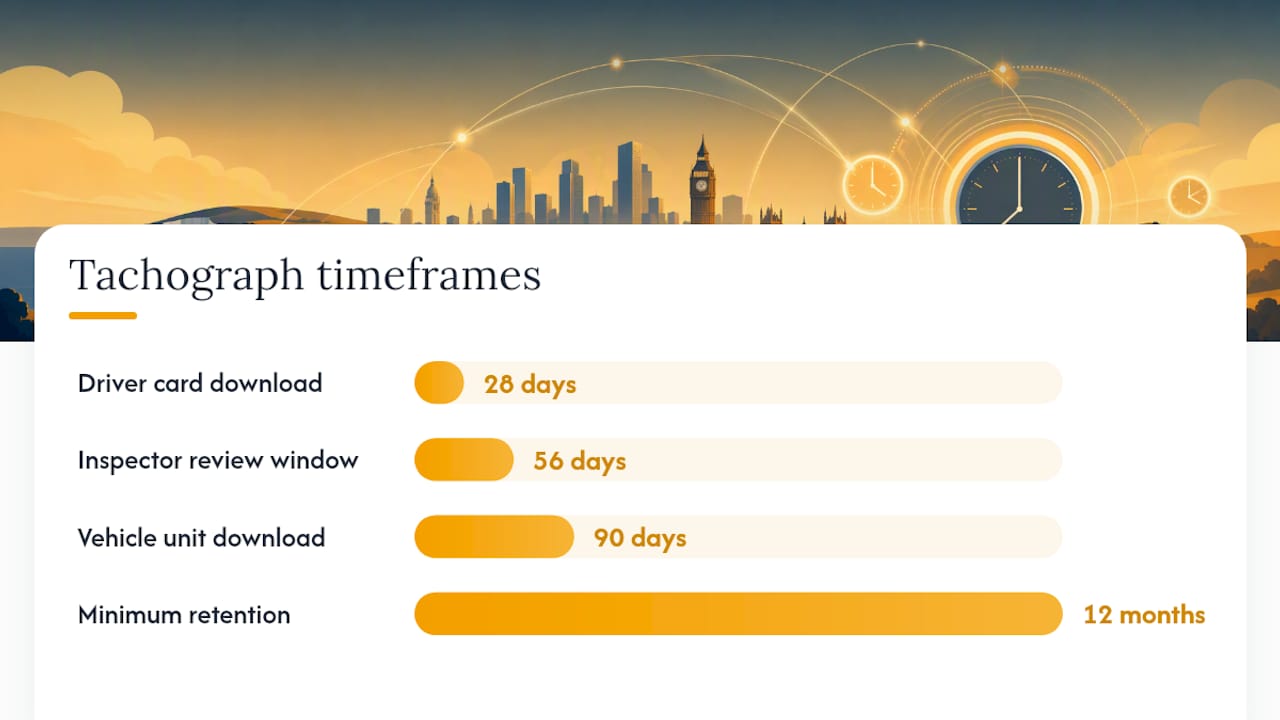
Operators must download vehicle unit data every 90 days and driver card data every 28 days, then keep those records for a minimum of 12 months. This isn’t a paperwork formality. Roadside and premises checks routinely cover the current day plus a significant run of prior weeks, and expanded review windows now commonly stretch to the current day plus the previous 56 days. So an error from six weeks ago can still surface during a routine stop.
Poor record‑keeping compounds the original problem. If you can’t produce a clean download when asked, that gap itself becomes an infringement, on top of whatever the underlying driving pattern shows.
- Download vehicle units at least every 90 days; driver cards every 28 days.
- Retain all tachograph data for a minimum of 12 months.
- Expect inspectors to review the current day alongside several prior weeks.
- Treat repeated infringements as a trigger for O‑licence review, not just a driver conversation.
Under your operator’s licence undertakings, you’ve committed to monitoring drivers’ hours proactively. Repeated infringements without a documented response pattern are exactly what triggers a traffic commissioner’s interest.
How do you check for tachograph infringements yourself?
Waiting for DVSA to find a problem first is the slowest, most expensive way to learn about it. A structured download and review routine catches most issues before they become a pattern.
- Connect the vehicle unit and download the .DDD file, using a compatible card reader or the in‑cab download function.
- Download the driver card separately, either at base or via a remote download solution if your fleet supports it.
- Run both files through analysis software and generate a signed printout or digital report the driver can sign off.
- Scan the output for gaps in activity, unexplained mode changes, or a card inserted late relative to the vehicle’s ignition‑on time.
- File the report, along with any driver explanation, in a dated folder you can retrieve for a full year.
Pro Tip: Don’t just look for red flags on the summary page. Cross‑check the timeline against the vehicle’s actual job sheet, because a driver switching between “other work” and “driving” without updating the mode selector often looks fine on paper but tells a different story against the delivery schedule.
Can you appeal or mitigate a tachograph infringement notice?
Yes, though the route depends on the type of notice. Fixed penalties carry their own short appeal window, detailed on the notice itself and on GOV.UK’s guidance pages, while court referrals and traffic commissioner action follow separate procedural timelines that are worth checking as soon as a notice arrives, not weeks later.
Realistic mitigation grounds include a documented tachograph fault, a genuine emergency that forced a driver to exceed a limit, or a demonstrable honest error caught and corrected quickly. None of these carry weight without paperwork behind them.
- Keep signed printouts and manual entries as your first line of evidence.
- Hold maintenance invoices that prove a fault was genuine and reported promptly.
- Log driver training dates to show the error was isolated rather than habitual.
- Note down the exact circumstances of any emergency at the time, not retrospectively.
Preventing infringements before they happen
Most infringements are preventable with a simple weekly audit habit rather than expensive retraining. Checking card insertion timing, missing manual entries, and unusual driving patterns every week, instead of only after a DVSA letter, is what enforcement guidance itself recommends as the more effective route, because it catches driver mistakes while they’re still rare rather than letting them repeat unchecked.
Remote downloads change the maths here. Instead of waiting for a driver to plug in at base, automated pulls flag an anomaly within days, not months, which is the gap that usually turns one missed break into a pattern of six.
- Run a weekly audit covering card insertion, manual entries and driving pattern anomalies.
- Use remote or automated downloads so errors surface within days, not at the next depot visit.
- Build induction training around real anomaly examples, not generic rule recitals.
- Keep an export‑ready evidence pack so a DVSA or traffic commissioner request never catches you unprepared.
- Refresh driver competence periodically through DVSA‑approved Driver CPC training rather than treating it as a one‑off box‑tick.
Pro Tip: Assign one person to own the weekly audit, even in a small fleet. The moment “everyone’s responsible” becomes the actual answer, nobody checks the file until an inspector does.
Immediate triage and common operator mistakes
When a notice lands, preserve every relevant file first, download the current data second, and only then review whether recent audits missed the pattern. Three mistakes come up repeatedly: treating a warning as a one‑off rather than a trend signal, letting drivers explain infringements verbally instead of in writing, and reviewing tachograph data monthly instead of weekly. Fix the review cadence and the rest usually follows.
— Vytautas
OperatorCompliance: automate downloads, flag infringements automatically
Manual downloads and spreadsheet tracking work until a driver forgets, a card expires, or a pattern of small errors goes unnoticed for six weeks. OperatorCompliance’s tachograph analysis reads digital .DDD downloads automatically, flags drivers’ hours infringements as they appear, and lets each driver sign their infringement report directly in the app, so you’re never chasing paper signatures during a busy week.

That means less time spent reconstructing what happened weeks after the fact and more time acting on issues while they’re still small. The platform also builds an audit‑ready compliance pack, pulling together infringement history, signed reports and driver records into the format a DVSA or traffic commissioner review actually expects. For operators managing drivers across different first languages, the same reports and app run in English, Polish, Romanian, Lithuanian and Bulgarian. If you want to see how it handles your own fleet’s download rhythm, start with a demo on the OperatorCompliance homepage.
Official guidance and legislation to consult
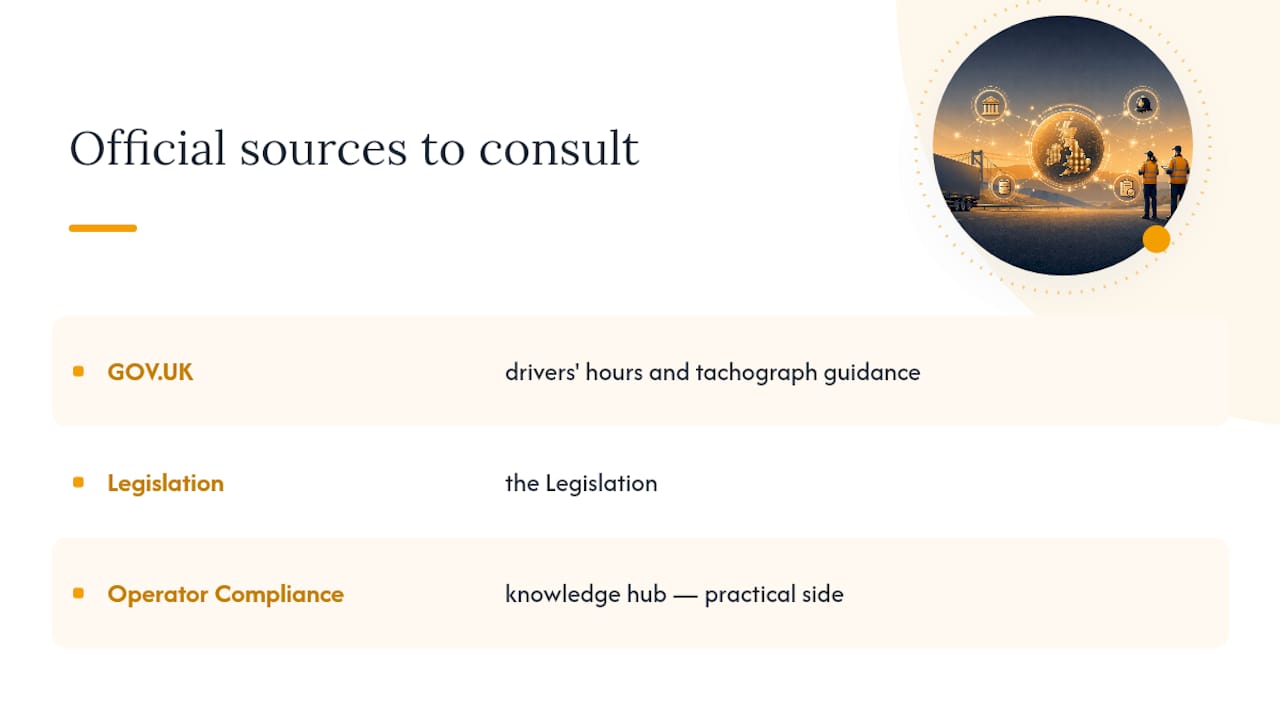
Two primary sources cover the legal detail: GOV.UK’s drivers’ hours and tachograph guidance and the Legislation. Operator Compliance’s knowledge hub covers the practical side.
Sources
FAQ
What happens if you get infringements on tacho?
You’ll typically face a fixed penalty for a standard breach, or court referral and prosecution for serious offences like card misuse or tampering. Repeated infringements also damage your OCRS and can trigger a traffic commissioner review of
tachograph infringements