· 10 min read
UK Operators, Prevent Overloading Fines with Audit Ready Checks
Practical steps for UK operators to avoid DVSA overloading penalties, from £100 fixed fines to unlimited court risk. Checklists, weighbridge tickets and...
UK Operators, Prevent Overloading Fines with Audit Ready Checks
Overloading fines in the UK follow a graduated scale starting at £100 for the smallest breaches and rising to £300 fixed penalties before serious cases move to the Magistrates’ Court, where fines become unlimited. DVSA enforces these rules at the roadside, and it can immobilise a vehicle on the spot. Get it wrong and you’re not just facing a fine. You could be looking at a prohibition notice, a Traffic Commissioner referral, and an invalidated insurance policy.
TL;DR:
- Overloading fines in the UK vary based on how much a vehicle exceeds weight limits, with fixed penalties starting at £100 and rising to £300, depending on the percentage over the limit.
- DVSA roadside examiners typically issue fines for overloads over 10%, with a 5% leeway for minor cases and a one-tonne threshold before strictly enforcing weight violations.
- Severe or dangerous overloading cases, especially with an overload above 30%, are likely to be referred to court, where fines can be unlimited and significantly higher.
- Liability for overloading can involve drivers, operators, or vehicle keepers, with operators required to report fixed penalties or convictions to the traffic authorities.
- Using compliance software that tracks vehicle documentation and load details can help operators prevent overloads and demonstrate proper procedures during roadside checks.
Table of Contents
- What are the fixed penalties for overloading in the UK?
- What happens when DVSA stops an overloaded vehicle?
- When does overloading go to court instead of a fixed penalty?
- Who is legally responsible for an overloaded vehicle?
- How is vehicle weight actually measured and checked?
- How can operators reduce the risk of overloading fines?
- Author perspective: enforcement trends and priority actions
- A practical way to stay ahead of overloading penalties
- Sources
- FAQ
What are the fixed penalties for overloading in the UK?
DVSA’s graduated fixed-penalty system sets fines according to how far over the legal weight limit a vehicle is, not a flat rate for every breach. That distinction catches out a lot of operators who assume any overload attracts the same penalty.
The banding works like this:
- Under 10% over the limit: a fixed penalty at the lower band
- 10% up to 15% over the limit: a fixed penalty at the middle band
- 15% or more over the limit: a fixed penalty at the higher band
These figures apply to excess weight on either the gross vehicle weight or an individual axle, whichever the examiner is measuring against. An examiner checking axle weights on a rigid HGV might find one axle within tolerance and another 12% over, and the fine gets calculated against the axle in breach.
Not every overloading fine carries penalty points. Whether a notice is endorsable depends on the specific offence charged and the circumstances at the roadside; some overloading fixed penalties are non-endorsable, while related offences (particularly where the examiner considers the load a danger to other road users) can attract points on the driver’s licence. Drivers should always ask the examiner to clarify whether the notice is endorsable before signing anything.
DVSA examiners normally build in a 5% leeway before treating a vehicle as overloaded at all, recognising that weighbridge readings and load distribution aren’t always precise to the kilogram. That leeway disappears the moment the excess weight reaches one tonne or more, regardless of the percentage involved.
Examiners generally prefer to issue a fixed penalty rather than push a case to court. It’s faster, it’s proportionate to minor and moderate breaches, and it keeps the roadside check moving. Court referral tends to happen only when the overload is severe, when there’s a pattern of repeat offending, or when the examiner judges the load genuinely dangerous rather than merely non-compliant on paper.
What happens when DVSA stops an overloaded vehicle?
An examiner who finds a vehicle overloaded at the roadside has several tools available, and which one gets used depends on how serious the breach looks and how quickly it can be resolved.
- Prohibition notice (TE160P): this legally stops the vehicle continuing its journey until the excess weight is removed or otherwise corrected. You cannot simply drive away and deal with it later.
- Offence rectification notice (ORN): used where the fix is straightforward, such as redistributing a load across axles, giving the driver a defined way to correct the fault before continuing.
- PG3 weighbridge referral: the examiner directs the vehicle to a weighbridge for an accurate reading where roadside equipment can’t confirm the exact weight. Refusing or failing to comply with a PG3 instruction is a separate offence in its own right, on top of any overloading fine.
- Immobilisation: where the examiner considers the vehicle unsafe to move even short distances, they can physically prevent it continuing until the load is corrected.
Removing excess weight at the roadside isn’t always simple. Drivers sometimes have to offload part of the cargo into another vehicle, contact the operator for instructions, or arrange for goods to be collected from the roadside. None of that is quick, and every hour the vehicle sits there is an hour it’s not earning.
Pro Tip: Keep a laminated card in the cab with your operator’s emergency contact number and a basic decision tree for roadside overload findings. Drivers under pressure from an examiner make worse decisions when they’re improvising, and a clear “call this number, then do this” process saves confusion at exactly the wrong moment.
When does overloading go to court instead of a fixed penalty?
Court referral isn’t reserved for edge cases. It becomes the likely outcome once the overload crosses a significant threshold, and transport solicitors report that cases at such levels are routinely sent to the Magistrates’ Court rather than dealt with by fixed penalty.
Several factors push a case toward court rather than a roadside fine:
- The percentage overload is large, typically 30% or above
- The examiner judges the load an immediate safety risk, not just a paperwork breach
- The driver or operator has a recent history of similar offences
- The overload involves dangerous goods, an unstable load, or compromised braking or steering
Once a case reaches the Magistrates’ Court, the financial exposure changes entirely. Fixed penalties are capped at £300. Court fines are not. “Unlimited fine” means exactly that: the court sets the penalty based on the severity of the offence, the operator’s turnover, and the risk created, with no statutory ceiling. A large haulage operator with a serious repeat overloading conviction can face a fine running into tens of thousands of pounds, calculated to reflect both the offence and the company’s ability to pay.
There’s also a smaller but real criminal dimension beyond the fine itself. Where an overloaded vehicle contributes to a collision or the driving is judged dangerous under the Road Traffic Act 1988, prosecutors can bring separate charges carrying custodial risk. That’s rare, but it’s not theoretical. Overloading a vehicle to the point where handling or braking is compromised, then driving it on a public road, moves the case from a compliance matter into genuine criminal territory.
Who is legally responsible for an overloaded vehicle?
Liability for overloading doesn’t sit with one person by default. Drivers, vehicle keepers, and operators can all be prosecuted, sometimes simultaneously, depending on who knew what and who had control over the loading decision.
- The driver is usually the person who receives the fixed penalty at the roadside, since they’re the one in charge of the vehicle at the point of the check.
- The operator or employer can be prosecuted separately where they instructed, permitted, or failed to prevent the overload, particularly where load planning or scheduling pressure clearly contributed.
- The vehicle keeper, if different from the operator, can also face liability depending on who was responsible for loading arrangements.
Operators carry a reporting duty that drivers don’t. A fixed penalty or conviction for overloading generally needs to be declared to the Office of the Traffic Commissioner (OTC) as part of the operator licence undertakings, and missing that disclosure is its own compliance failure. Transport solicitors note that an overloading finding frequently triggers a wider DVSA review of an operator’s systems, not just a look at the single offending vehicle.
The regulatory fallout for operators can be more damaging than the fine itself: a formal warning, new undertakings attached to the licence, or in serious or repeated cases, suspension or revocation of the operator licence entirely. A traffic commissioner reviewing a pattern of overloading findings is looking for evidence of systemic control, and a single well-documented incident reads very differently to a file showing three unexplained overloads in six months.
How is vehicle weight actually measured and checked?
Enforcement officers work against two separate limits, and a vehicle can pass one while failing the other. GOV.UK’s guidance on HGV maximum weights sets both the overall gross vehicle weight (GVW) limit and individual axle weight limits, and both are enforced independently.
- Gross vehicle weight (GVW): the total permitted weight of the vehicle, load, and any trailer combined.
- Axle weights: the maximum weight permitted on each individual axle, which matters because poor load distribution can overload one axle even when the total GVW is within limits.
A vehicle can be well under its GVW limit and still get a fixed penalty because the load has shifted forward and put an axle 14% over its individual limit. That’s why load distribution matters just as much as total tonnage.
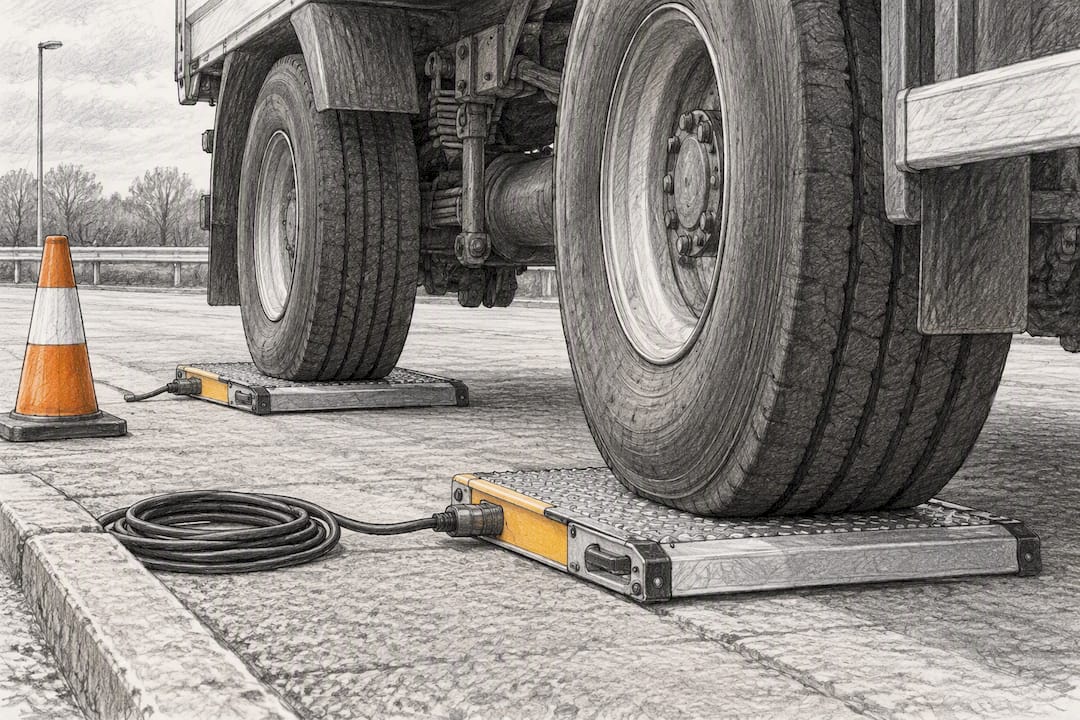
Weighbridge checks work by driving the vehicle onto a weighing plate, or a series of plates positioned under each axle, to get an exact reading rather than an estimate. Roadside portable weighpads give examiners a quick indicative figure; a full static weighbridge, which is where PG3 referrals send vehicles, gives the definitive reading used in any subsequent penalty or prosecution.
Percentage overload is calculated as a simple proportion: excess weight divided by the legal limit, multiplied by 100. The same principle applies at axle level, and as covered earlier, the 5% leeway and one-tonne exception both apply to these calculations before any penalty is issued.
How can operators reduce the risk of overloading fines?
Most overloading fines trace back to a handful of preventable gaps: no plating check, no documented load plan, or a driver who wasn’t told what the vehicle’s actual limits were that day. A tight operational routine closes most of that gap before a vehicle ever leaves the yard.
- Check the plating certificate against the planned load before departure, not after loading is finished.
- Document the load plan, including axle distribution, for anything approaching the vehicle’s limits.
- Keep weighbridge tickets as evidence where a load is borderline, since contemporaneous weighbridge records significantly strengthen an operator’s position at a Traffic Commissioner hearing or in court.
- Brief drivers on the day’s specific limits, not a generic company policy, since loads and vehicles change daily.
- Follow published load-securing guidance for stowage and distribution, referring to Gov where the load type is unfamiliar.
Manual checklists work until someone forgets a step during a busy shift. Automated reminders for plating checks, digital sign-off on loading instructions, and exportable audit packs cut the administrative slack that leads to overloads slipping through, and they leave a clear paper trail if a Traffic Commissioner ever asks for evidence of your systems.
Pro Tip: For fleets with multilingual drivers, build bilingual sign-off into your pre-departure routine so a driver confirms understanding of the load plan in their own language, not just a language they can technically read. A misunderstood instruction is functionally the same as no instruction at all.
Author perspective: enforcement trends and priority actions
DVSA has been leaning harder into roadside checks generally, and vans up to 3.5 tonnes are getting more attention than they used to. That’s the segment where load planning is often informal, precisely because it’s exempt from some of the heavier HGV paperwork.
My honest read: the biggest risk isn’t the £100 or £200 fixed penalty. It’s what happens after. A single overload finding can trigger a systems review, and if your records are thin, that review escalates fast. Prioritise fixing the load
overloading fines uk